Why Does Predicting the Future Feel Smarter Than Explaining the Past?
Two Giants Clash in 1840: Prediction or Accommodation?
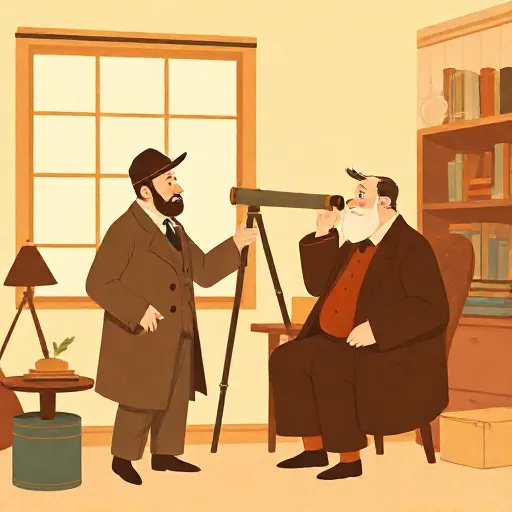
In the 1830s and 1840s, two of the sharpest minds in England went head to head. William Whewell (1794–1866) was a towering scientist and philosopher. He believed a hypothesis — a proposed explanation — is truly proven only when it successfully predicts a brand‑new fact that nobody expected. Think of an astronomer who announces where an unseen planet must be, and then a telescope confirms it right there. Whewell argued that such a surprise hit is so unlikely by chance that the theory must be true.
John Stuart Mill (1806–1873), a philosopher and economist, shot back. He said a theory that is built to fit facts we already know — this is called accommodation — can be just as well supported. Mill pointed out that a clever person can always adjust a story after seeing the data, like a detective who, after finding a clue, claims he suspected the suspect all along. He insisted that predicting the future feels dramatic, but it gives no real extra proof. Their debate still rumbles through every laboratory and classroom today.
Popper Draws a Line: Science Must Stick Its Neck Out
A century later, Karl Popper (1902–1994) turned the debate into a test for telling real science from fake. He called it the demarcation problem. Popper noticed that some grand theories — Marx’s story of history, Freud’s psychoanalysis — could explain absolutely anything that happened. If a revolution broke out, Marx’s theory could explain it; if no revolution happened, Marx’s theory could explain that too. These theories never risked being wrong. They were, Popper said, pseudosciences.
Real science, he argued, must be falsifiable. That means it makes specific, risky predictions that could prove it false. Einstein’s general relativity famously predicted exactly how much starlight would bend around the sun during an eclipse. If telescopes had shown a different number, the theory would have been in trouble. Popper didn’t think a successful prediction proved a theory true, but he believed only a theory that sticks its neck out — rather than merely soaking up known facts — earns the title “scientific.” That made accommodation look suspicious, especially when a scientist invents an ad hoc hypothesis, a fix designed only to rescue a theory from a threatening result, with no new testable consequences.
A Mysterious Coin and a Magical Predictor

Imagine two people, Penny and Annie, standing in front of a coin that is about to be flipped 100 times. Penny, without seeing a single toss, writes down a long, apparently random sequence of heads and tails — and then the first 99 flips match her guess exactly. Annie, meanwhile, watches the first 99 flips, memorizes the results, and then announces the same 99‑plus‑a‑guess sequence that Penny did. Both now predict the 100th flip will be heads. Whose guess do you trust more?
Almost everyone feels Penny is more reliable. Why? Philosopher Patrick Maher (20th century) argued that Penny’s stunning success gives us strong evidence that she has a reliable method — some real skill or rule that homes in on the truth. Annie’s performance, however, could be explained simply by her copying what she saw. The difference is not that Penny’s sequence fits the data better; it’s that her success signals a method we have reason to trust. Maher’s thought experiment launched a wave of modern predictivism: the view that predictive success is a special sign of reliability, not just a fresh coat of paint on the same old evidence.
Severe Tests and Hidden Cores: When Accommodation Works
Does that mean an accommodated theory is always weaker? Not so fast, says philosopher Deborah Mayo (20th–21st century). She argues that what really matters is whether a hypothesis passed a severe test — a test it was very likely to fail if it were false. Imagine you look at all the SAT scores of a class, add them up, and then announce, “The mean score is exactly 612.” You’ve just built your claim to fit the data perfectly. Yet that claim survived a severe test, because if you had added wrong, the numbers wouldn’t match. So even an accommodation can pack a hefty evidential punch.
Another contemporary philosopher, John Worrall, developed a way of seeing why some predictions feel weightier. Many scientific theories have a core idea — say, “light is a wave” — plus adjustable numbers called free parameters, like the exact wavelength of a particular color of light. If you use an experiment to fix one of those parameters, the data only endorses that specific version of the theory, not the core itself. That’s conditional confirmation. But if the core idea, without any fine‑tuning, spits out a novel prediction — like a bright white spot in the shadow of a disk — and the spot appears, that unconditional confirmation rocks the whole theory. Worrall’s point: it’s not when you learned the fact, but whether the fact was needed to build the theory in the first place.
The Case Against Prediction: Is It All an Illusion?

Some critics have argued that the whole advantage of prediction is a trick of our mind. John Maynard Keynes (1883–1946) pointed out that when a scientist proposes a theory and then makes a stunning prediction, she usually started with background reasons that already supported the theory. A rival who simply copied the data to build a theory lacks that head start. So it’s those extra, hidden reasons — not the fact of predicting — that make the first theory stronger. Later, philosopher Colin Howson showed that if you give two theories equal starting odds, and one predicts fresh evidence while the other accommodates, the predictor can indeed end up better confirmed — but only because its prior probability was higher, not because prediction magically adds extra weight.
Philosopher Marc Lange added a twist with the idea of arbitrary conjunctions. If a scientist pastes together unrelated facts just to cover old data, we suspect the theory is a messy collage that won’t hold up. But if a theory is deeply unified, even accommodated data can support it strongly. And David White gave us the archer analogy: if a skilled archer shoots an arrow and then you draw the target around it, we learn nothing about her aim. But if she shoots first and the arrow lands in a distant target, we have evidence of her reliability. The real work, all these thinkers suggest, is done not by the label “prediction” but by what the act of predicting reveals about the thinker’s method.
Why This Fight Lives On in Your World

This isn’t just a dusty debate among philosophers. Every time you trust a weather forecast, a medical study, or a climate model, you are betting that predictive success means something real. If a model perfectly matches past storms but fails to foresee the next one, we lose faith. That’s why many scientists and philosophers — called scientific realists — point to long chains of novel predictions as evidence that a theory is at least approximately true. The “no miracle” argument says it would be a miracle for a false theory to keep nailing predictions it wasn’t built to fit.
But history throws cold water on that. Some thoroughly false theories, like the old idea that heat is a fluid called caloric, also made impressive novel predictions. Opponents argue that you can’t just trust a theory because it’s been lucky before. The result is a live, open question: should we place more weight on a prediction than on an equally good explanation of old data? Philosophers have given us the tools to see that the answer depends on reliability, severity, and background knowledge — and that it’s okay to be impressed, but wise to ask exactly why we are.
Think about it
- If a friend says “I knew it would rain today” after the storm starts, do you trust her weather instincts more than if she had told you yesterday it would rain? Why or why not?
- Imagine a video game AI seems to guess your every move in advance. How could you figure out whether it’s truly clever or just reacting to what it sees?
- A detective explains a crime perfectly after finding all the clues. Could you design a test to see if she would have solved it before knowing them? What would that test look like?