Why the Same Evidence Can Support Opposite Ideas
When the Plant Dies: The Detective’s Dilemma

Your favourite houseplant is dead. You want to know why. Was it the dry soil? The scorching afternoon sun? The fertilizer you used last week? You cannot simply run an experiment that tests one cause alone. If you change the watering schedule, the sunlight and the soil are still there in the background. The plant’s fate is the result of many things working together. So the evidence — a wilted stem and brown leaves — does not point a single, accusing finger at just one culprit.
This everyday puzzle is a miniature version of a huge problem in science and philosophy: underdetermination. The idea is that the evidence we have never forces us to accept exactly one explanation. Many different stories can fit the same facts. This problem has two main forms, both explored by the French physicist‑historian Pierre Duhem (1861–1916) and the American thinker W. V. O. Quine (1908–2000). It makes us ask uncomfortable questions about how science works and about how sure we can ever be that we are right.
Duhem and the Team of Beliefs
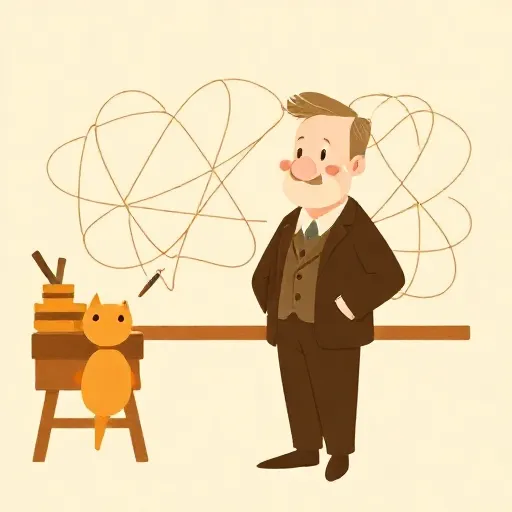
Duhem noticed something about how scientists test ideas. A single hypothesis, all by itself, never predicts anything. To get a prediction, you must join the hypothesis with a whole gang of other beliefs: background knowledge about how the world works, assumptions about your measuring instruments, ideas about what else might interfere, and much more. Duhem called this confirmational holism: hypotheses can only be tested in groups, never one at a time.
So when an experiment “fails” — when the world does not do what your theory‑and‑friends predicted — you have a problem. You know that at least one belief in the team is wrong, but the evidence does not tell you which one. As Duhem put it, the experiment teaches us that somewhere in the whole group of ideas there is an error, but “where this error lies is just what it does not tell us.” This is holist underdetermination.
Duhem used a famous example. In the 1800s, physicists fought over whether light is a stream of tiny particles or a wave. The French scientist Léon Foucault designed an experiment to test the two theories’ predictions about the speed of light in water versus air. The particle theory said light would go faster in water; the wave theory said the opposite. When the experiment showed light moving faster in air, many people declared the particle theory dead. Not Duhem. He pointed out that the particle theory itself was a whole network of assumptions. The experiment revealed an error somewhere in that network, but it could be a hidden auxiliary assumption rather than the core “particle” idea. Indeed, Duhem argued, a determined scientist could probably build a new particle‑based optics that agreed with Foucault’s result while still treating light as projectiles. A single experiment is never a crucial experiment that definitively kills one theory and crowns another.
Real history backs this up. When Newton’s theory of gravity gave a wrong prediction for the orbit of Uranus, astronomers did not abandon the whole theory. Instead they challenged the background belief that the solar system had only seven planets. By calculating where an unseen eighth planet must be, they discovered Neptune in 1846. The same trick failed spectacularly when they invented a planet “Vulcan” to fix Mercury’s orbit — that anomaly only made sense once Einstein came along. Scientists always face a choice about where to lay the blame, and the evidence alone does not force a single answer.
Quine’s Web: Everything Is Connected
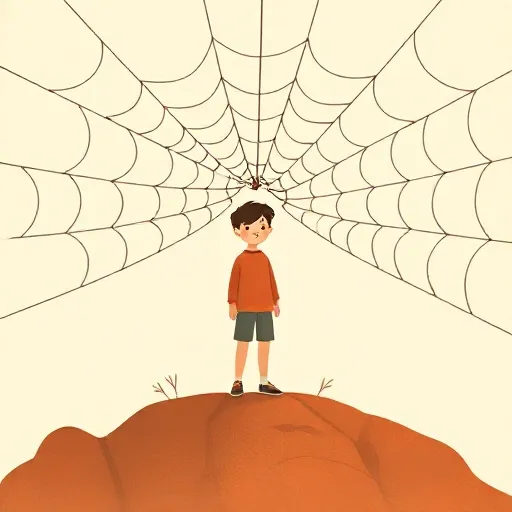
Quine expanded Duhem’s point to all human knowledge. He asked us to picture everything we believe as an enormous spiderweb. The outer edges touch sensory experience — what we see, hear, and feel. A conflict with experience, like a surprising observation, sends a tremor through the web. But because every strand connects to others, you can adjust almost any part of the web to relieve the tension.
Suppose you walk down Elm Street and see no brick houses, but you vividly remember that there were brick houses yesterday. You could give up the belief that there are brick houses on Elm Street. But you could instead decide that your memory is faulty, or that you are dreaming, or that bricks change colour overnight, or even that your current visual experience is a hallucination. A mismatch between belief and experience does not dictate which belief to change; it simply tells you that something must give. This is why Quine famously said that any statement can be held true no matter what, if we make drastic enough adjustments elsewhere in the system.
Quine’s web includes not just everyday facts but also mathematics and logic. In the face of a truly stubborn conflict, we could — in principle — revise the law of non‑contradiction, allowing something to both be and not be at the same time. Most of us never do that, but Quine’s point was that nothing is completely immune to revision. Every belief stands on the same kind of footing, tested only by how well it helps the whole web fit our ongoing experience.
So why do we almost always blame the least‑central beliefs first? Quine thought it was a matter of psychological preference for conservatism — minimum mutilation of the web — and for virtues like simplicity and scope. Those habits are themselves part of the web, guiding our repairs. But that does not shield them from the same underdetermination: even our principles of good reasoning could, in some far‑out scenario, be traded in.
Does This Mean Science Is Just About Power?

If evidence leaves so many choices open, what actually determines which beliefs scientists drop and which they keep? Some thinkers have drawn a dramatic conclusion. Sociologists of scientific knowledge and certain feminist critics of science argue that it is the social and political interests of scientists — their hunger for prestige, funding, or influence — that do the decisive work. The philosopher Mary Hesse (1924–2016) suggested it is only a short step from Quine’s underdetermination to the idea that theory choice is shaped by social rather than merely logical factors.
Larry Laudan (b. 1941) pushed back hard. He insisted that underdetermination comes in many strengths. Showing that several responses to data are logically possible or psychologically possible does not mean they are all rationally defensible. Scientists rely on ampliative principles of good reasoning — rules about what counts as a simple explanation, what makes evidence stronger, and so on. Those rules, Laudan argued, narrow the field dramatically.
Yet Quine’s web makes Laudan’s reply tricky. The ampliative rules we cherish are themselves just strands in the web. They too are open to revision when we overhaul our beliefs. Each possible revision might look perfectly rational by its own lights, which makes it hard to step outside the web and judge which set of rules is really the right one. This does not prove that politics fills the gap; it simply shows that the boundary between “what we happen to prefer” and “what is genuinely good reasoning” is harder to draw than we might wish.
This debate is alive today in discussions about values in science. Many philosophers, including Helen Longino (b. 1944), argue that because data underdetermine theory, values inevitably play a role in closing the gap. But she and others do not see this as a disaster; instead, they say objectivity is best served by bringing together a diverse community of scientists who hold different values — so that no single set of biases quietly runs the show.
The Curve That Fits: When Two Theories Look the Same
There is a second, very different form of underdetermination, often called contrastive underdetermination. Instead of asking which part of our web to blame, it asks: could a completely different theory fit the very same evidence just as well?
Mathematicians know that if you have a handful of dots on a graph, you can draw infinitely many curves that go through all of them. Each new dot eliminates some curves but leaves infinitely many still standing. The philosopher Bas van Fraassen (b. 1941) used a similar idea to shake up scientific confidence. He noted that Newton’s laws of motion and gravity make exactly the same predictions whether you assume the entire universe is absolutely at rest or moving with any constant velocity in any direction. From inside the universe, we cannot detect constant, absolute motion. So we have infinitely many empirical equivalents: theories that agree on every possible observation and experiment, yet differ about an invisible background fact.
Van Fraassen’s constructive empiricism suggests that the aim of science is not to find true theories about hidden reality, but only theories that are empirically adequate — ones that get all the observable phenomena right. If two theories are empirically equivalent, believing one is no safer than believing the other, so we should suspend judgment about the invisible parts and commit only to the theory’s success with what we can see.
Many philosophers think van Fraassen’s modesty goes too far. Larry Laudan and Jarrett Leplin argued that two theories that appear empirically equivalent today might well become distinguishable tomorrow when new instruments expand what we can observe, or when auxiliary assumptions change. They also insisted that a theory can get extra evidential support from being part of a larger web of ideas that explains other things — so even if two theories have the same direct observations, one may still be better supported overall. Most philosophers find this reassuring: we do not need to panic about the bare possibility of a doppelgänger theory unless someone can actually produce a serious rival. Until then, it is reasonable to trust the best explanation we have.
The Ghosts of Unconceived Ideas
Kyle Stanford (20th–21st centuries) thinks the threat of underdetermination is real even if we abandon the search for perfect empirical equivalents. He points to a pattern he calls the New Induction. Look at the history of science: in domain after domain, the best theory of its day was supported by all the evidence available at the time. Yet later thinkers dreamed up radically different theories — ones the earlier scientists never even imagined — that fit exactly the same old evidence just as well. From Aristotle’s physics to Newton’s mechanics to Einstein’s relativity, the evidence on the table at each stage equally supported later alternatives that were, at the earlier moment, simply unconceived.
If this pattern keeps repeating, then right now there are probably serious alternatives to our best theories that nobody has yet thought of, but that are just as well confirmed by the data we already have. This is a recurrent, transient form of underdetermination: at any moment in history, our theories look far better than the rivals we have actually managed to name, but the rivals we truly need to worry about are the ones we have not yet imagined. Stanford admits this is not a mathematical proof; it is a humble lesson from history itself.
Why Should You Care? The Humble Detective

Underdetermination is not just a puzzle for lab‑coated scientists. It lives inside every argument you have ever had. When you and a friend disagree about why a team lost a game, or why a character in a story acted a certain way, you are both seeing the same facts and fitting them into different webs of belief. The evidence alone seldom declares a winner.
This does not mean that all views are equally good, or that science is a sham. It means that being rational asks more of us than simply pointing at the data. It requires checking which background assumptions we are taking for granted, asking whether we could tell the same story with different ingredients, and staying alive to the possibility that the best explanation might be one we have not even dreamed up yet. That kind of detective work — careful, curious, and a little bit humble — is what makes science strong, and it is a habit worth taking into everyday life.
Think about it
- If two completely different explanations can fit the same facts perfectly, how should you decide which one to believe? What does that tell you about the feeling of being “sure” you are right?
- Suppose you could protect your favourite belief from any experiment by constantly adjusting other parts of your thinking — even changing the rules of logic. Would you ever do it? Why or why not?
- Historians note that ancient scientists could not imagine that invisible germs cause disease, so they missed a powerful theory. What important idea might we be missing today simply because nobody has yet found a way to imagine it?