
Was the Future Already Settled? The Strange Logic of Diodorus Cronus
The friend you didn’t meet

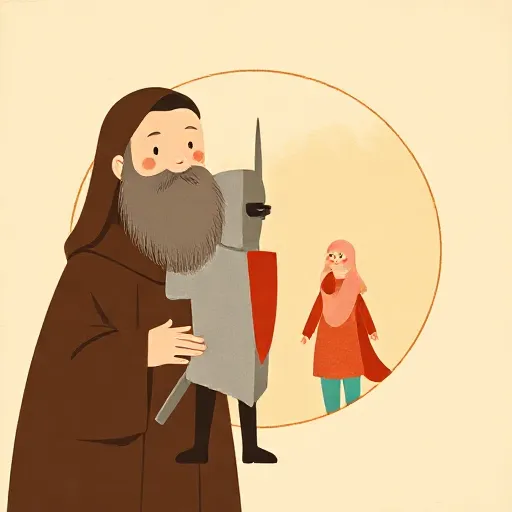
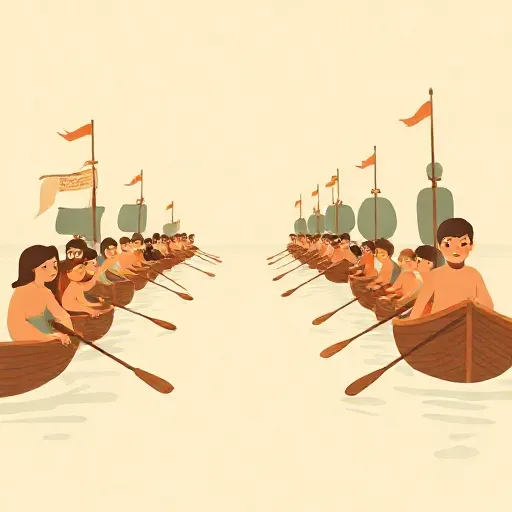
Imagine you’re walking to school and you see two friends ahead. You can wave to one on the left or call out to the other on the right. You hesitate, then choose the right. You think you could have chosen the other way. But what if, from the very start, it was impossible for you to do anything else?
That was the astonishing conclusion of a Greek philosopher named Diodorus Cronus (died around 284 BCE). His nickname “Cronus” meant “old codger,” but his ideas were sharp and young. Diodorus argued that the only things that are possible are the things that either are happening right now or will happen at some point in the future. Anything else — any path you didn’t take, any dream that never comes true — is not just something that didn’t happen; it’s something that couldn’t have happened.
He didn’t just announce this. He built a snakelike argument that starts with two ordinary thoughts and drives right into that radical end. It became one of the most famous puzzles of the ancient world, and people still argue about it today.
The Master Argument: three claims that clash

The centerpiece of Diodorus’s thinking is called the Master Argument. We know it from a later report by the philosopher Epictetus. It goes like this. There are three claims:
(MA1) Every past truth is necessary.
(MA2) The impossible doesn’t follow from the possible.
(MA3) Something is possible even though it isn’t true now and never will be true.
These three can’t all be true at the same time. They form an inconsistent triad — a set where you must give up at least one of them. Epictetus tells us that different philosophers chose different things to reject. The logician Chrysippus gave up (MA2). Another thinker, Panthoides, rejected (MA1). Diodorus himself held onto (MA1) and (MA2) and, as a result, denied (MA3).
So Diodorus ended up with a striking definition: something is possible if and only if it either is true now or will be true at some future moment. Everything else — every would-be possibility that never gets actualized — is, for him, impossible.
Why the past can’t be undone and possibility can’t lead to nonsense
To see why Diodorus found this convincing, you have to feel the pull of the two premises he kept.
(MA1) says every past truth is necessary. What’s done is done. You can’t change the fact that you ate toast this morning, or that you weren’t on the bus yesterday, or that you never trained as an Olympic gymnast when you were little. Those facts are fixed forever. That seems obvious — even the Greek tragedian Agathon wrote that not even a god can undo what has already happened.
(MA2) says the impossible does not follow from the possible. In other words, if you start with something possible, you can’t end up with something impossible. A true “if‑then” chain should never carry you from a genuine possibility all the way to an impossibility.
Now take a concrete case. I never trained as a gymnast as a child. So it’s a past truth, and by (MA1) a necessary truth, that I didn’t train. Suppose I say, “It’s possible that I will be an Olympic gymnast.” But being an Olympic gymnast implies that I did train from childhood. That would mean a necessary falsehood (I didn’t train) follows from a possibility. That’s an impossibility following from a possibility — which (MA2) forbids. So my supposed possibility can’t be a real possibility. It is impossible that I will be an Olympic gymnast.
Diodorus applied the same reasoning to everything. If something never happens and never will happen, then supposing it possible always leads to a clash with some fixed past truth. Therefore, anything that never occurs is impossible. The only things that are possible are the ones that actually play out, sooner or later.
Did Diodorus cancel your free will?

If only what will actually happen is possible, that sounds like a kind of fatalism. It seems to say you never had a real choice. You were always going to pick the right‑hand friend. You were never going to become a lawyer, an astronaut, or a guitarist unless, in fact, you do. Every alternative life is literally impossible.
Many ancient thinkers worried that Diodorus’s view trapped people. If nothing can happen except what does happen, then what’s the point of trying? This challenge got its own name: the Lazy Argument. If I will pass my exam, it’s impossible that I fail, and if I will fail, it’s impossible that I pass — so why study?
But Diodorus’s system has a surprising reply. You don’t know which outcome is the settled one. From your point of view today, both passing and failing are still unknown. So you are still motivated to study, because which outcome is “already true in the future” is hidden from you. The Lazy Argument only works if you think you already know what will happen — and you don’t.
What about the feeling that you could have done otherwise? A modern defender of Diodorus might say: that feeling isn’t proof of genuine alternate possibilities. It’s just your awareness that you didn’t know the outcome in advance. You can still feel free, even if, looking back, things couldn’t have gone differently. That’s a kind of compatibilism — the idea that freedom and a fixed future can go together.
A world where change lives only in the past

Diodorus didn’t stop with possibility. He built a whole picture of reality using tiny, unbreakable simples — atoms not just of matter, but also of space and time. In his view, time is made of indivisible instants, like a movie made of single frames. In any single instant, nothing can be moving, because moving would require being partly in one place and partly in another. But an atom of time can’t contain “partly” — it’s indivisible.
So Diodorus denied that anything changes right now. The only real changes are past ones. “Helen had three husbands” is true, but there was never a moment when she was married to all three at once; she married them in succession. That’s fine: the truth is about a relation between now and earlier times, not about a magical present change. This way of thinking let Diodorus accept that things have moved without ever saying they are moving.
Why it still matters

You don’t need to be an ancient philosopher to wrestle with Diodorus’s puzzle. Every time you wonder, “Could I have done something different?” you are stepping into his argument. If the past is locked, and if possibilities can’t unwind into impossibilities, then maybe the future is locked too.
But notice what’s at stake. If Diodorus is right, regret changes shape. You can stop beating yourself up over past mistakes, because in his universe, those mistakes were the only possible path. At the same time, you can still work hard for the future, because you don’t yet know which possibility is yours.
The Master Argument has never been decisively refuted. Some philosophers reject the fixity of the past. Others find loopholes in the logical move from past truths to necessary truths. And plenty still think Diodorus was basically correct. The argument continues to prowl through debates about free will, time, and fate, reminding us that the simplest‑seeming thoughts can lead to the strangest places.
Think about it
- If a scientist could prove that every choice you’ll ever make was set at the beginning of time, would you still feel responsible for your actions?
- Suppose you check the weather forecast and it says there’s a 0% chance of rain tomorrow. Does that mean rain was impossible, or just that it won’t happen?
- When you regret a decision, are you wishing you had chosen differently, or are you wishing that the past itself had been different? Is there a difference?