
The Philosopher Who Stole All Your ‘Could-Haves’
The Night Diodorus Cronus Ruined ‘Could-Have’
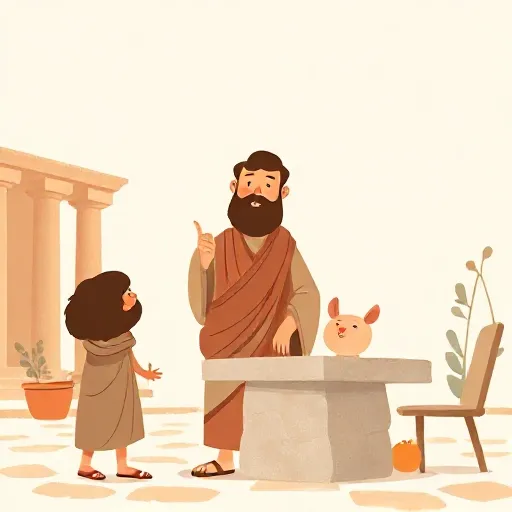
In Athens around 300 BCE, after dinner, a wiry philosopher with a sharp grin liked to corner friends. His name was Diodorus Cronus (c. 315–284 BCE). He would pick up a child’s toy ship and ask, “You think this ship could sail tomorrow. But suppose it never sails. When exactly was it possible for it to sail?” His friend would squirm. Diodorus would press: if the ship never sails, then there is no moment when “it can sail” is true. So, he concluded, it was never possible at all. Poof — stealing your “could-haves” like a magician making a coin vanish.
Diodorus belonged to a lively group called the Dialecticians. Their name came from dialectic, the art of arguing by asking and answering tight, probing questions. Like Socrates, they believed that grilling someone with questions could uncover truth — or at least expose sloppy thinking. But unlike most philosophers, they were addicted to logical puzzles that twisted your brain until it squeaked.
A Team of Question-Flinging Logic Geeks

The Dialecticians grew out of the Socratic family tree. Their intellectual great-great-grandfather was Euclides of Megara, a friend of Socrates. Many ancient writers lumped them together with the Megaric school, a group linked to the city Megara. But some later sources, like Diogenes Laertius (3rd century CE), listed the Dialecticians as a separate “ethical sect.” The group may have been founded by Clinomachus of Thurii, a student of the paradox-master Eubulides of Miletus. The name “Dialectical School” itself was reportedly coined by Dionysius of Chalcedon (active around 320 BCE) because they always put arguments into question-and-answer form.
Modern scholars still argue whether they formed a proper school with a building and a head teacher, or were simply a gang of friends who shared a love for logic. One clue comes from ancient gossip: Stilpo of Megara, a famous Megaric, once boasted that he had stolen three students “from the Dialecticians.” That sounds like a rivalry between two distinct camps. Whatever their exact setup, the group included some of the most inventive logical minds of the time. The two brightest stars were Diodorus and his student Philo (late 4th–early 3rd century BCE). Diodorus taught in Athens and Alexandria, and even his five daughters — Menexene, Argeia, Theognis, Artemisia, and Pantacleia — were said to be skilled logicians.
Eubulides and the Puzzles That Bite Back

Before the Dialecticians, Eubulides of Miletus (4th century BCE) had already made a name with baffling paradoxes. The most famous is the Liar Paradox. Imagine someone says, “I am lying.” Is that statement true? If it is true, then the speaker is lying, so it must be false. But if it is false, then the speaker is not lying, so it must be true. Around and around it goes, never settling. Eubulides also crafted the Sorites Paradox. Start with a heap of sand. Remove one grain. It’s still a heap. Remove another grain — still a heap. Keep going. Eventually you have one grain left, and clearly that is not a heap. But when exactly did the heap stop being a heap? No answer feels right.
The Dialecticians inherited this appetite for clever traps. They saw such riddles not as silly games but as tools to sharpen thinking about truth, language, and the limits of words. By forcing a contradiction, they hoped to get clearer about what “true” and “possible” really mean. This is where Diodorus walked onto the stage and turned the dial up to full volume.
The Master Argument: Does Possibility Even Exist?

Diodorus took the puzzle of possibility to a shocking extreme. He crafted what came to be called the Master Argument. In plain terms, he tried to prove that if something will never happen, it is not just unlucky — it is impossible. His reasoning went like this. Take a simple coin flip. Before you toss the coin, is it already true that it will land heads? Diodorus thought so. A statement about the future is either true now or false now, even if we don’t yet know which. If it is true now that the coin will land heads, then it is necessary that it lands heads — because you cannot change a truth that already exists. So it was never possible for it to land tails. The one future that actually unfolds is the only future that could unfold.
He used the same trick on everyday choices. If you end up eating vanilla ice cream, the statement “You will eat chocolate” was false the whole time. And since it was false, it could never become true. So, Diodorus would say, you never really had the possibility of eating chocolate. To his friends, this felt like a logic trap: Diodorus seemed to rob them of all alternatives while they still experienced choosing. His student Philo likely pushed back hard, though his exact counter-arguments are lost. The debate spread fast. Stoic logicians, including Zeno of Citium (who studied under Diodorus), absorbed and rebuilt these ideas, laying the foundation for a system that would blossom into modern propositional logic — the logic of “if … then,” “and,” and “or.”
Why Your Computer Speaks Dialectician

You may never meet a Dialectician, but their fingerprints are all over your world. The Liar and Sorites still tickle your brain. The Master Argument forces you to ask: when you say “It could have rained today,” what makes that true if it didn’t rain? This question touches everything from free will to computer programming. The Stoics developed a crisp logic of connectives, inspired by Diodorus and Philo. Centuries later, those connectives became the foundation of the Boolean logic inside every computer chip, every search engine, every game. An if-then command in a coding project is a direct descendant of the arguments those ancient questioners scribbled on sand or wax.
And the Master Argument didn’t stay buried. In the 20th century, the logician Arthur Prior used Diodorus’s ideas to build a whole new logic of time called tense logic. The puzzle remains alive: is the future truly open, or is it just a story we tell ourselves while only one path can ever be walked? Next time you argue with a friend about what could have happened, you’re doing dialectic. You might even be channeling Diodorus Cronus, who would listen, grin, and then calmly prove you were never free to pick the other side.
Think about it
- If a friend says “I could have caught the ball, but I didn’t,” would Diodorus say that is impossible? Whose side do you lean toward, and why?
- Think of something that might happen tomorrow but probably won’t — like you winning the lottery. If you don’t win, was it ever truly possible? Is there a difference between being possible and being probable?
- If the future is already fixed, like Diodorus believed, would it still make sense to hold people responsible for their actions? Why or why not?