Was Your Whole Life Decided Before You Were Born?
What If a Demon Could Predict Your Every Move?

In 1814, the French scientist Pierre-Simon Laplace (1749–1827) dreamed up a thought experiment about a super-smart demon. This demon was not a monster, but a mind so powerful that it knew the exact position and speed of every particle in the universe at a single moment, and every law of nature. Laplace argued that such a demon could read the past and future perfectly—down to every heartbeat, every idea, every choice you would ever make.
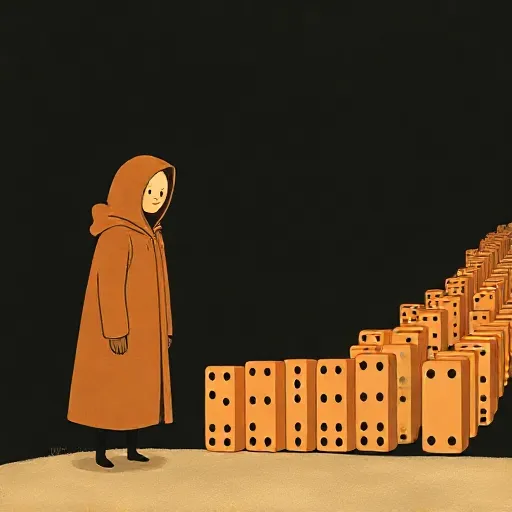
If that is right, then the decision you make tomorrow was already settled long before you were born. That idea is called determinism: the view that, given a complete description of the world at any moment, the laws of nature lock in everything that happens later (and earlier). Notice that determinism is not about gods or destiny. It is just a claim about how the physical world works—like cause and effect, but spelled out across the entire universe.
It’s Not Fate, and It’s Not Prediction

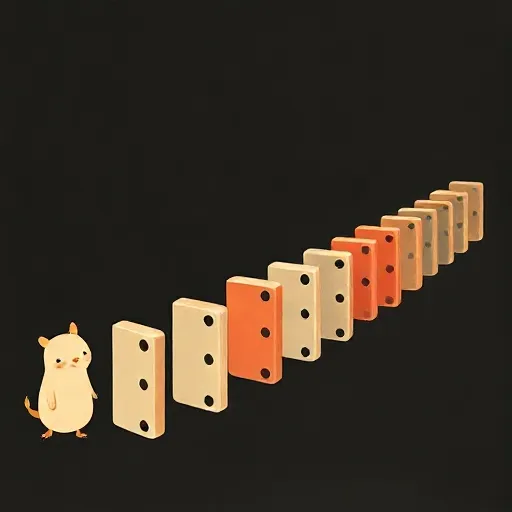
People sometimes confuse determinism with fatalism. Fatalism says that certain events are destined to happen no matter what you do—maybe because the gods will it or because the universe has a built‑in plan. Determined events, by contrast, are not “meant to be”. They simply follow from earlier conditions and the laws of nature. There is no mystical force needed. If a world is deterministic, a storm that ruins a picnic happens because of wind and temperature, not because someone was unlucky.
Determinism can also be confused with predictability. Even if every event is determined by what came before, that does not mean anyone—Laplace’s demon included—could actually work out the future. The 20th‑century philosopher Karl Popper (1902–1994) pointed out that a system can be perfectly deterministic yet too complicated for any real‑world mind to calculate. So determinism is about what must happen given the rules, not about what anybody can foresee.
Why We Have to Talk About the Entire Universe

You might think determinism only matters for your own brain and your own life. But if the future is truly fixed, the smallest outside influence can change things. In 1814 people believed influences could travel at any speed, so even an event on the other side of the universe could affect you instantly. Later physics showed that nothing travels faster than light, but the point remains: to guarantee that every future event is determined, you have to specify the state of everything, everywhere, at a single moment.
Philosophical problems arise, too. Suppose you are deciding whether to stay outside on a clear night. A bright blue star catches your eye; you think “What a lovely star” and linger. That starlight entered our solar system only a day earlier. If the state of the world a month ago hadn’t included the entire region that later sent that light, your decision would not have been fixed. So for full‑strength determinism, we fix the whole world at once.
Interestingly, deterministic laws usually work both ways: the past fixes the future, but the present also fixes the past mathematically. We just don’t feel threatened by the past‑fixing direction because we already think the past is locked and unchangeable. That one‑way feeling is a habit, not a physical fact.
Do Laws of Nature Push, or Just Describe?
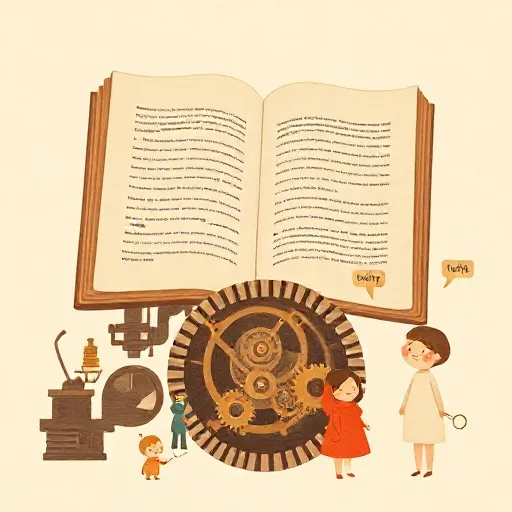
For determinism to be true, there must be genuine, exceptionless laws of nature. The 18th‑century philosopher David Hume (1711–1776) helped launch a long‑running tussle about what those laws really are. One side—call them the pushy explainers—holds that laws make things happen. A law of gravitation doesn’t just record that apples fall; it actively pulls them. If laws are pushy explainers, then a deterministic set of laws forces the whole history of the universe into one single path.
The other side—often called the Best Systems Analysis or Humean view—says that laws are merely the most elegant summaries of everything that actually happens. On this picture, the universe’s events are just a huge mosaic, and the laws pick out the neatest patterns in that mosaic. Here laws don’t push; they only describe. Modern philosophers like John Earman (b. 1942) have defended this approach.
Surprisingly, even if laws are only summaries, determinism can still seem to threaten free will. If the complete pattern of history includes exactly one sequence of actions from you, then there’s a sense in which you could not have done otherwise—at least not without changing the entire past. That is why many philosophers stay worried, no matter which account of laws they prefer.
A third group, including Nancy Cartwright, argues that universal exceptionless laws don’t exist at all. If they are right, determinism is simply false. The debate stays wide open.
Can We Ever Prove Determinism True?

Deciding whether our universe is deterministic turns out to be frustratingly difficult. One reason is chaos. A system can be completely deterministic yet so sensitive to tiny differences in its starting state that it looks random. Imagine a perfectly smooth billiard table with a rounded obstacle in the center. If two cue balls start a millimeter apart, after several bounces they may end up on opposite sides of the table. That is sensitive dependence on initial conditions—and it means that even a truly deterministic billiard world might fool us into thinking chance is at work.
Quantum mechanics makes the puzzle even deeper. Many scientists in the 20th century believed quantum physics is irreducibly chancy: a radioactive atom doesn’t decay because of a hidden cause, but only with a certain probability. Yet some interpretations of quantum mechanics—like the one proposed by David Bohm—restore full determinism by introducing hidden variables while making exactly the same observable predictions. So a deterministic quantum theory and an indeterministic one can look identical to us, no matter how many experiments we run. Philosopher Patrick Suppes argued that we may never be able to settle the question empirically. So your belief in determinism might always rest partly on philosophical taste, not proof.
Why This Matters for Your Own Choices

So far, physics has not declared determinism true or false, and philosophers have not stopped arguing. But why should you care? Because the idea of determinism tugs directly at our sense of free will. If the state of the world a thousand years ago already contained everything needed to make you pick vanilla over chocolate today, can you really claim to have chosen?
Some philosophers—compatibilists like David Hume and John Fischer—say yes. They argue that freedom does not require the power to break the laws of physics, only the power to act on your own desires without being pushed around by someone else. If nobody is forcing you, then you are free, even if those desires themselves were determined.
Incompatibilists disagree. They think real freedom requires that, under exactly the same past circumstances, you could have chosen differently. Determined worlds trap you: only one outcome is ever possible. So if determinism is true, they say, free will is an illusion.
Crucially, the physics hints that the past has no special power that the future lacks—because determinism works both ways. Some philosophers, like Jenann Ismael, have used this symmetry to build new arguments that even a deterministic world can leave room for genuine agency. The question remains unsettled. Next time you make a choice, you might wonder: was it always inevitable? And you’ll be asking one of philosophy’s most stubborn questions.
Think about it
- If a supercomputer could correctly predict every choice you’ll ever make, would you still feel like you have free will? Why or why not?
- If determinism is true and a criminal’s actions were fixed by the past, can we still hold them responsible? What would justice require?
- Imagine you can never know whether the universe is deterministic. Does your answer change how you live your life day‑to‑day?