Is 'Red' a Real Thing, or Just a Bunch of Shades?
A Pigeon, a Tomato, and a Mystery
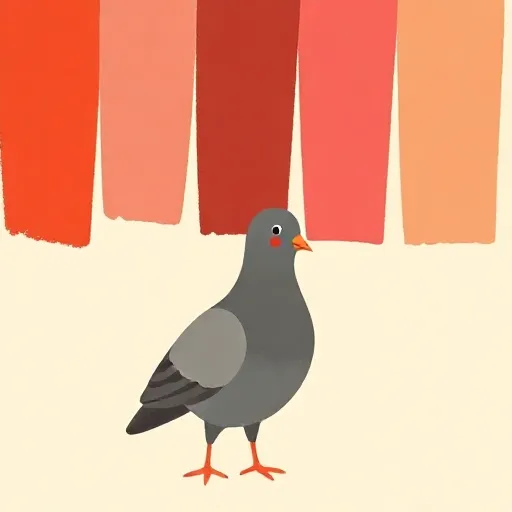
Sophie is a pigeon with a job. Her trainer taught her to peck at anything red. Wave a scarlet scarf, and she pecks. Show her a burgundy tile, and she pecks. Her picky cousin Alice, though, pecks only at scarlet — nothing else will do.
What makes Sophie succeed where Alice fails? Sophie seems to track something more general: the property of being red, not just one exact shade. Philosophers call a general property like color a determinable (from a Latin word meaning “able to be made more specific”). The exact shades — scarlet, burgundy, crimson — are called determinates of that determinable. The same pattern shows up everywhere: shape is a determinable with determinates like triangular and square; mass is a determinable with determinates like 5.2 kilograms or 0.7 pounds.
The puzzle Sophie raises is ancient. Are determinables real features of the world, as real as the most specific shades? Or are they just handy labels we slap onto collections of determinates — as if “color” were nothing but a mental file folder?
The English philosopher W. E. Johnson (1858–1930) gave the relation its modern name in 1921, but the debate goes back at least to Aristotle (384–322 BCE). Aristotle noticed that defining a species — say, human — isn’t the same as gluing a genus (animal) and a difference (rational) together like two blocks. Instead, the more specific thing is somehow a way of being the more general thing. That insight is the seed of everything that follows.
When “Red” Isn’t Just Red-Plus-Something

Suppose someone told you that scarlet is simply “color plus a certain extra ingredient,” like a smoothie. Johnson thought that couldn’t be right. If scarlet were really a conjunctive property — color trussed up with some independent extra — then you could in principle add that extra to something else and get a new color. But that isn’t how it works. Being scarlet isn’t like being a “colored-and-also-X” thing; it’s a more specific way of being colored. Philosophers call this non-conjunctive specification.
This features produces other characteristic marks. Because scarlet and burgundy are both determinates of the same determinable, they are incompatible at the same level: a single patch can’t be both scarlet and burgundy all over at once. They are also related in a special way — not just different, like blue is different from loud or from inflation, but opponent. Johnson put it this way: the difference between red and blue is a unique and peculiar kind of difference, not like the difference between red and circular.
Another key mark is asymmetric dependence. If something is scarlet, it must be red; but something can be red without being scarlet (it might be burgundy instead). Determinables are less demanding; they carry fewer requirements. Sophie the pigeon only needs something to be red, not a particular shade.
However, not every example fits the neatest picture. A sauce can be both sweet and sour — two determinates of taste, apparently compatible. A bell’s tone can contain a fundamental pitch and several overtones at once. And some determinables, like the boundary of a mountain, may not have a single unique determinate at all. Still, the core pattern is sturdy enough that philosophers have built entire theories around it.
Real Color or Just a List of Shades?

Now the central fight. Are determinables genuinely part of reality, or can we explain everything with determinates alone?
Realists say determinables exist in their own right, and are not just disguised lists. One argument comes from perception. Look at a color gradient from orange to red: neighboring patches look the same, but patches a few steps apart look different. This sorites effect suggests our eyes never pick out a maximally specific shade. If reality contained only fully determinate shades, every patch would look distinct — but they don’t. Another argument comes from science. The law of gravity involves mass, a determinable; plug in exact numbers and you get determinate instances of the law. Many philosophers think the determinable law does scientific work that no list of specific cases can do.
Then there’s causation. Sophie pecks at any red patch. The determinable red has a causal power — getting Sophie to peck — that every shade of red shares. Her cousin Alice, however, requires scarlet. The determinable has a proper subset of the powers of the determinate. Realists argue that this power-sharing shows determinables are not just logical shadows.
Reductionists (sometimes called “anti-realists” about determinables) counter: reality is ultimately completely specific. David Armstrong (1926–2014) insisted that all fundamental properties must be fully determinate. On this view, to be colored is simply to possess one of the exact shade properties — color is just the disjunction “scarlet or burgundy or crimson or….” It’s a shorthand, not an extra ingredient.
Reductionists also worry about redundancy. If every causal job done by a determinable could already be done by the determinate, why believe in both? Isn’t that like hiring two workers when one would finish the task? Realists reply that determinables are not extra workers; they are intimately tied to their determinates, sharing the very same powers rather than duplicating them.
Why Clouds and Choices Depend on This Debate

Why should a twelve-year-old care whether determinables are real? Because the answer spills into two huge everyday mysteries: how our minds cause things, and why so many boundaries feel blurry.
First, minds. Many philosophers think mental states — like feeling hungry or believing it’s Tuesday — are determinables of physical brain states. If that’s right, then mental properties don’t compete with physical ones for causal power. They share powers the way red shares powers with scarlet. This could solve the old worry that thoughts are causally useless because the brain already does everything. So Sophie’s pecking at red is a small model of how your decision to raise your hand can be a real cause, not an illusion.
Second, vagueness. Where exactly does a cloud begin? If you say a cloud has a precise boundary, you have to choose one water droplet as the last one — which seems absurd. Philosopher Jessica Wilson (1974–) suggested that an object like Mount Everest might have a determinable boundary property, but no unique determinate boundary at the fundamental level. There are too many candidate precise boundaries to pick just one without cheating. This glutty indeterminacy makes sense of blurry edges without blaming our language — it’s baked into reality itself. In quantum mechanics, particles sometimes seem to have determinable properties (like spin in a certain direction) without having any correspondingly precise determinate, a gappy case that puzzles even physicists.
So next time you squint at a foggy hillside or wonder whether your choice really made a difference, remember Sophie the pigeon. The question of whether redness is real is really a question about what the world is made of — and whether it has room for the blurry, the general, and the powerful.
Think about it
- If a scientist could perfectly predict every choice you’ll ever make, would it still be fair to say your thoughts caused your actions?
- Can you imagine a world where only the most exact properties exist (no general “red,” only exact shades)? What would be different about that world?
- Think of an everyday object with a fuzzy boundary (a pile of leaves, a crowd, a puddle). Does the fuzziness live in the thing itself or only in the words we use?