Do Numbers, Colors, and Stories Really Exist?
What makes two apples red?
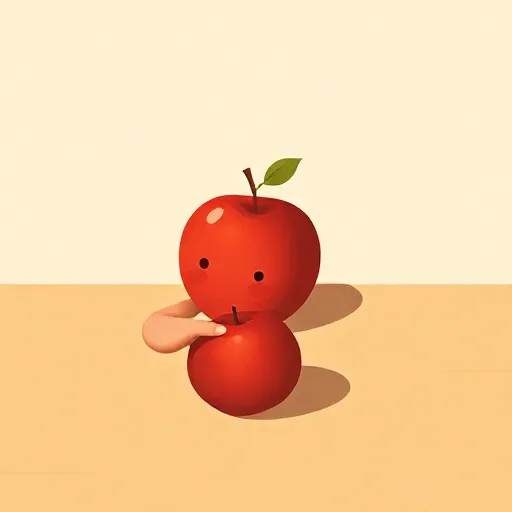
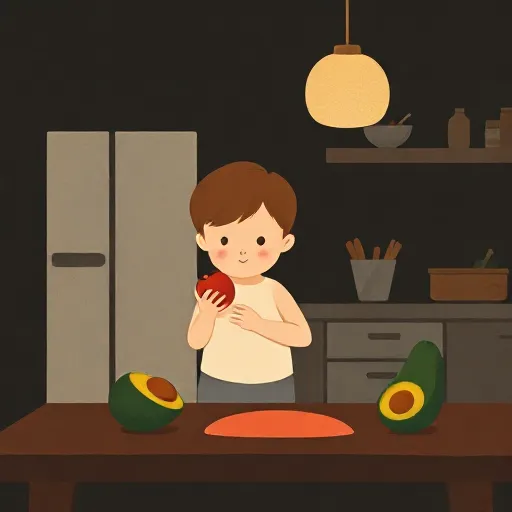
You are in the kitchen. In one hand you have a shiny red apple. In the other, a bumpy green avocado. You bite into the apple; it’s sweet. You set it down and pick up a second apple, exactly the same shade of red. You know right away they match. But what makes them match? Is there something — a single, invisible “redness” — that both apples have?
Philosophers call that shared something a universal. A universal would be a quality or property that can be fully present in many different things at the same time. If redness is a universal, then this apple and that apple each have the very same redness, in the way two different houses can both be standing under the exact same rain. A rival view agrees that something explains why both apples are red, but denies that the something is a single item shared by the fruits. Instead, each apple has its own particular redness, its own trope. A trope is a quality that belongs to just one thing; it is not spread across multiple objects. Your apple has its own private “red-there” and the other apple has a different, though perfectly matching, “red-here.”
Now comes the bold move. Some philosophers, called strict nominalists, deny that any special entities like universals or tropes are needed at all. They say the apples don’t “have redness” in some mysterious way. It’s simply true that the apple is red, full stop. A strict nominalist like W.V.O. Quine (1908–2000) insisted we can describe the world perfectly well without inventing hidden color‑stuffs behind it. For them, qualities are not extra things; they are just ways that ordinary objects are.
Numbers and stories as real things

The debate over red apples is only half the story. Many philosophers also argue about whether abstract entities exist. An abstract entity is something that doesn’t live in space or time and cannot push, pull, or be touched. Numbers, sets, propositions, and musical works are often taken to be abstract. Your desk is a concrete entity — it sits in space, has mass, and you can stub your toe on it. The number seven, by contrast, doesn’t seem to be anywhere at all. You can’t trip over seven.
In 1947, Nelson Goodman (1906–1998) and Quine wrote: “We do not believe in abstract entities. No one supposes that abstract entities — classes, relations, properties, etc. — exist in space-time; but we mean more than this. We renounce them altogether.” This statement launched a modern version of nominalism about abstract entities — the view that there are no numbers, sets, fictional characters, or other non‑physical things.
For a nominalist, saying “seven is a prime number” is a tricky business. It sounds as if the sentence talks about an object, seven, and says something about it. But if numbers don’t exist, how can that sentence be true? Nominalists need to explain how we can talk meaningfully about mathematics, fiction, and properties without buying a ticket to a ghostly realm of abstract stuff.
Why some philosophers want a world without abstract things
One powerful reason to reject abstract entities comes from how we know things. Paul Benacerraf (born 1930) noticed that if numbers are outside space and time, and never interact with our brains, then it’s very hard to explain how we have any knowledge about them. We learn about chairs by seeing and touching them; numbers offer no such grip. Hartry Field (born 1946) sharpened this causal argument: because abstract objects can’t cause anything, there’s a mysterious gap between us and mathematical truth. Nominalists find the gap too wide to accept.
Another motive is simplicity — what philosophers call ontological parsimony. If we can describe everything that happens in the world using only concrete objects, why also believe in a second, shadowy realm of numbers, properties, and propositions? A theory that gets by with fewer kinds of stuff is, other things being equal, better. Nominalists try to show that talk about “the number two” can be replaced by sentences that mention only concrete things, like “there is a planet x and a planet y and they are different, and every gas giant is one of those two.” If such paraphrases work, the extra weight of abstract entities can be dropped.
Paradoxes also unsettle anti‑nominalist theories. Bertrand Russell (1872–1970) discovered that some natural ideas about sets lead to contradictions, like the set of all sets that don’t contain themselves. If positing sets invites such trouble, nominalists urge, perhaps we are better off without them.
But don’t we need them to make our sentences true?

Philosophers who defend abstract entities point to everyday truths that seem to require them. The sentence “seven is prime” looks like a fact about the number seven. Gottlob Frege (1848–1925) argued that if a sentence contains a name that appears to pick out an object, and the sentence is true, then that object must exist. Since “seven” behaves like a name, and “seven is prime” is true, there must be a number seven. A similar line of thought says that when we claim “Sherlock Holmes is cleverer than Watson,” we are committed to fictional characters as real (though perhaps abstract) things.
Another anti‑nominalist weapon is the indispensability argument, developed by Quine and Hilary Putnam (1926–2016). Our best scientific theories are swimming in mathematics. Physics uses numbers, functions, and sets everywhere. If we believe the theories are true, we should believe in the things they can’t do without — including mathematical entities. Rejecting numbers would mean rejecting huge chunks of confirmed science.
Some philosophers also appeal to truthmakers. They say that for any true statement, something in the world must make it true. The truthmaker for “this apple is red” seems to involve the apple and the property redness. If there is no property redness, what makes the sentence true? Nominalists owe an answer, and anti‑nominalists think their own answer — that properties exist — is the most straightforward one.
How nominalists live without numbers and colors

Nominalists have developed clever strategies to keep using number‑talk and property‑talk without believing in anything abstract. One popular approach is fictionalism. A fictionalist says that claims like “two is the number of gas giants” are literally false, but they are useful fictions, just like the stories we tell about Sherlock Holmes. According to the fiction of arithmetic, two exists and has properties; in reality, it doesn’t. We endorse the fiction because it helps us organize our knowledge of concrete things.
Other nominalists rely on paraphrasing. They try to rewrite apparent commitments away. Instead of saying “the number of planets is eight,” a nominalist might say something like: “there are exactly eight things, each of which is a planet, and no planet is left out.” If the paraphrase captures the original information without talking about numbers, the nominalist can claim that true‑looking number sentences don’t force us to accept numbers as real. This strategy is difficult but remains a central project.
A different angle altogether, austere nominalism, insists there is simply no deep metaphysical question to answer. Quine, a famous austere nominalist, thought that saying “the apple is red” does not require a special entity called redness. It only requires an apple. The apple itself, being the way it is, is enough. No hidden qualities, no abstracts, no problem.
Other nominalists treat talk of properties as really talk about language or concepts. A metalinguistic nominalist might claim that “red is a color” is best understood as a comment about the word “red” — that it is a color‑predicate. In this way, we never commit to colors as things out in the world at all.
Why this still matters in your life
You probably assumed that numbers and colors just exist, somehow. The nominalist–realist fight shows that the most familiar parts of your world — counting to five, seeing that your shirt is blue, enjoying a story about a superhero — sit on top of deep philosophical cracks. If numbers aren’t real, what makes math true? If properties aren’t real, can we genuinely say two leaves are both green? And if fictional characters aren’t real in any sense, why does it feel so natural to talk about them?
Working scientists, mathematicians, and writers rarely settle these questions before getting on with their jobs. But the answers you lean toward can change how you think about truth, knowledge, and even video games. Every time you ask “how much health does my character have?” or “is this color really the same as that one?”, you step onto ground that philosophers have been mapping for centuries. The choice between a world of only concrete things and a world rich with invisible universals is still open — and it belongs to anyone who is willing to think.
Think about it
- If no one had ever invented the word “red,” would redness still exist? How could you decide?
- Suppose a scientist tells you that numbers are just useful fictions. Would you still trust the math that built your phone? Why or why not?
- Imagine you meet someone who says fictional characters like Sherlock Holmes don’t exist at all, not even in stories. How would you explain why we still feel like we know him?