Is the Sky Really Blue? The Big Color Puzzle
Why Does This Tomato Look Red?

Imagine you’re holding a ripe tomato in the sunshine. Its skin glows deep red. Without thinking, you would say, “This tomato is red.” But take a second look. Is the redness really spread across the tomato’s surface, like roughness or roundness? Or is color something your brain creates, like a feeling of warmth? That question has launched a great fight in philosophy and science — one that’s been going strong since the 1600s.
The Scientists’ Surprising Claim: Colors Are in Your Mind
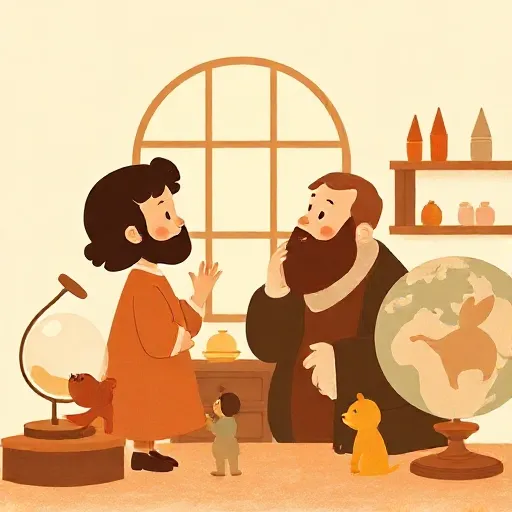
Many of the giants of modern science held a shocking view: physical objects are not colored in the way we naturally think. Galileo Galilei (1564–1642), René Descartes (1596–1650), Isaac Newton (1642–1727), and James Clerk Maxwell (1831–1879) all believed that colors exist only as sensations — experiences inside the perceiver. Maxwell even wrote that recognizing color as a sensation was the foundation of a consistent theory of color.
The philosopher David Hume (1711–1776) put it bluntly: sounds, colors, heat, and cold are not qualities in objects, but perceptions in the mind. In this picture, a tomato is not red; it simply has a surface that reflects certain wavelengths of light. Those wavelengths trigger cells in your eye, which send signals to your brain, and your brain cooks up the vivid red you see. As modern psychologist Stephen Palmer points out, objects and lights are not actually colored in the way we experience. The physical properties that cause us to see color are very different from the colors we perceive.
Descartes added a twist. He thought we could still say “the apple is red” in everyday talk, as long as we understood it to really mean “the apple has a power to produce the sensation of red in me.” Ordinary color talk could go on, just with a secret translation. The world of colors, on this view, becomes a kind of useful fiction.
But Can We Really Say the Sky Isn’t Blue?
For many people, this scientific picture feels hard to swallow. We grow up learning color words by pointing: that lemon is yellow, that stop sign is red. The idea that lemons aren’t yellow seems to pull the rug out from under language. It is hard to make sense of the claim that colors are properties of sensations: if colors are anything, they are properties of peaches, skies, and glasses of wine — not of sensations.
So who’s right? Realist philosophers think colors are genuine features of the world, not just fictions. But they disagree about what kind of features those are.
Physical Colors: The Hidden Properties of Surfaces
One popular realist view is Color Physicalism (also called Reductive Physicalism). It holds that colors are physical properties of objects — specifically, the way surfaces reflect, absorb, and emit light. A tomato is red because its skin reflects long-wavelength light more than short-wavelength light, a pattern called its reflectance. According to philosophers like David Hilbert and Alex Byrne, each color corresponds to a type of reflectance.
This fits nicely with science: measuring reflectance curves can predict what a camera or an eye will detect. But problems creep in. First, metamerism — different physical surfaces can look exactly the same color under one light, yet look different under another. Two socks that match indoors might not match in sunlight. So which reflectance is the “real” color? Physicalists answer that colors are not single curves but groups, or types, of curves. Still, grouping them can seem arbitrary.
A bigger headache is the idea of Unity — the fact that colors form a neat, structured family of similarities. Orange is more like red than it is like blue; yellow stands opposite purple. These relations feel basic to color. But reflectance curves don’t naturally sort themselves into those neat boxes. Philosopher C. L. Hardin argues that no purely physical property captures the way colors relate to one another in our experience. Physicalists reply that the relations are really about the experiences themselves: orange experiences are more similar to red experiences than to blue experiences. Critics say that only pushes the problem onto the mind, leaving it unclear whether objects themselves are colored.
Dispositions: The Power to Look Red
A second family of theories avoids tying color to hidden physical properties. Dispositionalism says that colors are dispositions — powers to produce certain visual experiences in perceivers under certain conditions. A tomato is red because it is disposed to look red to a normal human observer in daylight. This idea goes back to John Locke (1632–1704) and has modern defenders like Mark Johnston.
At first glance, this seems circular: red is defined as looking red. But dispositionalists break the circle by describing “looking red” as producing a distinctive kind of visual sensation, often called qualia — the raw what-it’s-likeness of seeing red. You don’t need to see redness out in the world; you just have a certain type of experience.
Johnston argued that the ordinary concept of color includes a cluster of beliefs. One core belief — called Revelation — holds that the very nature of a color is fully revealed to you when you see it, with nothing hidden behind the experience. Johnston thinks this belief must be given up, because no real property can satisfy it. If we drop Revelation, he says, dispositionalism handles the other core beliefs well.
Trouble comes from variation. People’s color vision differs, even among those with “normal” sight. Some see unique green slightly differently; others might not. And lighting conditions change drastically. If redness is a disposition to look red to normal observers in standard conditions, then picking out which observers and which conditions are “normal” begins to look like a human choice, not a fact of nature. Hardin and Jonathan Cohen have pressed this point forcefully. Cohen even proposes Color Relationalism: there is no such thing as red all by itself, only red-for-a-specific-perceiver-in-specific-circumstances. So a strawberry might be red for you at noon and a different color for a bee — both equally true.
So, What Color Is Your Tomato? Why the Debate Matters
You might think this is just a puzzle for scientists in lab coats. But it touches everything you see. When you pick the reddest strawberry, argue about whether a dress is blue or gold, or mix paint in art class, you’re stepping into a question that has no final answer.
The debate matters because it tests our deepest assumptions about perception. Is the world we see the world as it really is? Or does your brain paint a picture that’s useful but not entirely true? That same question appears in other parts of philosophy, from sounds to tastes to the feeling of time.
Right now, no single theory wins. Physicalism gives a crisp scientific picture but struggles with the felt similarity of colors. Dispositionalism respects our experience but struggles with variation and circularity. Some philosophers even hold that colors are simple, irreducible, primitive properties — a view called Primitivism — or that no objects are colored at all. Which side you lean toward might depend on which part of the puzzle you find hardest to give up.
But there’s a gift hidden in the confusion. If color is in part created by your mind, then every blue afternoon and every glowing sunset is something your brain helps bring into being. The world gives you light; your mind gives it color. And that’s worth seeing with fresh eyes.
Think about it
- If you dreamed of a red apple that felt completely real, would you say the apple was red? What if scientists could prove that the awake-world apple has no redness at all?
- You and a friend both look at a shirt. You see blue, your friend sees green. Is there a way to find out which of you sees the “real” color, or does that question not make sense?
- Suppose colors turned out to be nothing but brain sensations. Why, then, do we all agree that stop signs are red and bananas are yellow? Could our shared color language work even if redness isn’t a property of the sign?