
Can Thinking Make You Happy? Descartes' Surprising Answer
The Tree That Shows What Matters Most
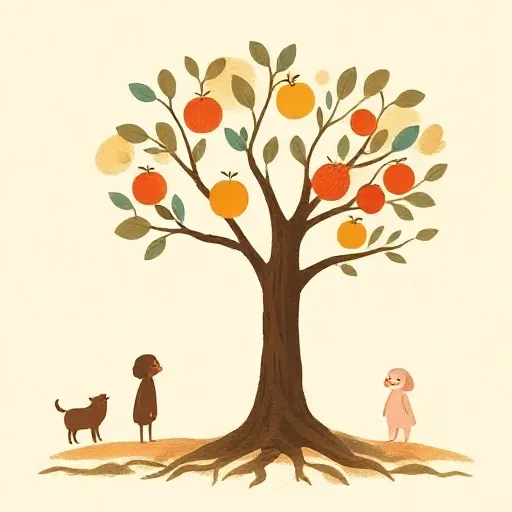
In 1647, Descartes drew a picture of a tree. It wasn’t a real one—it was a tree of knowledge. “The roots are metaphysics, the trunk is physics, and the branches are all the other sciences.” Three main branches held the most important fruit: medicine, mechanics, and morals. For Descartes, the sweetest fruit was la morale—the science of living well and being happy.
That might surprise you. Descartes is famous for doubting everything, searching for absolute certainty. But he also believed philosophy’s ultimate job was to teach us how to be happy. He wrote: “The principal benefit of philosophy depends on those parts of it which can only be learned last of all.” First you understand reality, then you learn how to live.
For him, happiness isn’t about money or never feeling sad. It’s tranquillity: a deep mental peace that comes from having a well-ordered mind. He compared philosophy to medicine for the mind. Just as a doctor treats bodily diseases, philosophy treats vices—the illnesses of the soul. He once noted, “I use the term ‘vice’ to refer to the diseases of the mind, which are not so easy to recognize as diseases of the body.” Most of us have known a healthy body, but few of us have ever enjoyed “true health of the mind.”
Ancient Stoics and Epicureans also wanted philosophy to heal life. Descartes agreed. He even said one main point of his ethics was “to love life without fearing death.” The idea is simple: if you train your mind, you can face scary things without losing your inner peace.
Rules for Living Without Knowing Everything
How do you get a well-ordered mind? In 1637, Descartes published the Discourse on the Method. He told a story about his own hunt for certainty. He realized he couldn’t sit around doubting forever—he had to eat, act, and live. So he built a provisional moral code, a set of “three or four” temporary rules to ride out the uncertainty.
The first rule: obey the laws and customs of your country and stick to your religion. The second: once you decide on a path, act as firmly as if your choice were absolutely certain, even when it’s not. The third: “try always to master myself rather than fortune, and to change my desires rather than the order of the world.” Don’t waste energy wanting things you can’t control—like the weather or others’ opinions. Change your own wishes instead. The fourth rule: spend your whole life cultivating reason and pursuing truth. That last rule was the real goal; the others were just scaffolding.
Descartes didn’t claim these rules were the final truth. They were a safety net. He believed that, by using reason well, he would eventually discover real knowledge about what is truly good. Then he could replace the temporary rules with something solid. Even so, following the provisional code already brought a kind of peace, because acting decisively and wanting only what’s in your power calms the mind.
The Dangerous Power of Your Will

Reason is the guide, but how does it steer your choices? In the Meditations, Descartes explored the link between believing true things and doing good things. He said the will—your power to choose—is free. It’s the most godlike part of you. When your intellect sees something clearly and distinctly true, your will is compelled to agree. You can’t help but believe 2+2=4 once you see it clearly. The same, he thought, should hold for goodness: if you saw what is truly good with perfect clarity, your will would automatically choose it.
But life isn’t a math problem. We rarely see goodness that sharply. Often we are indifferent—we could go either way. Descartes argued that error (whether about facts or morals) happens when we misuse free will: we judge too quickly, before we see clearly. The safe rule is don’t judge until the truth is plain.
A thinker named Antoine Arnauld spotted a problem: when you’re facing a real choice, you can’t always wait for perfect clarity. Life demands action. If a bear is chasing you, you can’t pause until you’re 100% sure it’s dangerous. Descartes admitted this. In everyday life, you often must choose without crystal-clear knowledge. Later, he would explain how we can still choose well enough to be happy even without certainty.
A Princess, a Secret, and the Recipe for Happiness

In the 1640s, Descartes began writing to Princess Elisabeth of Bohemia. She was brilliant, often ill, and deeply sad. She asked: how can a person be happy when their body is broken and life is full of trouble? Their letters became Descartes’ clearest lesson in ethics.
He carefully split three ideas that earlier thinkers often blurred. The supreme good is virtue—he defined it as “a firm and constant will to bring about everything we judge to be the best and to employ all the force of our intellect in judging well.” In everyday language: always try your hardest to figure out what is right, and then do it with all your heart. Happiness is a “perfect contentment of mind and inner satisfaction” that blossoms naturally from being virtuous. It’s a side effect, not a prize you chase directly. The final end is what we aim at: we aim at virtue (the target), and we’re pulled toward it by the pleasure of happiness (the reward).
Virtue depends only on free will. That’s why it’s the greatest good—nothing outside you can steal it. If you act virtuously, you’ll be content, no matter what. But how do you know what’s best? Descartes gave Elisabeth five useful truths to help reason guide the will:
- An all-powerful, perfect God exists, so whatever happens fits a larger plan. This helps you accept even painful events calmly.
- The soul is immortal and separate from the body, so you don’t have to fear death.
- The universe is vast and you are not its centre. That cures the idea that everything should go your way.
- You are part of a larger community, and its interests matter more than your own narrow wishes.
- Passions often make things seem better or worse than they really are, so don’t trust your first emotional reaction.
And one last rule: when you honestly don’t know what to do, follow the customs and laws of your country. This way you’ll never freeze with indecision. Firmness itself blocks regret.
These truths don’t give you a detailed rulebook. They more like remove mental blocks—fear of death, obsession with small things—so your reason can work cleanly. If you act with resolution and a clear conscience, that is enough for virtue.
Mastering the Storms Inside You

Descartes’ last major work, The Passions of the Soul, explored what we’d now call emotions. He studied them like a natural scientist, but his aim was deeply ethical. He identified six basic passions: wonder, love, hatred, desire, joy, and sadness. They all spring from movements in the body and brain. Their natural job is to preserve the body—fear makes you flee, joy rewards you. So passions aren’t bad by themselves.
But they can mislead. Passions tend to exaggerate: a small danger feels huge, a single sweet looks like the best thing ever. They can also be triggered by a sick body, not by real threats. So reason must govern them. The “proper weapons” against runaway passions are “firm and determinate judgments bearing upon the knowledge of good and evil”—calm decisions you make before the heat of the moment.
Descartes also uncovered internal emotions produced by the soul alone, like the satisfaction you feel when you know you’ve done the right thing. These are more powerful and lasting than bodily passions. They can withstand “the most violent assaults of the passions.” This inner happiness is the true fruit of virtue.
He called generosity the key to all the other virtues. It begins as a feeling of wonder at your own free will and your power to use it well. Over time it grows into a habit—a settled trait. A generous person knows that nothing truly belongs to her except her freedom to choose. She feels a constant resolve to use that freedom well. But here’s the surprising part: this makes her see others as equally precious. She recognizes that every person has a free will just like hers, so she respects everyone, no matter their wealth, smarts, or rank. Descartes wrote, “Those who possess this knowledge and this feeling about themselves readily come to believe that any other person can have the same.” It’s a quiet, radical equality that points ahead to later thinkers like Kant.
Why It Still Matters: Your Mind as a Fortress

You live in a world full of pings, comparisons, and pressure. It’s easy to think happiness depends on likes, grades, or what other people think. Descartes would call that a mistake. Those things sit outside your control. What you can control—your judgments, your will, your honest effort to figure out what’s right—is the only reliable source of real happiness.
This isn’t just “think positive and you’ll be fine.” Descartes is asking you to train your mind to see things as they really are. Recognize that a single bad grade doesn’t touch your deepest worth. Notice that the fear before a performance is just a bodily passion exaggerating danger; breathe, and act anyway. Decide now what kind of person you want to be. When tough moments come, you won’t be ruled by panic.
He challenges you to treat your own mind as a project. By using reason, you can build a fortress of calm that no outside storm can break. That doesn’t mean you’ll never feel sad or scared. But it means that, deep down, your soul can remain still. And in that stillness, you find a happiness that doesn’t run out.
Think about it
- If happiness comes from within, does that mean we should stop caring about things like friendship and achievement, or is there a way to enjoy them without letting them shake our peace?
- Descartes said we should follow the customs of our country when we’re unsure. But what if the custom seems unfair—should you still follow it, or is there a better way?
- He believed that acting decisively, even on a doubtful opinion, prevents regret. Can you think of a time when being too quick to decide might actually cause more harm?