

Reasons Are Causes, But Minds Aren't Machines
Why Did You Take the Last Cookie? Reasons as Causes

It’s a sleepover. Your friend points to an empty chocolate wrapper in your hand. “Why did you eat my last piece?” she asks. You shrug: “I just wanted to.”
You gave a reason, not a physics lesson. But Donald Davidson (1917–2003), an American philosopher, spent his career arguing that when you give a reason like that, you are actually naming the cause of your action. In his famous 1963 paper “Actions, Reasons and Causes,” Davidson set out to prove that reasons are causes – not something separate that only “makes sense” of behavior.
According to Davidson, every intentional action has a primary reason – a pair consisting of a belief and a desire (or pro-attitude). For you, it was the desire to eat chocolate plus the belief that the wrapper held the last piece. That combination makes your action understandable. But for it to be the reason you acted, Davidson insisted, that belief-desire pair must actually have caused your arm to reach out. If you had several reasons but only one caused the action, that one is the reason.
He also borrowed an idea from philosopher G.E.M. Anscombe: the same action can be described in many ways. Flip a light switch to brighten the room, and you might also startle the cat lurking behind the couch. Under the description “turning on the light,” it’s intentional. Under “startling the cat,” it might not be. Davidson saw that both the reason-explanation and the causal story are compatible – they just refer to the same event under different descriptions. This opened up a new way to think about action: reasons aren’t ghostly forces; they’re part of the causal web.
But Can You Predict the Mind? The Puzzle of Anomalous Monism
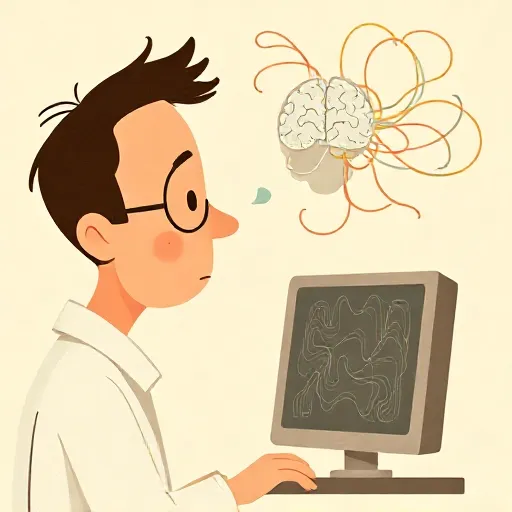
If reasons are causes, shouldn’t we be able to predict behavior with the same certainty we predict a ball rolling down a hill? Not according to Davidson. In his 1970 paper “Mental Events,” he laid out three principles that seem to clash, yet he argued they all can be true:
- Causal interaction: Mental events (like believing it’s raining) can cause physical events (grabbing an umbrella) and vice versa.
- Nomological character of causality: Events that cause each other must fall under some strict, exceptionless law.
- Anomalism of the mental: There are no strict laws that connect mental events and physical events under their mental and physical descriptions. You can’t write a formula that moves from “believes it’s raining” to a precise pattern of neurons.
How can all three hold? Davidson’s trick is that the same event can be described in different vocabulary. The umbrella-grabbing event, described as a physical movement, does fall under some strict physical law. But described as “responding to a belief about rain,” it doesn’t. So the mental description is anomalous – it resists being captured in strict scientific laws. This view became known as anomalous monism: the mind and brain are one thing (monism), but the mental side has a loose, lawless character.
Why no strict laws for the mental? Because thoughts and beliefs are governed by norms of rationality – they must cohere, make sense, avoid contradiction. Physical particles don’t care about making sense; they just follow equations. Davidson said the mental supervenes on the physical: you can’t have a mental difference without some physical difference, but you can’t reduce the mental to neat physical laws. You can think of it like a movie and the film reel: every scene depends on frames, but the story’s meaning isn’t captured by describing each frame’s chemicals.
Cracking the Code of Language: Radical Interpretation

Davidson didn’t stop at action. He wanted to explain how words get their meaning. He argued that a theory of meaning for a language should work like a truth theory: for any sentence, you can state the conditions under which it is true. Using the work of logician Alfred Tarski, Davidson proposed that the meaning of a sentence like “Schnee ist weiss” is given by the statement: “Schnee ist weiss” is true if and only if snow is white. That simple, two-way connection reveals meaning without needing mysterious “meanings” floating in your head.
But how would you ever build such a theory for a real language you’d never encountered? Davidson’s answer is radical interpretation. Imagine you’re dropped into a remote village where no one shares your words. You have to figure out what people mean just by watching their behavior and the world around them. The problem seems impossible: you can’t guess word meanings without knowing what they believe, yet you can’t know their beliefs without understanding their words.
Davidson’s solution is the principle of charity. To get started, you must assume that the speakers are largely rational and that their basic beliefs about obvious things (like “there’s a tree right there”) are true by your own lights. So when a villager points at a rabbit and says “gavagai,” you charitably guess “gavagai” has something to do with rabbits. You build a web of guesses, testing and adjusting, always aiming for the overall interpretation that makes the best sense of their total behavior. Meaning and belief are figured out together, like filling in a huge crossword puzzle where every answer affects the others.
This holism means no single word has a meaning all by itself – its meaning depends on its role in the whole language. And because multiple overall interpretations can fit the evidence equally well, translation is always slightly indeterminate. Just as temperature can be measured in Celsius or Fahrenheit with equal accuracy, you can have two different interpretation schemes that both work perfectly.
The Triangle That Makes Thought Possible

Davidson later introduced a striking image: a triangle. To have thoughts at all, you need not just a brain but a setup involving at least two creatures and a shared world. He called this triangulation. Think of two people on a beach, both watching the same pelican dive. Each person responds to the pelican and to the other’s responses. The pelican becomes the common cause of both their perceptions, which lets them calibrate what they mean.
This triangle explains why self-knowledge, knowledge of other minds, and knowledge of the world are inseparable. You can’t know your own thoughts without also grasping that others have thoughts, and you can’t do either without interacting with a shared, stable world. This leads Davidson to reject total skepticism – the idea that all your beliefs about the world could be false. If everything you believed were wrong, you couldn’t even identify your own beliefs, because belief content depends on a history of causal interaction with things in the world.
A famous thought experiment illustrates the point: if lightning struck a swamp and miraculously rearranged molecules into an exact copy of you, would that Swampman have real thoughts? Davidson said no. It might behave perfectly, but it lacks the causal history of interacting with the world and other people – and without that history, its “words” have no meaning and its “thoughts” no content. You can’t think in a vacuum.
Why This Fight Still Matters: Minds, Machines, and Misunderstandings

Davidson’s ideas aren’t just for dusty journals. They shape how we think about artificial intelligence, everyday arguments, and what it means to understand one another.
Today’s large language models sound fluent, but Davidson would argue they lack genuine understanding. They haven’t grown up pointing at pelicans with other children or building a shared history of causes. A chatbot can mimic patterns but can’t mean anything, because meaning requires triangulation – the real-world causal links and the rational give-and-take between living minds. That’s why AI still fails at sarcasm or simple common sense.
On a personal level, every time you try to figure out why a friend said something hurtful or why your sibling is acting strange, you’re practicing radical interpretation. You unconsciously apply a kind of charity, assuming they’re basically reasonable and that their words connect to a shared world. When you stop doing that – when you decide someone is completely irrational – communication breaks down entirely.
Davidson’s work also challenges the dream of reducing everything about you to predictable physical equations. It suggests that even if scientists can map every neuron, your reasons and meanings will always outrun any neat formula. That doesn’t make the mind magic; it just means our ways of making sense of each other are fundamentally different from our ways of measuring matter. So the next time you say “I just wanted to,” remember: you’re both describing a cause and doing something no machine can do.
Think about it
- If you knew a supercomputer could predict every choice you’ll ever make, would it still make sense to blame a friend for doing something wrong? Why or why not?
- Imagine you meet someone whose language you cannot understand at all. Is it ever reasonable to decide that their words are just meaningless noise, or must you always assume they make sense?
- When you argue with a friend about what someone meant by a text message, are there always multiple equally good interpretations, or can one be the single “right” one? How would you know?