
Did a Philosopher Named David Ever Really Exist?
A Voice Full of Fire

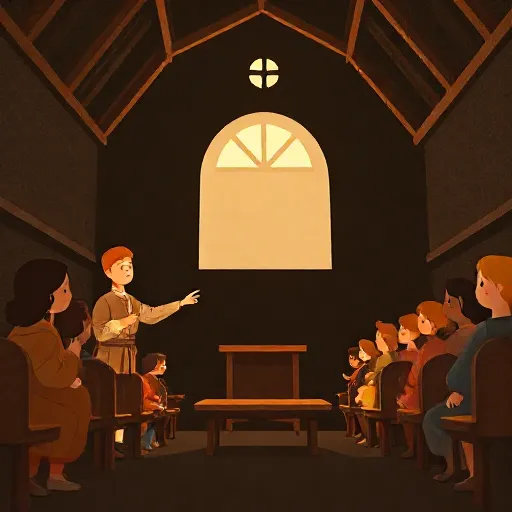
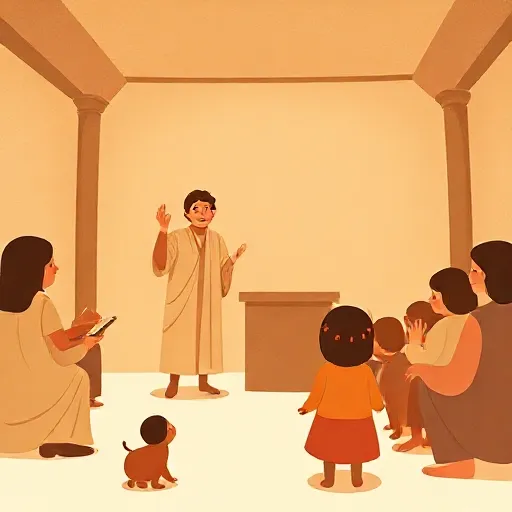
Sometime in the late 500s CE, a classroom in Alexandria fell silent. A teacher stood up to speak, not about grammar or history, but about the kind of knowledge that grabs hold of you and won’t let go. One student — we don’t know their name — sat ready with a stylus and a wax tablet, because these lectures were going to be written down “from the voice” of the speaker. That student would take notes, and later the notes would be copied, shared, and saved.
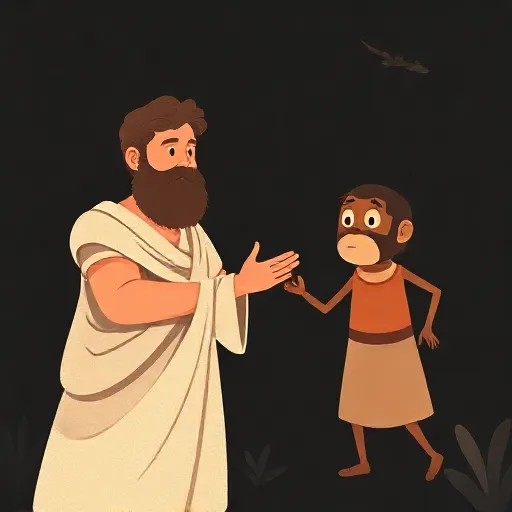
The teacher’s first words were startling. He said that anyone who tastes philosophy’s pleasure even with their fingertips, having left behind all of life’s ordinary concerns, is pulled into it by a kind of beautiful madness. Their souls catch fire with a love for understanding how things really are. According to the teacher, philosophy was nothing less than the knowledge of everything that exists — and studying it was the most important fight a person could ever join.
The two surviving texts from those lectures are an Introduction to Philosophy (the Prolegomena) and a commentary on a famous work by the philosopher Porphyry (c. 234–305). In them, the speaker refers four times to a teacher named Olympiodorus (c. 495–570), the head of the philosophy school at Alexandria. That makes it very likely the lectures were given by one of Olympiodorus’s own students. In many manuscripts, this mysterious figure is called “David.” But was that really his name? The truth is far stranger than a simple label.
Three Names, One Mystery

If you found a stack of anonymous notes in an old library, you might look for clues to guess who wrote them. When modern scholars examined the ancient Greek manuscripts of these lectures, they found serious confusion. No early manuscript names the author as David at all. The oldest copies, from the 11th century onward, are either anonymous or give the name “Elias” — another philosopher of the same school. A few manuscripts attribute the texts to a saint named David of Thessaloniki (who died around 530), or to a 10th-century scholar who used the monastic name David. Only manuscripts from the 14th and 16th centuries finally say the author is simply “David.” By then, the name could easily be a later guess, added to give the work authority.
If “David” is not the real name, who was? One strong candidate is indeed Elias, a philosopher who also wrote an Introduction to Philosophy, closely related in style. In fact, another commentary on Aristotle’s Categories says it is by “David,” but its style fits Elias much better. So perhaps the same person wrote under both names, or later scribes mixed them up.
Then there is an entirely different tradition. An Armenian translation of a simplified version of the Introduction was attributed to “David the Invincible,” a 5th-century Armenian theologian. That idea is historically impossible — the lectures are clearly from a 6th-century Alexandrian school — yet it shows how easily names can migrate and multiply. One teacher produced the lectures, but three different identities cling to them like mismatched labels on an ancient jar.
A Pagan Teacher in a Christian Classroom

What makes the puzzle even more intriguing is what the lectures actually say. Egypt in the 500s was officially Christian, and yet the works of “David” contain not a single Christian idea. Instead they are soaked in the old pagan philosophy of Greece. The teacher tells his students that the world is eternal, the soul immortal, and the stars and planets are divine beings. He speaks of irrational avenging spirits and nymphs who live for ages. He quotes the pagan poet Homer and insists that the highest goal is to “assimilate to god.” At one point he claims that “the complete philosopher is similar to god because he is characterized by the same things as god, in particular universal knowledge.”
This is surprising if the school was operating under Christian rulers, but not impossible. Olympiodorus, the teacher’s own mentor, was an open pagan who held the philosophy chair in Alexandria for over thirty years. Philosophy schools in late antiquity sometimes kept the old Platonic curriculum alive even as the world outside changed. So the speaker could have been a pagan like his teacher, wearing no disguise except, perhaps, a name that was easier for Christian scribes to accept. Some scholars think the lectures began as unsigned notes and only later gained a safe, Christian-looking name — “David” — precisely so they could survive. But we will probably never know what the teacher himself believed.
Why the Name Still Matters

You might wonder: does it really matter if we can’t pin a name on this person? Yes, and for a wonderful reason. The detective work that goes into recovering an author’s identity is a perfect lesson in how we know anything about the past. Historians of philosophy compare writing styles, trace manuscript families, check references to other thinkers, and weigh the possibility of later forgeries or mix-ups. They accept that some questions stay open, because the evidence is just not enough.
But there is another reason the name matters less than you might think. Even without a secure author, the teacher’s ideas are alive. Like many earlier philosophers, he believed that before you could do philosophy, you had to understand five basic kinds of things: genus, species, differentia, essential attribute, and accidental attribute. (For example, “animal” is a genus, “human” a species, and “rational” the differentia that sets humans apart.) These concepts, borrowed from Porphyry, became the building blocks of logical thinking for centuries — and they still appear in any careful argument today.
Most of all, the teacher’s passion shines through the crumbled papyrus. He ended his lectures by saying that philosophy “adorns human souls and transfers the soul from the dim corporeality of this life to what is divine and immaterial.” That sort of language is not about textbooks and quizzes; it is an invitation to love something with your whole mind. The lessons are not less powerful because their author’s name has drifted into fog. In fact, they show us that ideas can outlast names, and that a voice — even one we cannot firmly label — can pull a curious 12-year-old, or anybody, toward that same beautiful madness.
Think about it
- If you wrote an incredible story but your name got erased and someone else’s was written on the cover, would it still be your story? What if all the words stayed the same?
- Imagine you are an ancient librarian holding three different copies of the same lecture notes, each with a different author’s name. How would you decide which name is right, and would it be fair to invent a new one?
- The teacher described philosophy as a kind of beautiful insanity that makes you forget everyday life. Is there something you love doing that feels that way? Could that feeling be a guide to what matters most to you?