Why a Simple Question About Sets Nearly Broke Mathematics
The Barber Who Shaved a Riddle

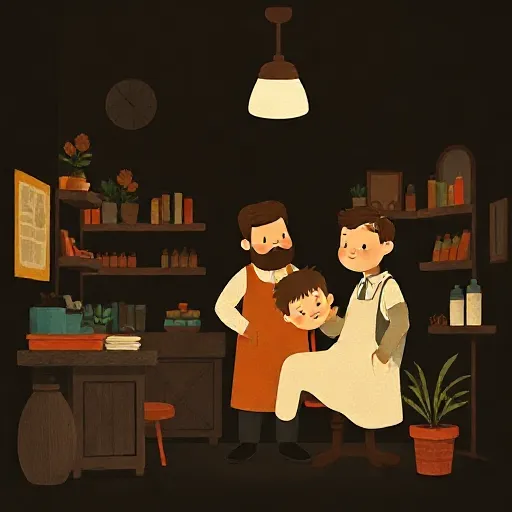
Imagine a small village with a single barber. The barber puts up a sign: “I shave all and only those men who do not shave themselves.” So if a man does not shave himself, the barber shaves him. If the man already shaves himself, the barber leaves him alone. So far, so good. But then someone asks the tricky question: Who shaves the barber? If the barber shaves himself, then according to his own rule he must not shave himself (since he only shaves men who do not shave themselves). If he does not shave himself, then the rule says the barber must shave him. Either way, a contradiction explodes. The rule cannot be followed consistently.
In the early 1900s, mathematicians discovered that a very similar riddle was hiding inside the very foundations of mathematics. The puzzle did not involve barbers — it involved sets, the most basic tool for building numbers, shapes, and functions. And the discovery shook mathematicians to their core.
Collections Without Limits: The Dream That Crumbled

A set is just a collection of distinct objects — your pencil case contains a set of pens; the list of your classmates forms a set. In the late 19th century, the mathematician Georg Cantor (1845–1918) began treating sets themselves as mathematical objects you can study. He asked: can you have sets of numbers, sets of sets, even infinite sets? His work created a whole new language for mathematics. The natural assumption that made all this possible was what we now call the Comprehension Principle: for any property you can describe, there is a set of all things that have that property. Want the set of all red apples? Done. The set of all prime numbers? Done. The set of all sets? Sure.
But in 1901, the philosopher Bertrand Russell (1872–1970) noticed that this principle leads straight to a paradox. Consider the set R of all sets that do not contain themselves. Does R contain itself? If it does, then by definition it does not. If it does not, then by definition it must. Either answer leads to a contradiction — just like the barber who shaves only those who don’t shave themselves. This became known as Russell’s Paradox. The Comprehension Principle was the source of the trouble: it lets you form a set that logically cannot exist without breaking the whole system.
The German mathematician Gottlob Frege (1848–1925) had just finished a massive book trying to build arithmetic on the idea that every concept has an extension (a set). Russell wrote to him, pointing out the paradox. Frege was devastated; he famously said that a foundation of his work had been shaken after it was finished. If something as simple as “the set of all sets that don’t belong to themselves” could cause a contradiction, then the whole enterprise of using sets to underpin mathematics was in danger.
Zermelo’s Fence: How to Build Sets Safely
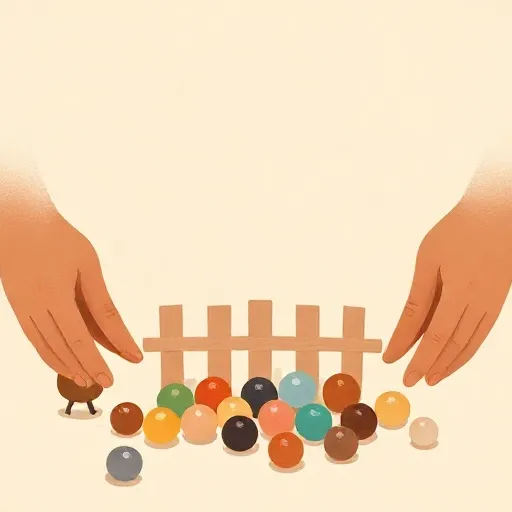
The challenge was enormous: you needed a new rulebook for sets that would avoid all known paradoxes while still allowing all the mathematics that Cantor and others had built. In 1908, Ernst Zermelo (1871–1953) proposed just such a rulebook — an axiomatic system. An axiom is a starting statement you accept without proof, like a rule of a game, and then you see what you can build from it.
Zermelo began by imagining a domain 𝔅 of “objects,” some of which are sets. The fundamental relation between them is membership: an object a can be an element of a set b, written a ε b. He then listed seven axioms that describe what sets exist and how they behave.
The most important for avoiding paradoxes was the Separation Axiom (Aussonderungsaxiom). It says: given any set a you already have, and any “definite” property, you can separate out just those elements of a that satisfy the property to form a new set. Crucially, you cannot start from nothing — you can only carve a new set out of an existing one. This prevents you from forming the monstrous set of all sets that don’t contain themselves in the first place, because there is no universal set from which to separate it. Zermelo even proved that no set contains all objects; the domain itself cannot be a set. Russell’s paradox is blocked because the Comprehension Principle, which let you conjure a set from any property, is replaced by this restricted principle.
Other axioms filled in the needed collections. The Axiom of Elementary Sets guarantees the empty set (a set with no members) and the ability to form singletons and unordered pairs. The Power Set Axiom says the collection of all subsets of a set is itself a set. The Union Axiom lets you collect together the members of the members of a set. The Axiom of Infinity asserts that an infinite set exists, containing the empty set and, for each set it contains, the set formed by putting that set into a singleton. And the Axiom of Extensionality says that sets are determined solely by their elements — if two sets have the same members, they are the same set. These axioms together allowed mathematicians to reconstruct most of ordinary number systems and functions without falling into paradox.
The Great Choice Debate: Can You Pick Without a Rule?
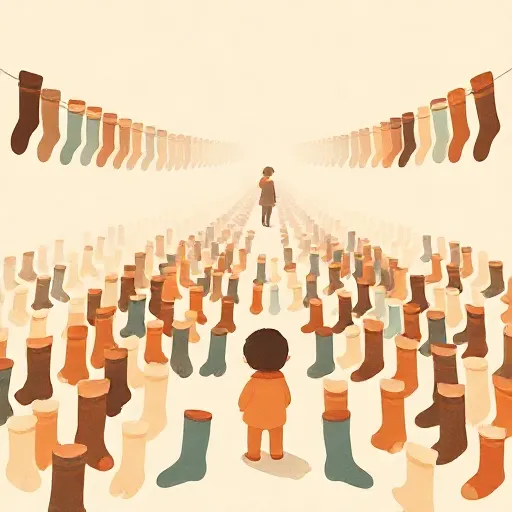
But a further storm was brewing. Zermelo’s sixth axiom was the Axiom of Choice, and it became one of the most contested ideas in the history of mathematics. The problem arose from the ancient hope of being able to well-order any set — to arrange its elements in a sequence so that every non-empty subset has a first element. Georg Cantor believed that every set could be well-ordered, calling it a “law of thought,” but no one could prove it. For infinite sets, the task seemed impossible without some extra power.
Zermelo showed in 1904 that if you allow one new logical move, the Well-Ordering Theorem follows. That move is the Axiom of Choice: given any collection of non-empty sets that have no elements in common, there exists a “choice set” that contains exactly one element from each of those sets. In his proof, Zermelo used a choice function that picks a distinguished element from each non-empty subset of a given set. By carefully linking these choices, he could define a well-ordering of the whole set.
Many mathematicians objected fiercely. The French mathematician Émile Borel argued that Zermelo had not given a rule or a law for making the choices — the selected elements were not “defined.” How can you claim a set exists if you cannot describe how to pick its members? Others worried that the proof used impredicative definitions (definitions that refer to the very thing being defined), which some believed were vicious circles responsible for the paradoxes. Zermelo replied that, like Euclid’s parallel postulate in geometry, the Axiom of Choice was necessary to prove results that mathematicians wanted, including the theorem that every set can be well-ordered and, with it, a proper theory of infinite cardinal numbers (the sizes of sets). He listed seven important problems that could not be solved without it. Over time, the pragmatic attitude won out: if you want to do certain parts of mathematics, you must accept the axiom. Still, the debate over what it means to “exist” in mathematics never fully disappeared.
Finishing the Toolbox: Ordinals and Replacement

Zermelo’s 1908 system was a brilliant start, but it still had gaps. It was not immediately clear how to represent ordinary mathematical objects like ordered pairs, relations, and functions purely in terms of sets. And it turned out that without an extra axiom, Zermelo’s theory could not guarantee the existence of sets with very large infinite sizes, such as ℵω (the next infinite cardinal after all the ℵn for finite n).
In the 1920s, Abraham Fraenkel and Thoralf Skolem independently proposed the Axiom of Replacement: if you have a set a and a functional “rule” that associates each element of a with exactly one object, then the collection of those associated objects is also a set. This allows you to build vastly larger sets step by step.
Meanwhile, mathematician Kazimierz Kuratowski showed how to define ordered pairs and relations using only the membership relation ε. An ordered pair (a,b) can be represented as the set {{a}, {a,b}}. This reduction meant that Zermelo’s simple language of sets could express all of the functions and relations that mathematics needed.
The final piece was a proper definition of ordinal numbers — numbers that represent order types, essential for counting “first, second, third…” into the infinite. John von Neumann (1903–1957) gave a definition in the early 1920s: an ordinal is a set that is well-ordered by membership and that contains all the ordinals that come before it. So 0 is the empty set, 1 is {0}, 2 is {0,1}, and the first infinite ordinal ω is {0,1,2,…}. These ordinals “mirror” the well-ordering of any set. Crucially, the Replacement Axiom was what allowed von Neumann to prove that every well-ordered set is isomorphic to exactly one ordinal — the result Cantor had dreamed of. With ordinals in hand, the system could generate the entire scale of infinite cardinal numbers (the alephs) and support the transfinite arithmetic that Cantor had pioneered. The combined theory is known as ZFC — Zermelo–Fraenkel set theory with the Axiom of Choice.
Why This Still Matters in Your Math Class
The story of set theory is not just a dusty historical episode. It is the reason your math textbook can talk about real numbers, functions, limits, and infinite series without collapsing into nonsense. When you solve an equation, you are relying on the fact that the real numbers can be built as sets from simpler ones, all the way down to the empty set. The paradoxes forced mathematicians to be exquisitely careful about what counts as a legitimate collection, and that carefulness protects the whole edifice.
The debate over the Axiom of Choice is still alive. Some modern mathematicians explore what happens if you deny the axiom, revealing strange alternative mathematical worlds. The Choice principle has consequences that feel deeply weird, like the Banach–Tarski theorem, which says you can take a solid ball, break it into a finite number of pieces, and reassemble them into two balls identical to the original — a result that challenges our intuition about volume. These puzzles show that mathematics is not just about obvious truths; it’s about building consistent systems that sometimes surprise us.
So the next time you use a number, draw a graph, or wonder about infinity, you are standing on the shoulders of Zermelo, Russell, and a whole generation of thinkers who learned to build sets with fences, not with wild promises. And the fight they started — about what exists if we can’t see it, and what it means to make a choice without a rule — is still not settled.
Think about it
- If you can define a set only by saying which objects belong to it, does a set exist before anyone lists its members? Why or why not?
- Is it fair to call a mathematical object “real” if there is no rule or algorithm that can ever completely describe it?
- If a rule for sets leads to a contradiction, should we change the rule or change the objects we allow ourselves to talk about? Who gets to decide?