
Can a Set Contain Itself? The Paradox That Shook Mathematics
A Barber’s Impossible Task

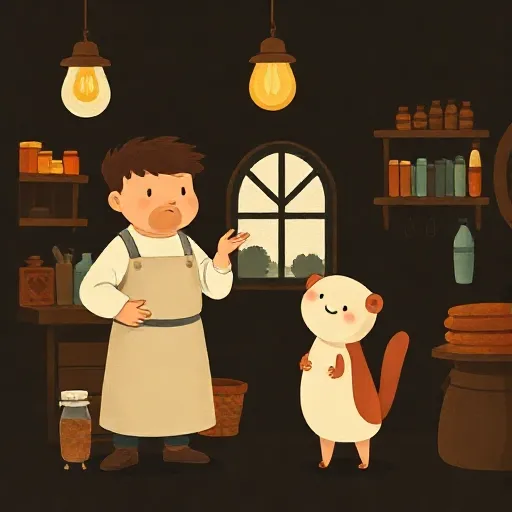
Imagine a small village with one barber. The barber shaves every man in the village who does not shave himself, and he shaves only those men. So far, so rule‑like. But then you ask: does the barber shave himself? If he does, then by his rule he shouldn’t — he only shaves men who do not shave themselves. If he doesn’t shave himself, then he must be shaved by the barber — but that’s him — so he must shave himself. Both answers lead to a contradiction. The rule sounds harmless, but it creates an impossible situation. No such barber can exist.
Now replace “man in the village” with “set,” and replace “shaves” with “contains.” A set is just a collection of things — like the set of all teacups or the set of prime numbers. In the late 1800s, mathematicians believed that for any clear description you could form the set of all things that fit it. This idea is called the naïve comprehension principle. It seems obvious: if you can describe it, you can collect it. But in 1901, a young logician named Bertrand Russell (1872–1970) realized that one particular description produces a barber‑style explosion at the heart of mathematics.
From “Any Rule” to a Contradiction

The naïve comprehension principle says: for any property you can state, there exists a set containing exactly those things that have that property. So you can have the set of all red objects, the set of all numbers, even the set of nothing — the empty set. What about the property “is not a member of itself”? Most sets don’t contain themselves. The set of teacups isn’t a teacup, so it doesn’t contain itself. But maybe some unusual sets could. A set of all sets would seem to contain itself, since it’s a set. Now collect all the sets that are not members of themselves. Call this set R.
Now ask: is R a member of itself? If R is in R, then by the condition “not a member of itself,” R must not be in R. If R is not in R, then it satisfies the condition, so it must be in R. In just a few steps, you get a flat contradiction. The innocent‑looking rule — “for any description, there is a set” — produces a logical loop that cannot be true or false without breaking both options.
Russell wasn’t the first to stumble on a paradox about large collections. Georg Cantor (1845–1918), who created much of set theory, had already noticed that some collections, like the collection of all ordinal numbers, were too vast to be treated as ordinary sets. But Cantor’s paradoxes involved fairly advanced ideas. Russell’s paradox uses only the most basic concept — membership — and the simplest description: “does not belong to itself.” It didn’t need cardinals or ordinals, just the pure notion of a set. That’s what made it so devastating.
“Dear Frege, I Found a Problem”

Russell wrote to the German philosopher and mathematician Gottlob Frege (1848–1925) on June 16, 1902. Frege was about to publish the second volume of his life’s work, Grundgesetze der Arithmetik (“Basic Laws of Arithmetic”). He believed he had shown that arithmetic could be built safely from logic alone, using a law that linked concepts to their extensions — collections of objects falling under those concepts. That law, Basic Law V, essentially guaranteed the naïve comprehension principle: every well‑defined concept gave you a set. Frege’s system was his answer to “what are numbers, really?”
Russell’s letter was courteous but blunt. He pointed out that the concept “set of all sets that are not members of themselves” produced a contradiction. As Russell wrote, “under certain circumstances a definable set does not form a whole.” Frege saw immediately that his Basic Law V was false. He added a hasty appendix to his book, admitting the crisis. Russell later described Frege’s reaction: “His entire life’s work was on the verge of completion… and upon finding that his fundamental assumption was in error, he responded with intellectual pleasure clearly submerging any feelings of personal disappointment.” Frege’s dream of reducing mathematics to a flawless logic was shattered — but his honesty set a standard for how to respond to a proof that your whole project is wrong.
Building Walls Around the Paradox
If you can’t freely form sets from any description, what can you do? Mathematicians began building careful axioms — precise rules stating when a set exists. The German mathematician Ernst Zermelo (1871–1953) proposed a key principle in 1908: the axiom of separation. It says that if you already have a set A, you can form the set of all elements of A that satisfy some condition. But you can’t just grab all objects from nowhere. To get something like R, you would need a pre‑existing set that contains everything, and in Zermelo’s system, no such “universal set” exists. The contradiction only shows that the universal set is not a set at all.
Later, John von Neumann (1903–1957) introduced a distinction between sets and proper classes. Sets can be members of other classes; proper classes cannot. The collection of all sets that don’t contain themselves turns out to be a proper class — not a member of anything. So R cannot be asked whether it belongs to itself, and the paradox dissolves. In other approaches, like the one proposed by Russell himself, all statements are arranged into types — levels that forbid a set from containing sets of its own level. The vicious circle is blocked by the very grammar of the system. Each solution creates a safe, gated community for sets, where the old free‑for‑all has become a carefully regulated town.
Why It Still Matters

You might wonder: why should I care about a puzzle from 1902? Because modern mathematics sits on top of set theory. Numbers, functions, shapes — all can be defined as sets. If the rules for sets were sloppy, the whole building could shake. Russell’s paradox forced mathematicians to be explicit about what counts as a set, producing the axiomatic systems we use today, like ZFC set theory. That precision gave us the tools to prove astonishing results — about infinity, computation, and the limits of what can be known — without landing in contradiction.
The paradox also teaches a broader lesson about definitions. Whenever you propose a rule that can apply to itself, watch out. “The list of all lists on this page that do not include themselves” is a linguistic trap, just like the barber. If the list should be on the page, you get a contradiction; if it shouldn’t, maybe it should. The fact that some collections are too big, or too self‑referential, to be treated as ordinary objects isn’t just a mathematical curiosity — it’s a warning that even the simplest‑seeming descriptions can hide loops. Russell’s paradox reminds us that clear thinking sometimes means building walls, drawing careful boundaries, and accepting that not every phrase we can say describes a genuine thing.
Think about it
- If you tried to write a list of all the lists you have ever made, would that list be on the list? Why is that question trickier than it sounds?
- Can you think of a rule that, if you apply it to itself, leads to a contradiction? (For example, “Only people who never make rules may make this rule.”)
- Why do you think mathematicians decided to restrict how sets are formed instead of giving up on sets altogether? What would happen if we had no such restrictions?