Can You Really Add 2+3? The Philosopher Who Said No.
What If You Couldn’t Mix 2 and 3?
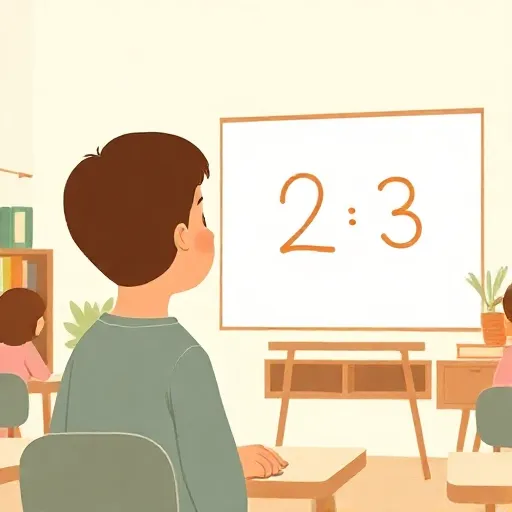
Picture this: You’re at your desk, adding 2 + 3. Easy, right? But what if the numbers 2 and 3 were like perfect crystal blocks that could never touch? Around 350 BCE, the philosopher Xenocrates (c. 396–314 BCE) believed something very close to that. He was the head of Plato’s famous Academy, and his strange ideas about numbers sparked a furious debate with Aristotle, one of the greatest thinkers ever. At the center of the fight: can you really do basic arithmetic with numbers that refuse to be mixed?
The Academy After Plato: A Three-Way Tug-of-War
When Plato died, his Academy didn’t stay united. Three big thinkers each took numbers in a different direction. Plato (c. 428–348 BCE) had taught that there are two kinds of reality: the world we see and touch, and an invisible world of perfect Forms — ideal versions of things like beauty, justice, and even numbers. For Plato, the Form of 2 and the Form of 3 were real, unchanging, and separate from the ordinary numbers mathematicians use every day. Those ordinary numbers he called mathematical numbers.
Plato’s nephew Speusippus (c. 410–339 BCE) then led the Academy. He tossed the Forms out completely. In his view, only mathematical numbers existed — no perfect, untouchable numbers behind them. Then Xenocrates took over. He said Speusippus was wrong to reject Forms, but Plato was too complicated. Why have both Form-Numbers and mathematical numbers? Xenocrates merged them: Form-Numbers and mathematical numbers are the same thing.
Aristotle (384–322 BCE) told this story carefully. He wrote that Plato kept the two classes apart, Speusippus admitted only mathematical ones, and Xenocrates put Forms and mathematical objects into a single class. It was like three collectors: one owns both real gold coins and play coins, one owns only play coins, and the third insists all your coins are real gold. Xenocrates’ move was bold — but it opened a huge problem.
Why You Can’t Mix Form-Numbers: Aristotle’s Attack

The problem was all about units. Think of the number 5 as a pile of five equally sized pebbles. To add 2 and 3, you just push a pile of two pebbles and a pile of three pebbles together. In ordinary math, the pebbles are all the same — you can mix them freely.
But Xenocrates’ Form-Numbers worked differently. Each Form-Number is made of a special kind of unit, and the units inside one number can never combine with units from any other. So the two units that make up the Form-Number 2 are unique, and the three units that make up the Form-Number 3 are totally different. You can’t pour them into one pile to make 5 — they repel each other like two magnet cages.
Aristotle hammered this point: if you can’t add units, you destroy mathematical number. Arithmetic becomes impossible. He complained over and over that Xenocrates’ system “makes doing mathematics impossible” and that he ends up “destroying mathematical number.” Some modern scholars guess that Xenocrates might have pictured addition as a kind of map — start at Form-Number 2, step forward three places in the series, and you land at Form-Number 5, so 2 + 3 = 5 is just a description of that movement, not a real merging. Others think he might have appealed to a mysterious “participation” between numbers to make operations work. But we have no direct evidence; we only know Aristotle thought Xenocrates was not explaining addition — he was explaining it away.
And the trouble didn’t stop with numbers. Xenocrates also believed in indivisible lines: tiny line-segments that can’t be cut into smaller parts. If a line is made of such unbreakable bits, then not every magnitude can be divided, which upsets geometry. Once again, Aristotle objected that Xenocrates was twisting the basic rules of mathematics to fit his metaphysical system rather than letting math guide its own principles.
The Soul as a Self-Moving Number
Numbers weren’t just weird objects for Xenocrates — they were the glue of the whole universe. He famously defined the soul as “a self-moving number.” To make sense of that, he turned to Plato’s dialogue Timaeus, which describes how the world and souls were made.
According to later reports, Xenocrates imagined the soul’s creation in two stages. In the first, Number itself is born from the mixing of two ultimate principles: the One (indivisible, like a point) and the Indefinite Dyad (endlessly divisible, like a line that can keep splitting). That mixture is then combined with the principles of Sameness (which gives rest and stability) and Difference (which gives motion and change). The result is a number that can move on its own — exactly what a soul needs to know things and to act.
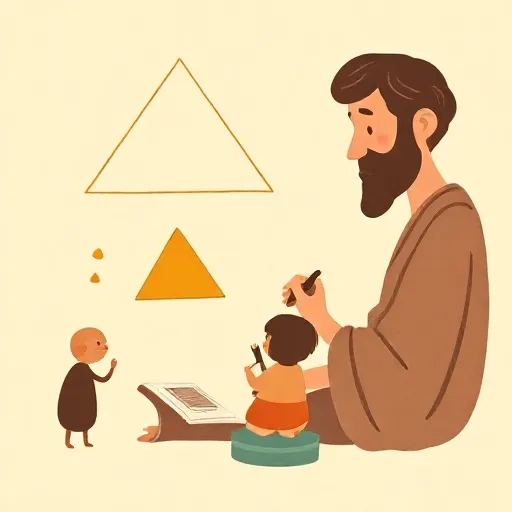
This weird formula helped Xenocrates connect everything into one continuous ladder. Unlike Speusippus, whose universe had separate, disjointed levels each with its own principles, Xenocrates used just his two first principles to unfold numbers, geometrical shapes, heavenly bodies, daimones (spirit beings between gods and humans), and finally perceptible things. One ancient reporter even noted that Xenocrates placed gods, daimones, and humans into different types of triangles: equilateral for gods, isosceles for daimones, scalene for humans. It’s a mind-bending picture, but it shows how seriously he took the idea that numbers and shapes structure reality from top to bottom.
Why This Ancient Puzzle Still Matters

Xenocrates’ story might sound like dusty history, but the question he raised is still alive. Every time you do math, you’re wading into deep water: are you discovering facts about an independent realm of numbers, or just playing with rules that humans made up? Xenocrates thought numbers are as real as rocks, built into the fabric of existence. If that’s true, then when you add 2 and 3, you’re tapping into an unchangeable cosmic structure.
But his struggle also reveals a tension. If numbers are too perfect — if their units can never mingle — then math stops working the way we expect. The price of making numbers wonderfully real might be making them unusable. And if an entire universe can be unfolded from a One and a Dyad, as Xenocrates believed, then math isn’t just a tool for scientists; it’s the secret code of everything, including souls, minds, and maybe even happiness (he thought a happy person has a good soul, and your soul is your own personal daimon).
The fight between Xenocrates and Aristotle wasn’t just about ancient arithmetic. It was about whether the world of ideas can be measured, mixed, and understood on our terms — or whether some things really are untouchable. Next time you solve an equation, you’re standing in the footprints of that old argument.
Think about it
- If every number were a perfect, unchanging object that can’t be split, could you still count apples? Why or why not?
- Imagine you have two sets of building blocks that can never interlock. Could you ever build a tower of five blocks? What does that tell you about Xenocrates’ mathematics?
- Xenocrates thought the universe is made of numbers all the way down, even souls and gods. Do you think numbers are real, or just a human invention? What could prove it one way or the other?