
The Quiet Number-Cruncher Who Defended Darwin with a New Philosophy
A dangerous book lands in a quiet study

In 1859, Charles Darwin (1809–1882) published a book that felt like an earthquake. On the Origin of Species claimed that all the strange and beautiful forms of life on Earth had arisen not by divine design, but by a slow, blind process he called natural selection. Many religious leaders and even some scientists were furious. Amid the uproar, a shy, gentle man in Cambridge, Massachusetts, began to write essays defending the new theory. His name was Chauncey Wright (1830–1875).
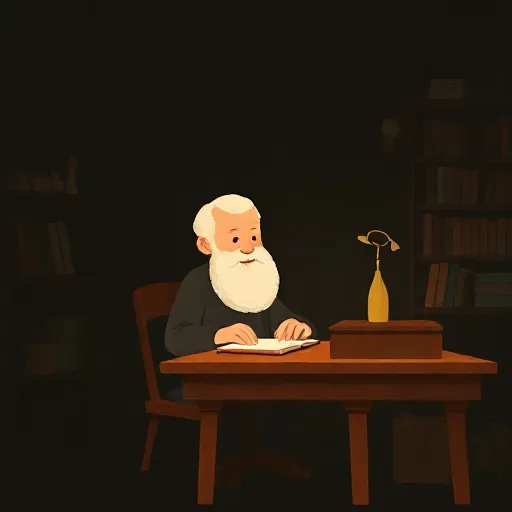
Wright did not look like a fighter. He worked as a “computer” for the Nautical Almanac — spending three months a year doing endless calculations so he could spend the other nine reading, thinking, and talking about science. He was so kind that neighborhood children loved to play with him. But when it came to ideas, he was relentless. He believed that Darwin’s theory was not only correct, but that it was a perfect example of what real science should look like. To show why, Wright first had to explain what makes any scientific idea trustworthy in the first place.
The golden rule of science: verification
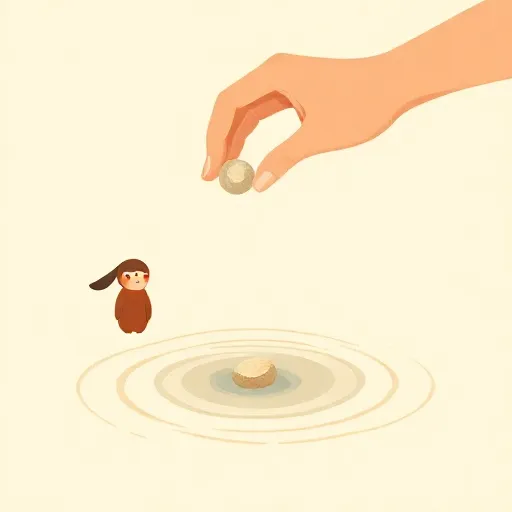
Wright had a clear answer to what gives a belief the right to be called knowledge: verification. The only evidence every honest person can agree on, he argued, is what our senses deliver — what we can see, hear, touch, and measure together. If a claim cannot be checked against shared sense experience, there is no way to settle disagreements about it.
This does not mean that scientists must never talk about things they cannot see directly. Molecules, light waves, and gravity are not visible to the naked eye. Wright fully accepted that science needed unobservables — hidden structures or forces — to make sense of what we do observe. What mattered was that those hidden things had to be linked to real phenomena in a way that produced testable consequences. Newton’s theory of gravity, for example, could never be verified by holding gravity in your hand. But it could be verified indirectly, because it made precise predictions about the movements of planets and falling objects that anyone with a telescope or a measuring tape could check.
Wright drew a sharp line between this sort of induction — reasoning from evidence gathered through the senses — and the kind of thinking he saw in much of philosophy and theology. Philosophers sometimes claimed that pure reason or an inner feeling gave them knowledge that was just as solid as what a physicist gets from an experiment. Wright disagreed. Those inner sources might produce strong beliefs, he said, but they could never produce the lasting, shared conviction that real knowledge requires. Unlike later thinkers, he never tried to reduce all theoretical language to statements about sensations. He simply insisted that, in the end, a scientific theory stands or falls on its verifiable predictions.
What kind of explanation is natural selection?

When Wright read Darwin, he saw something that many critics missed. Natural selection is not a mysterious force that pushes species to change. Wright described it as a “mode of operation” — a way of describing how several different kinds of causes work together over long stretches of time.
He broke the process into three distinct classes of causes. First, there are the external conditions an organism faces: climate, food, predators, competition with other living things. Second, there are the universal physical laws — the principles of mechanics, optics, and acoustics that determine what a wing, an eye, or an ear can actually do. Third, there are the little-understood phenomena of variation and inheritance, the fact that offspring are never exactly like their parents, and that some differences get passed on.
Natural selection itself, Wright said, is not another cause added to that list. It is a descriptive principle — a pattern that emerges when those three layers of causes interact. The pattern is organized around utility: the usefulness of a trait for survival. A feature of an organism, like the ability to see color, serves a function in the whole life of the creature. Wright urged scientists not to get stuck arguing about exactly which use a feature originally served. What mattered was that natural selection gave biologists a template for explaining how countless tiny adjustments, filtered by usefulness, could build the living world.
This put him in direct conflict with Herbert Spencer (1820–1903), a hugely popular thinker who treated evolution as a cosmic law that drove everything from stars to civilizations toward a higher state. Wright called that idea unscientific: a grand story the human mind finds satisfying, not a conclusion tested by evidence. Real natural selection, he insisted, is limited and modest. It explains the shape of a finch’s beak, not the destiny of the universe.
The cosmos without a purpose
Wright’s defense of Darwin was part of a larger argument against what was called natural theology — the attempt to prove the existence of God by pointing to the order and beauty of nature. He believed that project failed on scientific grounds.
Look at the universe through a telescope, Wright said, and you do not find an obvious story with a beginning and a happy ending. The best evidence, in his day, suggested that change in the heavens looked more like weather than like a planned journey: endless cycles of heating and cooling, attraction and dispersion, with no clear first cause and no detectable final purpose. He called this the principle of counter-movements — an eternal back-and-forth of forces like gravitation and heat, observed in geology and meteorology as much as in the birth and death of stars. He knew the new laws of thermodynamics seemed to point toward a universe that would eventually run down, but he thought the picture was too narrow and the evidence not yet decisive.
More fundamentally, Wright argued that no amount of scientific investigation could ever pick out a “final cause” — an ultimate purpose — in nature. If every cause is also an effect of something else, by what test could you ever prove that this particular arrangement is the goal toward which everything was aimed? A person might believe on faith that the universe has a divine architect. But Wright insisted that such a belief cannot be extracted from the data of sense experience. Science, he thought, must remain neutral toward all such cosmic stories, testing each theory only by the verifiable consequences it predicts.
The conversations that launched a new philosophy

Wright never became a famous lecturer. His power came through conversations. He took part in a series of informal discussion groups in Cambridge, where he debated with young thinkers who would go on to shape American philosophy. Among them were Charles S. Peirce, William James, and the future Supreme Court justice Oliver Wendell Holmes Jr. They all remembered Wright as a man whose mind was extraordinarily sharp and completely free from the desire to win for the sake of winning. James later said of him, “Never in a human head was contemplation more separated from desire.”
What Wright gave those younger friends was a vivid example of how to think about science without falling into old traps. His rule of verification, his refusal to reduce everything to a single kind of cause, and his treatment of signs and language — especially his idea that a scientific concept’s value lies in the effects it picks out — all pointed toward what became known as pragmatism. That philosophy, developed most famously by Peirce and James, says that the meaning of an idea is found in the practical consequences you would expect if it were true.
Wright did not build a full system. But by showing how Darwin’s theory could be understood as a genuine piece of science — not a guess, not a religion, not a cosmic poem — he cleared a path. Today, whenever someone asks whether a claim about the deep past or the far reaches of space counts as real science, they are asking the same kind of question Wright asked in his quiet study in 1870. The answer still depends on a simple, hard test: can the idea be made to touch the world our senses share?
Think about it
- If a scientist proposes a theory that predicts something we can never observe — like what happened before the Big Bang — can we ever call it science?
- Can a person believe in God and still insist that science should only use testable explanations drawn from sense experience?
- If natural selection is just a description of how usefulness works, and not a mysterious force, does that make evolution any less astonishing?