
Alfred North Whitehead Said Everything Is a Process. Was He Right?
From Math Genius to Rebel Philosopher
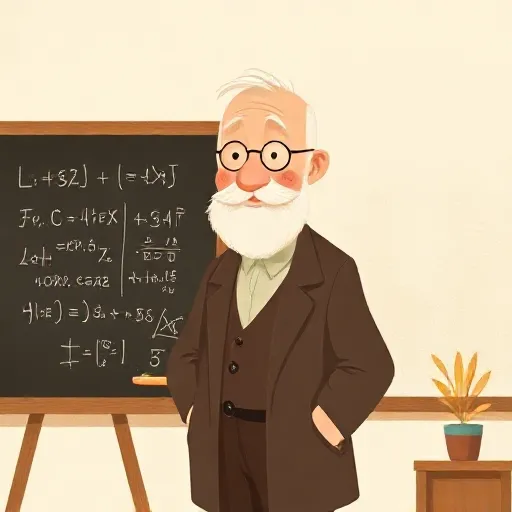
You pick up a gray stone from the ground. It sits in your palm, heavy, still, silent. A thing. But what if the stone is not a thing at all — what if it is an event? This was the startling idea of Alfred North Whitehead (1861–1947). He began his career as a mathematician at Cambridge University, where he co-wrote a massive, groundbreaking book with Bertrand Russell called Principia Mathematica. For a decade they tried to rebuild all of mathematics from pure logic. But after the death of his youngest son in World War I, Whitehead grew dissatisfied with a world described only by cold symbols and lifeless equations. He moved to Harvard in 1924 and, in his sixties, started asking the biggest questions: What is reality really made of? Why does science feel so separate from the colors, feelings, and values we actually live with? His answer would become one of the most original and controversial philosophies of the twentieth century.
Newton’s Clockwork Universe and the Split That Bothered Whitehead

To understand Whitehead’s rebellion, you have to see what he was pushing against. The physicist Isaac Newton (1643–1727) had given the world a picture of nature as a giant clockwork. Matter was made of tiny, solid particles, each with its own exact location in space and time, pushing on one another like billiard balls. This model is extremely powerful for predicting motion, but it leaves out something huge: it says the real world is colorless, soundless, and tasteless. The red you see at sunset, the warm feeling of affection, the beauty of a song — these are not really out there. They are just inside your mind. Philosophers call this the bifurcation of nature: reality gets split into two worlds. One is the objective world of particles and numbers; the other is the subjective world of sensations and values. Whitehead thought that split was a disaster. He called it the fallacy of misplaced concreteness — the mistake of treating a useful abstraction (like a mathematical particle) as if it were the concrete, full-blooded thing you actually experience. The philosopher David Hume (1711–1776) had already shown that if you limit yourself to bare sense data, you can never prove that anything causes anything else. Whitehead wanted to put the world back together.
From Electromagnetism to Interconnected Events
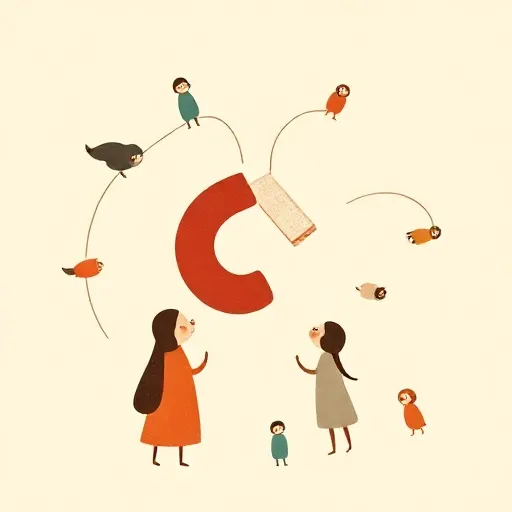
A huge clue for Whitehead came from the physics of James Clerk Maxwell (1831–1879), who discovered that electricity and magnetism are unified in a single field. An electric charge is not simply located in one spot — its influence fills all of space at once, like ripples on a pond. This meant that simple location, the idea that something is here and nowhere else in any meaningful sense, was false. Whitehead seized on that insight. If the most successful physical theories describe a world of activity and interconnection, perhaps the fundamental stuff of the universe is not inert matter but process. A waterfall is made of ever-changing water, yet we name it as one thing. In the same way, what we call objects — a stone, a table, even a human being — are really patterns of events, each event flowing out of the past and into the future. Whitehead called this process philosophy. From this point on, he would always write about “occasions” and “happenings” instead of dead clumps of stuff.
A Universe Made of Drops of Experience

Then Whitehead took a leap that made many scientists and philosophers shake their heads. He argued that the ultimate building blocks of reality are what he called actual occasions — tiny, momentary drops of experience. Yes, even a rock is composed of such drops. But don’t misunderstand: rocks do not think, and atoms do not have human emotions. Whitehead’s view is called panexperientialism, not panpsychism. It holds that every actual occasion “feels” its surroundings in a very basic way, not with a brain, but by taking in influences from the whole preceding universe. Each occasion inherits the past, but it is not completely determined by it. There is always a tiny flicker of self-creation. This is how novelty enters the world: each moment is partly shaped by what came before and partly a fresh decision of how to weave those influences together. Whitehead wrote that each actual entity is “a throb of experience.” He even included God in his system, but not as an all-powerful puppeteer. God, he said, offers each occasion a lure toward beauty and intensity without forcing it. The past conditions us, but we are never just dominoes falling.
Why This Still Matters: Ecology, Freedom, and Your Inner Life

You might wonder why an old philosopher’s strange idea about drops of experience matters when you’re trying to finish homework or worrying about the planet. But Whitehead’s vision has real consequences. His insistence that everything is deeply interconnected helped inspire later thinkers to argue that we need an ecological civilization — a way of living that sees nature not as a storehouse of dead resources, but as a living web of interrelated happenings. John Cobb, a major follower of Whitehead, has spent decades showing how process thought can reshape economics, farming, and community life. On a personal level, Whitehead’s philosophy offers a powerful kind of hope. You cannot change what the past has handed you — a bad grade, a loss, a sunny morning — but in each new moment you choose how you take it up and what you do with it. That tiny space of self-determination matters enormously. Whitehead also tried to heal the old war between science and religion. If God is not a dominating ruler but a tender persuader who feels the world’s joys and sufferings, then the problem of evil looks different, and different religious traditions can be seen as responding to different aspects of a many-sided reality. His ideas remain controversial — many philosophers still think talking about rocks feeling anything is just confusion — but his question will not go away: Is reality a collection of objects, or a flowing, feeling, interwoven happening? Your answer affects how you treat the stone in your hand, the people around you, and the world you are helping to create.
Think about it
- If a rock is made of billions of tiny “drops of experience,” does that change how you should treat a rock? Why or why not?
- Whitehead says you can choose how you respond to what happens to you, even if you can’t change the event itself. Can you think of a time when the way you reacted changed everything about a bad situation?
- Scientists often describe the world in terms of numbers and particles. Do you think their descriptions capture everything that’s real, or do things like beauty and sadness exist just as much as electrons do?