
Why Do We Ask ‘Why’? The Philosopher Who Put Cause Back into Because
The Barometer and the Storm: When Predicting Isn’t Explaining
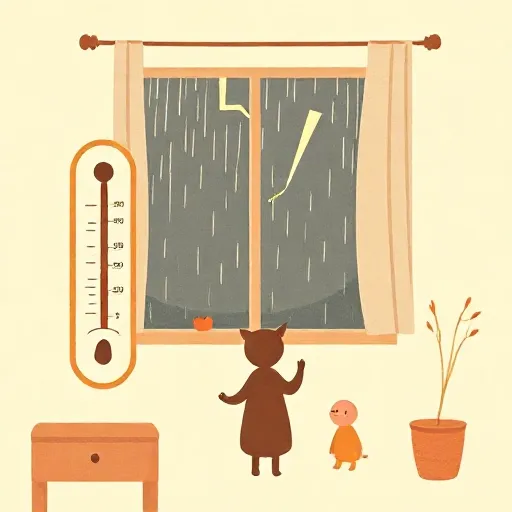
Imagine you are watching a barometer on the wall. The needle has fallen steeply. Outside, the sky darkens, and soon rain hammers the windows. You knew the storm was coming. But if someone asks you why the storm came, would you point to the barometer? Of course not. The barometer doesn’t make the storm happen. Yet for decades, the most popular theory of scientific explanation said that an explanation works almost the same way as your prediction: you explain an event by showing it follows logically from general laws and some prior conditions. This idea, called the covering law model, was defended by the philosopher Carl Hempel (1905–1997). According to Hempel, you explain the storm by deducing it from the laws of meteorology and the air‑pressure readings beforehand.
But that still feels hollow, like the barometer. Something is missing: the cause. The covering law model didn’t worry about what actually brings an event about. It treated explanation and prediction as two sides of one coin, and it demanded that the event to be explained be highly probable. That left low‑probability events — like a rare disease striking one unlucky child — unexplained, and it could not tell the difference between relevant and irrelevant facts. Wesley C. Salmon (1925–2001) thought those were fatal gaps. He set out to put the cause back into “because.”
Wesley Salmon: The Philosopher Who Wanted More Than Logic

Salmon began his career studying probability and induction under Hans Reichenbach (1891–1953), a philosopher who believed science’s main job is to predict using frequencies. But by the 1970s, working at Indiana University surrounded by scientists, Salmon grew convinced that philosophy of science had to look outward — toward real scientific practice — not just inward at logic. He saw that scientists rarely stop at saying “this event is what we expected.” They want to know how it came about, what made it happen. A good explanation, Salmon argued, doesn’t just tell you that something was likely; it reveals the causal mechanisms — the physical links and interactions — responsible for the event. As he liked to put it, we need to restore the “cause” in “because.”
This wasn’t a small tweak. It meant rejecting Hempel’s idea that an explanation is simply an argument. Salmon pointed out that irrelevant information is harmless in an argument (you can add “the sky is blue” to any premise without breaking the logic), but it ruins an explanation. If I tell you the storm occurred because the barometer dropped and someone in Tokyo ate a banana, you would immediately sense something is wrong. Explanation requires relevance — and for Salmon, the deepest relevance is causal.
Screening Off: How to Tell Real Causes from Mere Coincidences

To build a causal theory, Salmon first needed a tool to tell causal connections apart from accidental correlations. He found it in the notion of screening off, borrowed from Reichenbach. Take the barometer example. Let B stand for the barometer drop, S for the storm, and P for the sudden drop in atmospheric pressure. The barometer drop is statistically relevant to the storm: the probability of a storm given a falling barometer is higher than without it. But once you already know the pressure dropped (P), knowing about the barometer doesn’t change the probability of the storm at all. The pressure screens off the barometer from the storm. The correlation between barometer and storm is not a direct causal link; it’s entirely due to the hidden common cause — the pressure change.
Reichenbach had formalized this pattern as the principle of the common cause: when two events happen together more often than chance allows, there must be a third event, a common cause, that explains the coincidence. The structure, called a conjunctive fork, looks like a fork with one tine pointing to two effects. At a birthday party, two siblings both come down with mumps on the same day. Neither caught it from the other. The common cause is another child at the party who already had the virus. The sick child screens off the siblings’ illnesses from each other: once you know about that child, the two illnesses are independent. The fork is asymmetrical in time — it opens toward the future, never the past. Common effects do not explain their shared causes.
Salmon’s early statistical‑relevance model (or S‑R model) used screening off to build homogeneous reference classes — sets of factors that include all and only the genuinely relevant properties for an event. But he soon realized that even a complete list of statistically relevant factors, with their probabilities, isn’t yet an explanation. It’s like a wonderfully detailed phone directory: it tells you who is connected to whom, but not what is actually said along the lines. A real explanation must go further and describe the physical wires themselves — the causal processes.
The Beam of Light and the Spot on the Wall: What Makes a Causal Process?

What exactly is a causal process? Salmon thought of it as a continuous, physical entity that travels through space and time and can transmit a mark — a signal or alteration. His favourite illustration is a rotating spotlight in a dark room. The light beam that streaks from the source to the wall is a causal process. The bright spot that races around the wall is a pseudo‑process — it looks like something moving, but it’s just a pattern, not a thing in itself. If you put a red filter near the light source, the beam turns red, and the spot on the wall stays red as it moves. The red mark was carried along the beam. But if you stick a piece of red cellophane on the wall at one point, the spot turns red where the beam hits it, then immediately loses the red colour as it moves on. The spot cannot keep a mark on its own; it has no inner “stuff” to carry anything.
This mark method gave a simple test: genuine causal processes can transmit marks without further outside help. Pseudo‑processes cannot. The trasmission itself, Salmon said, is just the mark appearing at every point along the path between two places — an idea he took from Bertrand Russell’s at‑at theory of motion. To move is simply to be at the intermediate points at the intermediate times. Nothing spooky needs to be added.
Later, Salmon adopted a refinement proposed by the philosopher Phil Dowe. Instead of marks, the feature transmitted could be a conserved quantity — a physical quantity like energy, momentum, or electric charge that the laws of nature say cannot be created or destroyed in an isolated process. A causal process becomes the world line of an object that possesses and transmits a fixed amount of such a conserved quantity. This fits physics elegantly: when a photon collides with an electron in Compton scattering, energy and momentum are exchanged and then carried onward. That exchange, Salmon called an interactive fork — a point of causal production where processes intersect and change each other. Interactive forks are more basic than common‑cause forks, because they describe the actual physical encounters that generate new causal lines.
Two Levels of Explanation: The Map and the Roads

For years Salmon believed that the deepest explanation was the causal‑mechanical level: a complete space‑time diagram of all the processes and interactions involved. But a powerful criticism from Christopher Hitchcock forced a rethink. Hitchcock pointed to a blue billiard ball that gets a chalk mark from a cue stick. The ball then hits another ball, transferring its momentum. The blue mark travels with the ball; it is transmitted and counts as a mark on a causal process. Yet if you ask “why did the second ball move?”, the blue mark is utterly irrelevant. The momentum — a conserved quantity — is what does the explaining. Salmon’s original notion of mark transmission didn’t tell you which carried properties matter. You need statistical relevance information to pick out the right features. So Salmon revised his view: both levels are indispensable. Statistical relevance relations, in the absence of a connecting causal network, are like a phone directory without wires — they lack explanatory power. But a causal network without statistical relevance is like a web of glowing fibres that carries no message — you can’t tell why a particular outcome occurred rather than another.
This interplay means that explaining an event often requires tracing counterfactual dependences — “if this hadn’t happened, that wouldn’t have happened” — that are backed by observed statistical regularities. The window broke because it was struck by the baseball; had the baseball missed, the window would have been fine. That counterfactual rests on well‑known relationships between force, glass, and shattering that we’ve seen countless times.
Salmon called this overall picture the ontic conception of explanation. “Ontic” means having to do with what really exists. For Salmon, to explain a phenomenon is to show where it fits in the world’s enormous, objective causal machinery — a complete causal structure that exists independently of what anyone knows or cares about. Still, in everyday life, we never recite that entire structure. We select the parts that matter for the question at hand, depending on context. If a child asks why they are sick, we mention the virus they caught, not every subatomic collision along the way. The complete structure is there, like a continent‑sized map; a particular explanation draws a tiny, useful route across it.
Why It Still Matters: Learning to Ask “Why” Like a Detective
Salmon’s ideas remind you that asking “why?” is never just about collecting facts or noticing patterns. It’s about uncovering the hidden chains — the genuine physical links — that make the world tick. The next time you wonder why your bike chain snapped, why a friend fainted, or why a character in a story did something shocking, you are stepping into Salmon’s shoes. You look for causes, not just correlations. You want to find the low‑pressure system behind the barometer.
His work also shows why science feels so satisfying when it explains. A scientific explanation isn’t just a neat logical deduction; it’s a window into the inner gears of nature, down to the level of energy, momentum, and exchange. That longing to see the causal structure is something we all share, whether we’re investigating a broken toy or reading about black holes. Salmon gave it a name — the ontic conception — and spent his career showing that it’s both deeply rational and deeply human.
Think about it
- If you had a perfect computer that could predict exactly when you would catch a cold based only on the weather, your sleep patterns, and your past illnesses, would that count as an explanation of why you got sick? What would be missing?
- Choose a small, ordinary event from this morning — a glass slipping from your hand, a light turning on, a sound you heard. Try to explain it in terms of the causal processes that linked one moment to the next. How far back can you trace the chain before you feel you’ve really understood why it happened?
- In a video game, when your character steps on a trap and loses health, the explanation is “the code says so.” But if you wanted an explanation like Salmon’s, what would you need to talk about inside the game’s world? Could you ever get the same kind of causal story as in real life?