When "Because" Doesn't Mean Cause and Effect
A Puddle and a Statue: Two Kinds of “Because”
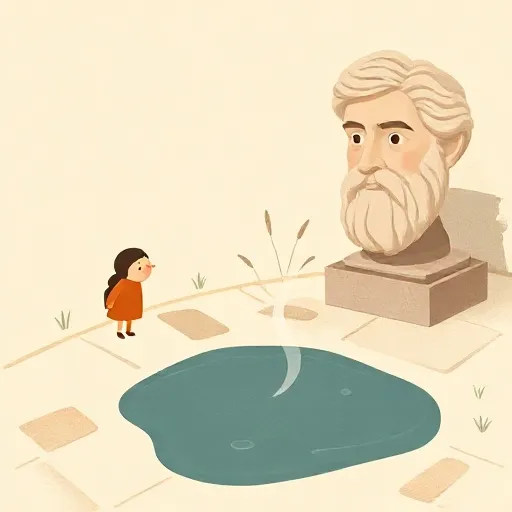
Imagine you walk into a room and see two things: a sunlit puddle on the floor and a marble bust of the philosopher Socrates. The puddle is shrinking — you can see steam rising. You ask, “Why did the puddle dry up?” Easy: the surrounding air is warm, and the water evaporated. That is a causal explanation. It tells you about a chain of physical causes over time: warmth causes evaporation.
Now you look at the bust. It has the same snub nose as the real Socrates, who lived thousands of years ago. Why does the bust share that exact feature with a man who is long dead? You can’t say the air caused it. The answer is something like: “Because both Socrates and the bust share the property of being snub-nosed — and the bust is meant to represent Socrates.” That is not a causal explanation. It is a metaphysical explanation, a “because” that does not work through pushing, pulling, or any process in time. Instead, it points to what things are or how features belong to things.
Philosophers notice that the world is full of these non-causal “because” statements. A red thing is red because it is scarlet (a specific shade of red). Something is a triangle because it has three straight sides. These are not about one event causing another. They are about a relationship that holds all at once, what philosophers call synchronic — happening “at the same time” rather than across time like a cause. The study of such explanations is a big part of contemporary metaphysics.
Grounding, Essence, and Breaking Things Down

Metaphysical explanations come in several varieties, but three stand out in recent debate: grounding, essence, and reduction.
Grounding is a way of saying that more basic facts “give rise to” or “determine” less basic facts, without any cause involved. The determinable‑determinate relation is a classic example. A scarlet apple is red because it is scarlet. Scarlet is a determinate, a specific way of being red, and red is the determinable, the more general property. The fact that the apple is scarlet makes it the case that it is red — that’s grounding. In our statue case, many philosophers would say that the resemblance between Socrates and the bust is grounded in the fact that both share the same property of snub-nosedness. The sharing of the property is more fundamental, and it gives rise to the resemblance.
Essentialist explanation works by citing what it is to be something. Aristotle (384–322 BCE) spoke of “the what it was to be” of a thing. If you ask, “Why is Socrates the individual he is?” one answer is: because he essentially has this particular human father. That fact is part of his essence — it makes Socrates the very person he is, not merely some random quality he happens to have. Unlike grounding, essential facts are often thought to be absolutely necessary: Socrates could not have been Socrates without that father, but a determinable might have been grounded in a different determinate.
Reductive explanation takes a phenomenon and “breaks it down” — showing it is really nothing more than something else. Plato (428–348 BCE) offers one: being just is nothing more than having a well-ordered soul. Such an explanation does not say that justice is caused by a well-ordered soul; it says that justice just is that. As with grounding and essence, reductive explanations are non-causal. Some philosophers think one of these types reduces to another, others treat them as distinct. For now, it’s enough to see that “because” can mean very different things.
Is the Explanation in the World or in Your Head?

Here is a puzzle. Metaphysical explanations seem to have one foot in the world — they are metaphysical, about how things are structured. Yet they also seem to have a foot in our thinking — they are explanations, something we use to make the world understandable. Can something be both fully objective and tied to our desire to understand?
Realists about metaphysical explanation lean toward the world side. They say that what explains what is a mind‑independent fact, just like the shape of a mountain. A good explanation may still need to be understandable, but its correctness comes from the world’s non-causal structure — relations like grounding or essence that exist whether or not anyone thinks about them.
Antirealists think our minds play a much bigger role. For them, a statement like “This table exists because its atoms are arranged table-wise” might be true only relative to our concepts and our capacity to grasp it. In a 2019 paper, James Norton and Luke Miller argued that metaphysical explanations are partly psychological: they depend on what agents are disposed to believe, not just on dry relations between facts.
Many philosophers land somewhere in between. They might accept that there is a real, objective relation doing the explanatory work (say, grounding), but add that what counts as an explanation also depends on context — what questions are being asked and what the questioner already understands. Just like you wouldn’t explain “red” the same way to an artist and to a five-year-old, metaphysical explanation can shift with what the explainer needs to know. This is a live debate with no settled answer.
When “Because” Acts Like a Cause (But Isn’t)

Some philosophers find it helpful to model metaphysical explanation on causal explanation — after all, we understand causes well. Jonathan Schaffer, for instance, argues that grounding is like causation, only without time. Both are forms of what he calls a “directed determination relation.” Alastair Wilson goes further and calls grounding “metaphysical causation.” On these views, a metaphysical explanation works by citing something like a cause — a metaphysical cause — that gives rise to the explained fact.
One powerful tool here is thinking in terms of counterfactuals: “What if things had been different?” If grounding is at work, then if the grounding fact had been otherwise, the grounded fact would have been otherwise too. Schaffer uses structural equation models — the same mathematical tools used in causal modeling — to represent grounding. The variables might be facts like “this apple is scarlet” and “this apple is red,” and the equation tells you that the scarlet fact determines the red fact.
Not everyone is convinced. Critics point out that grounding relations often lack the temporal order causes have; they are synchronic. Also, some metaphysical explanations — like “Socrates has this father essentially” — don’t look like anything causal at all. Trogdon’s mechanistic view, where grounding works through determination mechanisms like set‑formation or functional realization, tries to capture more of the “how” but still faces the challenge: can all metaphysical explanations fit into a quasi‑causal mold? That remains open.
Does Everything Have a Reason, or Can Some Things Just Be?

A famous idea called the Principle of Sufficient Reason claims that every fact must have an explanation. The philosopher Shamik Dasgupta has developed a modern version: all “substantive” facts — those for which it makes sense to ask “why?” — must be grounded in facts that are autonomous, meaning they do not themselves need an explanation.
But are there facts that simply do not admit of any metaphysical explanation? Some philosophers think facts about essence might be autonomous. After all, what would explain why Socrates’ essence includes his father? It might be a stopping point. Others go to the extreme and suggest that no facts are apt for metaphysical explanation, because such explanations would compete with scientific explanations and end up being superfluous. Jeff Engelhardt worries about overdetermination: if a house exists both because a builder built it (a causal explanation) and because its parts are arranged house-wise (a metaphysical grounding explanation), do we have two complete explanations fighting over the same job? His proposed solution: the builder causes the parts to be arranged, but does not directly cause the house’s existence — the grounding relation takes over. That move is clever but still debated.
This matters because if some things simply have no explanation, then the world might contain brute facts — facts that just are, without any reason why. Many philosophers find that thought disturbing, while others accept it as part of reality’s deepest structure.
Why This Still Matters: From Morality to Your Mind

You might think metaphysical explanation is only about dusty questions like properties and statues. But it pops up everywhere in your own life.
In ethics: Socrates asked Euthyphro, “Is that which is pious loved by the gods because it is pious, or is it pious because it is loved by the gods?” That question is a metaphysical explanation request — it asks what the fundamental relationship is between piety and divine love. Today, a similar question runs through metaethics: is an action wrong because it causes pain, or does it cause pain because it is wrong? The order of explanation matters.
In the philosophy of mind: why does a particular pattern of brain activity feel like pain? This is the “explanatory gap.” A grounding physicalist says the mental fact is grounded in the physical fact — just as scarlet grounds red — and that is a full metaphysical explanation. Critics respond that even if the grounding relation holds, we still don’t understand why the feel of pain goes with those neurons. The gap may be epistemic rather than metaphysical, but it shows how deeply explanatory habits shape our view of consciousness.
In social philosophy: what makes someone a woman? Some say it is occupying a subordinate social position. Immediately you face an Euthyphro‑style fork: is she a woman because she is in that position, or is she in that position because she is a woman? The direction of the “because” can make a view realist or antirealist about social kinds.
Next time you ask a “why” question about what’s right, what’s real, or who you are, listen to the answer. You may be asking for a metaphysical explanation — and that kind of “because” is doing work that no physics experiment can see.
Think about it
- If a friend says, “Lying is wrong because it just is — there’s no further reason,” do you accept that as an explanation? What would you need to hear to feel you really understood it?
- Imagine scientists build a complete copy of your brain, atom for atom. Would that copy’s feeling of sadness be explained by the atoms, or would something still be missing from the explanation?
- Could you live in a world where some facts have no reason at all — where certain things just are, and no further story exists? Would that bother you, or could you accept it?