
Are You Living in an Iron Cage?
The Professor Who Collapsed

In the autumn of 1897, a thirty-three-year-old German professor named Max Weber (1864–1920) fell apart. He had been a rising star — a brilliant law and economics scholar, a fierce political voice, the center of a lively intellectual circle in Heidelberg. Then, shortly after a bitter argument and the sudden death of his father, Weber collapsed into a nervous breakdown. For years he could not teach or write the way he used to. He would sit staring out a window, unable to work, while the world outside grew louder with factories, trains, and new empires.
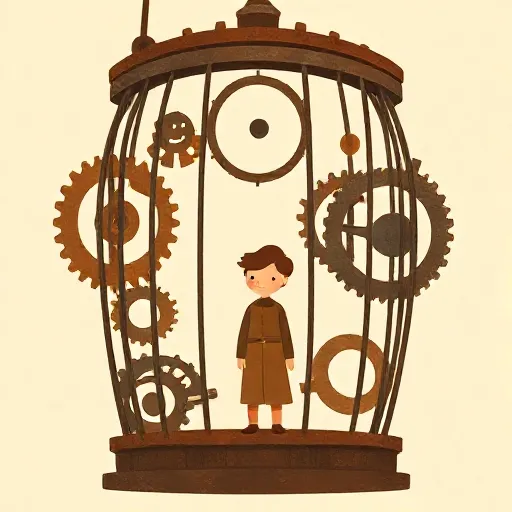
When Weber finally returned to his desk, he was a different thinker. The breakdown had not just been personal. It became part of his greatest question: what is happening to us in the modern world? All those triumphs of science, law, business, and government — were they setting people free, or were they building a new kind of prison nobody could see? Weber spent the rest of his life mapping that invisible prison. He gave it a name that still echoes today: the iron cage.
The Iron Cage: Why Modern Life Feels So Controlled

Weber did not think the iron cage was built by any evil plan. He traced it to a huge historical drift called rationalization. That word sounds complicated, but his idea was simple. To rationalize something means to make it more calculable, predictable, and governed by explicit rules rather than by habit, emotion, or personal whim. Think of a lemonade stand run by your grandmother versus a multinational fast-food chain. Grandma’s stand runs on love, memory, and a handwritten sign. The chain runs on spreadsheets, timers, and a procedure manual that tells every employee exactly how many seconds to fry the potatoes. That shift — from local, fuzzy, human ways of doing things to systems designed for efficiency and control — is what Weber saw spreading into schools, hospitals, courts, and even how we think about our own lives.
A modern factory is a tiny iron cage. Workers arrive at the same minute, repeat narrowly defined tasks, and are judged by numbers on a manager’s clipboard. The law becomes a set of impersonal codes applied sine ira et studio — a Latin phrase Weber loved, meaning “without anger or passion.” Even religion loses its messy, magical qualities. Over centuries, Weber argued, the Western world had produced a way of life where, as he put it, “one can, in principle, master all things by calculation.”
For Weber, this wasn’t all bad. Rationalization helped wipe out superstition, cruelty, and arbitrary power. It gave us medicine, reliable clocks, and the idea that every person should be treated equally under the law. But he also saw a dark side that was creeping in. A world built entirely on calculation can stop being a tool and start being a cage. When every part of your day is scheduled, optimized, and measured, you may begin to feel less like a person and more like a small part inside an enormous, indifferent machine.
The Disenchanted World: Where Did the Magic Go?

Weber called a related process disenchantment. For most of human history, people lived in a world thick with spirits, saints, and sacred meanings. A forest was not just a collection of trees; it could be a home for gods or a moral warning. With the rise of modern science and monotheistic religion, he argued, the world was gradually scrubbed of this magic. Lightning became electricity, not divine anger. Healing became medicine, not a miracle. Even ethical life became a kind of technical problem. As Weber famously worried, the modern age had chased out the old gods — only to find that the world felt empty, a collection of facts with no guide for how to live.
The trouble, Weber saw, was not that people stopped believing. It was that they started believing in too many little things at once. Science could answer “how” questions brilliantly, but it fell silent when you asked “why” or “what is worth doing.” In that vacuum, different areas of life — art, politics, religion, love — began to follow their own separate logic, each claiming to be the ultimate truth. Weber described modern life as a new kind of polytheism: not a peaceful marketplace of ideas, but a battlefield where irreconcilable values clash. Beauty might require cruelty, honesty might wreck kindness, and family loyalty might stand against justice. No calculator can settle which one to pick.
This left modern people in a strange and lonely spot. On one hand, you are surrounded by incredible systems of knowledge and control. On the other, when you face the most important decisions of your life — what to care about, what to commit to, who to become — the rational machinery goes quiet. You have to choose, and nothing outside you can prove your choice is right. That freedom can be thrilling, but it can also paralyze you, leaving you drifting between shallow pleasures and anxious self-doubt.
The Person of Vocation: Could There Be a Way Out?

Weber did not believe the iron cage was inescapable, but he thought escaping it required a certain kind of person — someone he called the Berufsmensch, or “person of vocation.” And to explain where that model came from, he wrote his most famous book: The Protestant Ethic and the Spirit of Capitalism.
His story went like this. After the Reformation, certain Protestant groups — especially Calvinists — lived with an agonizing worry. They believed their eternal destiny was already decided by God, and no good deed could change it. To handle that terrifying uncertainty, they turned their daily work into a sign. They threw themselves into their jobs with methodical discipline, not to earn money for enjoyment, but to prove to themselves that they were living a God-pleasing life. Leisure was suspect; waste of time, a sin. Slowly, this religious anxiety cooled into a secular habit. The disciplined, driven, inner-controlled personality became the engine of modern capitalism — and, for a time, a kind of antidote to the powerlessness of the iron cage.
Weber called this kind of person a personality or a person of vocation. She or he acts from a fiercely held inner conviction — a set of ultimate values chosen from the soul — yet channels that passion through a cool, rational, self-disciplined plan. It is not enough to feel strongly; you must also master the real-world consequences of your actions. The person of vocation is the one who can say: “Here I stand; I can do no other,” but also works tirelessly to understand the system enough to make a real difference. For Weber, this fusion of inner fire and outer control was the highest human possibility — and the thing most threatened by a rationalized world that rewards comfortable conformity and mindless pleasure.
The Politician’s Dilemma: Conviction vs. Responsibility

Weber never thought that being a good person or a good citizen was just about private life. He brought his quest for the person of vocation straight into the messy arena of politics. And there, he faced a brutal problem. In the political world, you often have to use force, break promises, and dirty your hands to get anything done. How can you stick to your deepest values while also making hard compromises?
Weber split the moral life into two ethics — two ways of weighing what is right. The ethics of conviction says: act on your principles, and let the consequences fall where they may. If you believe something is true and just, you speak it boldly, even if it costs you everything. The ethics of responsibility says: you must take full account of the results of your actions — including the unintended ones — and bear the guilt for the harm that even necessary choices cause. Most people think these two ethics are opposites. Weber said they are not; a mature political actor must hold both in a single, tense union. You must fight for a cause as if it were sacred, and at the same time accept that any real political victory will be partial, compromised, and tainted.
This is why Weber could sound both like a fierce democrat and a wary realist. He wanted Germany after World War I to become a vibrant democracy, but he also insisted that strong, charismatic leaders were necessary to push back against the stifling power of bureaucracy. Charismatic leadership, in his vocabulary, meant leaders who win followers not just by rules or tradition, but by a personal, almost magnetic quality that inspires devotion. And he thought such leaders had to be forged and tested in a loud, competitive public sphere — a living civil society of associations, debates, and elections — where people learn to be political without being smug fanatics or smooth careerists. The goal was never a clean, peaceful consensus. It was a permanent, honest struggle in which citizens develop the character to hold convictions fiercely and make compromises without losing their souls.
Why a Long-Dead Professor Still Looks Over Your Shoulder

Max Weber died of pneumonia in 1920, aged fifty-six, leaving behind a mountain of unfinished work. But his questions have outlived him. When you feel your day sliced into timetables, graded rubrics, and screen-time reports, you are brushing against the rationalization he described. When you sense that science and facts can’t tell you what is worth loving or fighting for, you are treading inside the disenchanted world he mapped. And when you wonder whether it is possible to be a passionate, unique individual and a functioning member of a giant, rule-bound system, you are standing exactly where Weber stood.
He did not offer a neat solution. Instead, he held up a mirror and asked: what kind of person are you becoming? Do you float through life as a cheerful cog, a specialist without spirit, a pleasure-seeker without heart? Or can you find, somehow, a core of conviction so solid that you can face the cage and still act like a free human being — with discipline, with courage, and with your eyes wide open to the mess? His whole intellectual life was an argument that the second path is possible, but only if we build institutions — schools, clubs, public debates, genuine politics — that train us to be more than cogs.
The iron cage is not gone. But if Weber is right, the lock is on the inside. And the key is a strange, difficult thing: a will that can hold contradictions together and still keep standing.
Think about it
- Think of a time when you felt like a small part of a giant system — at school, on a team, or even in your family. What, if anything, made you feel like a whole person again?
- If science and data can tell you how to do almost anything but not why it’s worth doing, how do you figure out what matters most in your life?
- Can a leader be both deeply principled and willing to make dirty compromises, or do those qualities cancel each other out? Try to imagine a real situation where you had to balance the two.