Is Your Lunch Really There? A Buddhist Smash Test
What’s Really Real? Smashing a Pot
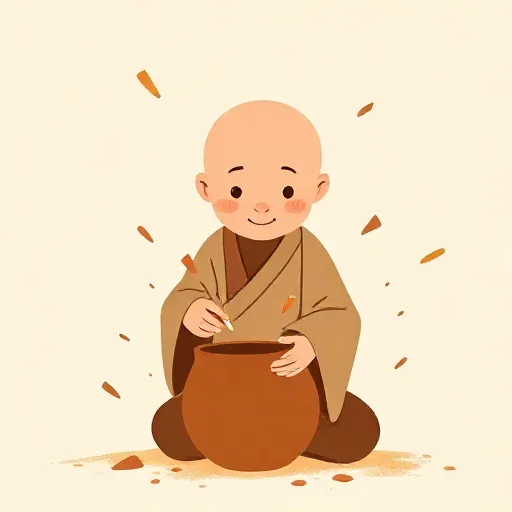
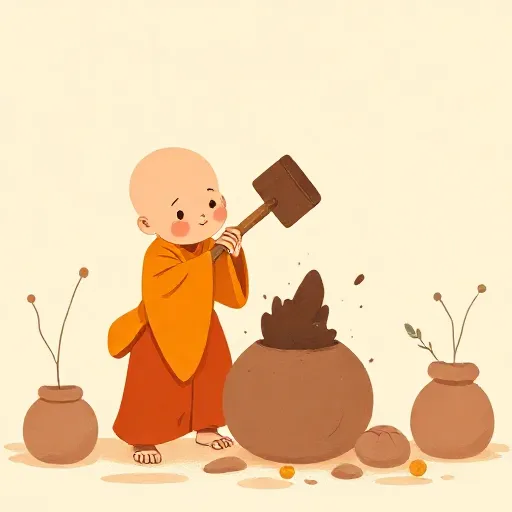
Imagine you hold a clay pot. You can see its shape, feel its weight. Now smash it with a heavy stick. The pot is gone. But did anything real disappear? The ancient Indian school called Sarvāstivāda (also known as Vaibhāṣika) said no — the pot was never ultimately real to begin with. Only the tiniest bits that made it up were.
The philosopher Vasubandhu (4th century) wrote a giant textbook called the Treasury of Knowledge that laid out their view. He defined two kinds of truth that everything falls into. Conventional truth covers things like pots and water: their very idea crumbles when you destroy them physically or mentally strip away their parts. If you smash the pot, you stop thinking “pot.” The idea depended on the arrangement, not on some deep, unbreakable stuff.
Ultimate truth, by contrast, points to things that can’t be broken down any further, either with a hammer or with analysis. For the Sarvāstivādins, that meant irreducible atoms of matter and point‑instant flashes of consciousness. These are foundationally existent (dravya‑sat): they don’t borrow their identity from anything else. The pot is just a composite entity, a convenient mental construction. It’s conventionally real — good enough for daily life — but it’s not what the universe is fundamentally made of.
A Flash of Fire: The Sautrāntika’s Causally Efficient Particulars
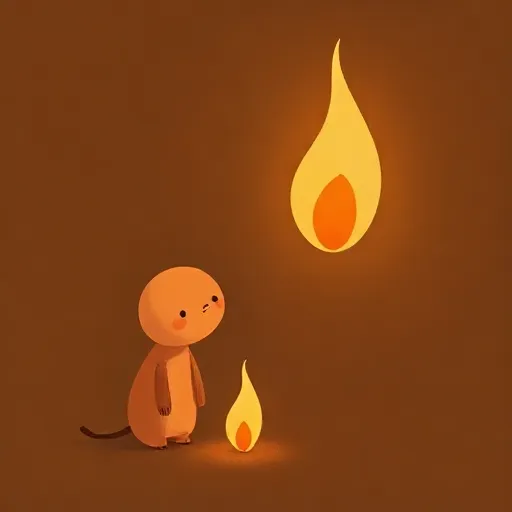
A later school, Sautrāntika, sharpened the picture. The logicians Dignāga (480–540) and Dharmakīrti (600–660) argued that ultimate reality is what is causally efficient — something that can actually do something, that can have an effect in the world. They called these things unique particulars (svalakṣaṇa).
A unique particular is a momentary event. It exists in a specific place at a specific instant, and then it’s gone. When you see a fire, what’s ultimately real is not “fire” as a lasting object, but a series of point‑instant fire‑events, each replacing the last. Because each flash can warm your hand or light a stick, it’s causally efficient and therefore ultimately real.
So what about the idea of “fireness,” the general concept that covers all fires? That’s a universal (sāmānyalakṣaṇa). Universals are purely conceptual, cooked up by our minds and language. They’re not causally efficient — you can’t warm your hands on a concept — so they belong only to conventional truth. Sautrāntikas were nominalists: they denied that general properties exist anywhere outside of our thinking. Language and inferential reasoning deal with universals, but direct perception touches only unique particulars. So ultimate reality is a rushing river of tiny, momentary events that can actually do things.
Is There Even an Outside World? The Yogācāra Dream

Both Sarvāstivāda and Sautrāntika agreed that physical stuff made of atoms is ultimately real. Then the Yogācāra school, developed by Asaṅga (315–390) and the same Vasubandhu who had earlier mastered the Sarvāstivāda system, took a much more radical step. They claimed that external objects aren’t even conventionally real. What you think of as a pot “out there” is actually just a mental impression — a representation created by your own mind.
To defend this, Vasubandhu used dream arguments. In a dream, you see a woman or a man at a specific time and place, yet no external object is present. The dream‑cognition still has spatial and temporal determination. He also pointed to shared hallucinations: in Buddhist stories, hungry ghosts (pretas) all see rivers of pus and urine, even though no such rivers exist outside their minds. Their collective karma produces a shared mental world. And in a wet dream, a physical effect (emission of semen) occurs without any real partner — so mental representations can be causally efficient on their own.
Yogācāra gave this a structure with the three natures. The dependent nature is the stream of mental impressions caused by subliminal karmic seeds. The imaginary nature is the mistake of splitting those impressions into a real subject (you) and real objects (the pot). The perfect nature is the true reality: non‑dual consciousness, free from that subject‑object split. So ultimate truth is not atoms, but a pure, undivided mind — often called emptiness of duality. Conventional truth is just the world of mental appearances. There is no outside world, only mind.
Nāgārjuna’s Empty Sky: Nothing Is Ultimately Real

Then came the Madhyamaka philosopher Nāgārjuna (ca. 100 BCE–100 CE), who refused to let anything be ultimately real. He argued that all phenomena — pots, atoms, minds, even emptiness itself — are empty (śūnya) of intrinsic nature (svabhāva). Intrinsic nature means a fixed, independent essence that makes a thing what it is. For Nāgārjuna, nothing has that. Everything is dependently arisen: it exists only in relation to causes, conditions, and conceptual labels.
A stormy debate broke out among his followers. The Prāsaṅgika branch, defended fiercely by Candrakīrti (ca. 600–650), insisted on a fully non‑foundationalist view: even conventionally things have no intrinsic nature. A pot is just a useful designation — a dependently arisen collection of parts, colors, and functions. Candrakīrti used the famous chariot analogy: you can search among its wheels, axle, and poles, but you’ll never find a separate “chariot” that is the real chariot. Yet you can still drive it. The self is exactly like that — a convenient label for the five aggregates (body, feelings, perceptions, habits, consciousness), not an ultimate soul.
If that sounds extreme, Candrakīrti went further. Emptiness itself is empty. If emptiness were an ultimately real entity, it would be a non‑empty foundation behind things. But emptiness is simply the fact that things lack intrinsic nature; it too has no essence of its own. That’s why ultimate truth for Prāsaṅgika is not a thing but a truth about things: they are empty. And because everything is empty of fixed essence, change and causal interaction become possible. A chariot can move, a pot can hold water, and you can grow — precisely because nothing is frozen in a permanent state.
Why It Still Matters: Are You Just a Convenient Label?

These ancient debates aren’t just dusty museum pieces. They ask a question that’s still alive: what kind of being are you? If you think of yourself as a fixed, unchanging self, then any change — growing up, learning new things, even healing from pain — seems almost impossible without something breaking. But if “you” are, as the Prāsaṅgika argued, a dependently designated person, a web of causes and conditions, then growth isn’t a threat; it’s just what you are.
That doesn’t mean you’re nothing. A pot holds water perfectly well, even if it’s only conventionally real. Your lunch is still there, and you can still enjoy it. But the insight that nothing — not even your own mind — is eternally fixed can be deeply freeing. It means you’re not trapped by who you were a moment ago. Like a chariot rebuilt while it moves, you can change direction. The Buddhist thinkers who smashed pots and dismantled chariots weren’t trying to prove you don’t exist; they were trying to show that you exist as a process, not as a frozen statue. And that, they believed, is the first step toward living with less suffering and more wonder.
Think about it
- If everything, including your own mind, is made of momentary flashes, what makes you the same person you were a minute ago?
- If a dream can feel completely real while you’re in it, how can you be sure you aren’t dreaming right now?
- If nothing has a fixed, permanent essence, does that mean you can become whoever you want — and does that feel exciting or terrifying?