Can a Good Reason Hop from One Belief to Another?
The train to Edinburgh

Imagine you’re on a train heading to Edinburgh. You’ve already spotted a sign that says “Newcastle upon Tyne,” so you’re sure you’re still in England. Then, at 16:05, the ticket controller tells you, “We’re not in Scotland yet.” That’s not exactly news. But now you have a new piece of evidence from the controller. If you think it through, you can use it to put together a short argument:
- Premise: You’re not in Scotland yet (the controller said so).
- Logical step: If you’re not in Scotland, you’re not in Edinburgh.
- Conclusion: You’re not in Edinburgh yet.
You already had a reason for the conclusion (the station sign). But the controller’s remark gives you a second, independent reason — one that “travels” from the premise to the conclusion through your knowledge that not-being-in-Scotland means not-being-in-Edinburgh. Philosophers call this epistemic transmission: when a justification (a good reason to believe something) moves from a premise to a conclusion you haven’t directly checked.
Epistemologists — the philosophers who study knowledge and justified belief — have found that this kind of travel isn’t guaranteed. Sometimes your reason for a premise can’t reach the conclusion at all, even when you know the premise makes the conclusion true. That’s a transmission failure. Why some arguments transmit and others don’t is a live puzzle, and it touches on huge questions like whether you can ever prove the world outside your mind is real just by looking at your own hand.
What makes a reason travel?
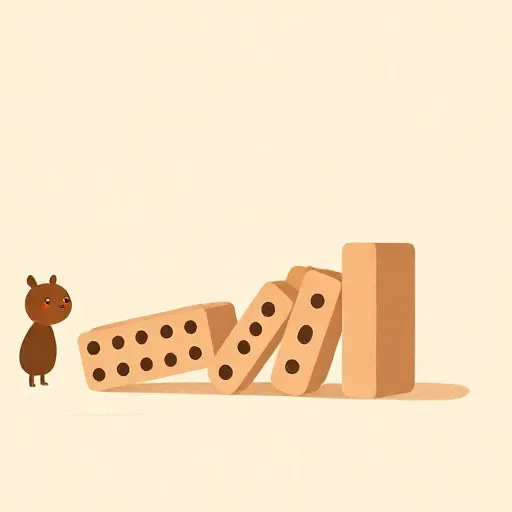
A reason doesn’t move by magic. For epistemic transmission to happen, three things are needed:
- You actually have a justification for the premise — for example, the controller’s statement gave you a good reason to believe you’re not in Scotland.
- You know that the premise leads to the conclusion — you’re aware that if you’re not in Scotland, you’re not in Edinburgh.
- Your justification for the conclusion must come from those two facts together, not from something else.
That third condition is the important one. It separates transmission from a simpler idea called epistemic closure. Closure just says: if you’re justified in believing a premise, and you know it leads to a conclusion, then you’re justified in believing the conclusion — somehow. But transmission says more: the justification you get for the conclusion must be built out of your justification for the premise and your knowledge of the logical link. The difference matters, as you’ll see.
Think of a straightforward example, from philosopher Crispin Wright (born 1942). Suppose you learn that Jones accidentally ate a whole dish of a deadly mushroom called Boletus Satana three hours ago. You know from background info that absorbing its toxin means death soon. Here the reasoning is:
- Premise: Jones swallowed a lethal dose of the mushroom’s poison.
- Conclusion: Jones will die shortly.
Your reason for the premise (you were told he ate the mushroom) travels cleanly to the conclusion through your knowledge of the link. That’s transmission: you get a new, first-time reason to believe the conclusion just by running the argument in your head.
When good reasons get stuck

Now picture this scene. You know that Jessica and Jocelyn are indistinguishable twins. You walk into a room and see a girl who looks exactly like Jessica. Can you reason:
- Premise: This girl looks just like Jessica.
- Logical step: If she is Jessica, she can’t be Jocelyn.
- Conclusion: This girl is not Jocelyn.
Seems simple. But notice a catch: in this case, your evidence (“looks just like Jessica”) can give you a reason to believe she is Jessica only if you already have an independent reason to believe the conclusion — that she’s not Jocelyn. After all, if you didn’t already have a way to rule out Jocelyn, then just seeing a familiar face wouldn’t be enough to tell the twins apart. The argument’s evidence for the premise depends on your having a prior justification for the very conclusion you’re trying to reach.
That’s an example of what Wright calls the information-dependence template: an argument where the evidence for the premise can’t do its job unless you’re already justified in believing the conclusion independently. When that happens, the reason you have for the premise cannot travel to the conclusion — because you’d need the conclusion first to get the premise off the ground. Philosophers call this a transmission failure of the first-time justification kind: you can’t earn a brand-new reason for the conclusion this way.
A related but different kind of blockage is indirectness. Imagine you see Jones kick a ball between two white posts. You reason:
- Premise: Jones just kicked the ball between the posts.
- Conclusion: A soccer game is taking place.
Here, your evidence (the kick) actually gives you a direct reason to believe a soccer game is happening, without needing to go through the premise that Jones “scored a goal.” (After all, if you later learned a referee flagged an offside, the kick might no longer justify “he scored a goal,” but it would still justify “a soccer game is on.”) So the argument itself is a kind of unnecessary detour; the evidence already justified the conclusion on its own, not through your knowledge that scoring a goal implies a game is happening. Transmission doesn’t happen because the reasoning doesn’t really add anything.
Seeing hands and the world outside

One of the most famous debates about transmission comes from G. E. Moore (1873–1958). Moore thought he could prove that an external world — a world of physical objects outside his mind — exists just by holding up one hand. His argument went like this:
- Premise: Here is a hand.
- Conclusion: There is a material world (because a hand is a material object in space).
Is this a good proof? Philosophers disagree. Many, including Wright, think Moore’s argument fails to transmit justification. The reason: your evidence that you see a hand — say, that your visual experience is as if of a hand — can give you a reason to believe there really is a hand only if you already have an independent reason to believe that you’re not in a dream, a computer simulation, or some other hand-illusion scenario. In other words, you’d need to already accept the conclusion (or at least rule out skeptical alternatives) before your experience could even count as a reason for the premise. The argument is stuck again.
Wright calls some propositions cornerstones — bedrock claims that must be accepted before your ordinary evidence for everyday beliefs can even get started. For physical-object beliefs, the claim “There is an external world” (or at least “I’m not being deceived by an evil demon”) is a cornerstone. He thinks you can have a special, non-evidential kind of rational trust — an entitlement — to accept such cornerstones, even though you can’t prove them with evidence without going in a circle.
Other philosophers, like James Pryor (born 1968), take a different line. According to a view called dogmatism, your perceptual experience — seeing a hand — gives you immediate, basic justification that doesn’t require you to already believe you’re not in the Matrix. On this picture, Moore’s argument does transmit justification from the premise to the conclusion. But the dogmatist still thinks Moore’s proof won’t convince a skeptic, because anyone who doubts the conclusion will simply reject the premise as unjustified in the first place. So the argument might be epistemically fine but dialectically useless — like shouting facts at someone wearing earplugs.
Why it still matters to you

You might wonder, “Who cares if a reason travels or gets stuck? I know when I’m thinking clearly.” But the same pattern lurks in everyday reasoning. Suppose your friend tells you over text that they’re at the library, and you conclude they must be in town. Your justification from the text depends on your already trusting that your friend isn’t playing a prank or using a fake location. If you had to prove they’re in town to a skeptical parent who doesn’t trust screenshots, you might find yourself going in a circle.
The transmission puzzle also touches something bigger. When you reason, “I think about water; therefore I’ve had contact with water” — an argument some philosophers have used to study whether we can know the outside world from our thoughts alone — the same kind of circularity pops up. You might need independent knowledge about water already to even have the thought you’re starting with.
So next time you build a chain of reasoning, ask yourself: is my reason for the first step already leaning on the finish line? If you need the last claim to be true before you can trust your first clue, then your proof might be less straightforward than it seems. That doesn’t mean you don’t know that you have hands or that you’re not in Scotland. It just means some paths in reasoning are one-way streets — and some are dead ends.
Think about it
- If you see a photo of your friend holding a birthday cake, does that give you a reason to believe they celebrated a birthday — or would you first need to be sure the cake wasn’t just a prop for a joke?
- Can you think of a time you trusted an argument, but later realized you had to already accept the conclusion before the evidence could count? What would that mean for whether the argument was a good proof?
- Suppose a brain scientist could make you perfectly hallucinate a hand. If you really were seeing a real hand, could you prove you weren’t in the scientist’s lab just by looking? Why or why not?