Can You Prove the World Outside Your Mind Is Real?
The Scandal of Philosophy

In 1787 the philosopher Immanuel Kant (1724–1804) was fed up. It seemed embarrassing that after more than two thousand years nobody had really proven that a world of trees, tables, and other people exists outside our own minds. He called this failure “a scandal of philosophy.” So Kant set out to build a proof that would silence the sceptic once and for all.
A sceptic is someone who doubts we can know something. René Descartes (1596–1650) had already imagined a powerful, tricky demon that could make you hallucinate an entire world. How could you be sure your life wasn’t one long, vivid dream? Kant’s strategy is now called a transcendental argument—an argument that starts from something even the sceptic must accept and then shows that the very thing the sceptic doubts is a necessary condition for it.
Here is Kant’s reasoning in his “Refutation of Idealism.” The sceptic admits that you experience your own mental states in a temporal order—first a feeling of boredom, then a pang of hunger, then a line of a song stuck in your head. To be aware of that order, you must also be aware of something that stays the same while the thoughts come and go. Your own self doesn’t seem permanent—David Hume (1711–1776) pointed out that no unchanging “me” shows up when you look inward. Your impressions flicker and vanish, too. So the only candidate for a permanent, steady thing is an object outside you in space—a real thing in the external world. Therefore, Kant concluded, you must have generally reliable experience of a world of objects. The dream scenario collapses: even a dream needs a background of permanence borrowed from waking life.
Strawson’s Independent World

Two centuries later, the British philosopher P. F. Strawson (1919–2006) gave the transcendental approach a fresh start. He wanted to keep Kant’s core insight but drop the heavy machinery Kant wrapped around it.
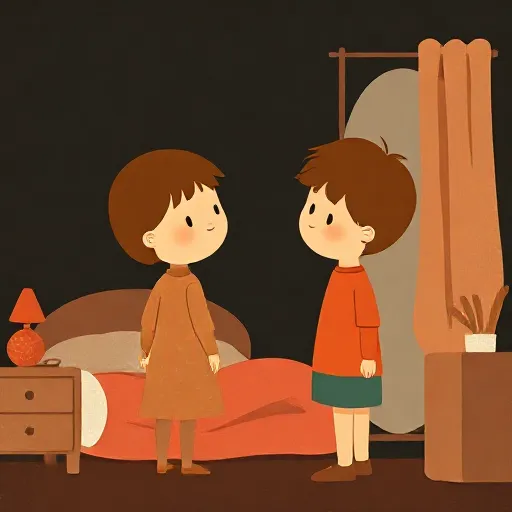
Strawson’s objectivity argument begins with self-consciousness—the ability to think of your own experiences as yours. To do that, Strawson argued, you have to be able to draw a distinction between “This is how things are” and “This is how things seem to me.” Imagine you see a stick poking into a pond. It looks bent, but you know it’s straight. That is/seems distinction only makes sense if there are subject-independent objects—things that don’t depend on your mind and can surprise you. If everything were just a movie inside your head, there would be no room for “seems,” because nothing could ever really be one way while appearing another. So, Strawson concluded, you must live in a world of real, mind-independent objects.
He thought an argument like this could answer the sceptic without getting tangled in Kant’s own complicated idealism. The move felt crisp: if you can even ask “Is the world real?” you are already using concepts that require a real world.
Brain in a Vat: A Modern Twist
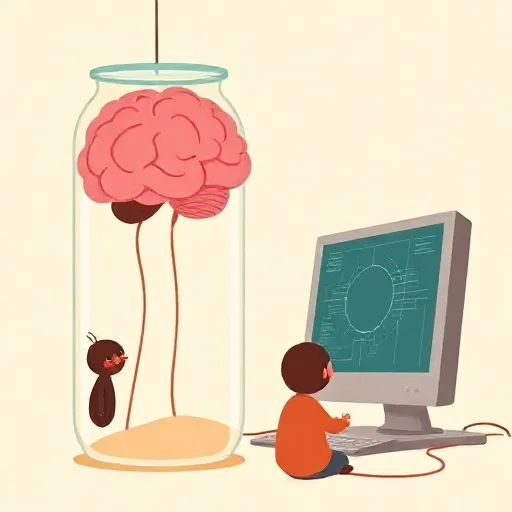
A more recent sceptical nightmare is the brain-in-a-vat hypothesis: what if you are just a disembodied brain in a lab, and a supercomputer feeds all your experiences directly into your nerves? The world you think you’re walking through would be entirely virtual. The philosopher Hilary Putnam (1926–2016) tried to turn this scenario against itself with a new transcendental argument.
Putnam relied on a causal theory of reference—the idea that a word connects to the thing that actually caused you to learn and use it, not by magic but by real-world interaction. If you have never causally interacted with real trees, your word “tree” does not refer to real trees. Now imagine you really are a brain in a vat. Every time you say “vat,” what causes you to use that word is not the real glass jar your brain sits in—it’s the pattern of electrical signals inside the computer that gives you hallucinations of vats. So the word “vat” in your mouth doesn’t pick out the real vat at all; it refers to something in the simulation.
As a result, the sentence “I am a brain in a vat” could never be true when said by you. If you are a brain in a vat, the statement is about simulated equipment, not about your actual situation. If you’re not a brain in a vat, it’s false. Either way, you can never correctly claim you’re a BIV. The hypothesis, Putnam said, is self-refuting—like saying “I don’t exist.” This investigation into the preconditions for thinking and referring is yet another kind of transcendental argument, and it convinced many that some sceptical doubts collapse under their own logic.
The Stroud Problem: Belief Isn’t Truth

Not everyone was satisfied. The philosopher Barry Stroud (1935–2019) raised an objection that still shapes the debate. Look closely at Kant’s argument, Stroud said. The most it really shows is that you must believe there’s a permanent object outside you, or that your experience must seem to include one. But a belief can be very strong and still be wrong. The sceptic can grant that you cannot help believing in the external world, yet still ask: “Does that make it true?”
Stroud argued that moving from “I must believe X” to “X is the case” requires crossing a bridge of necessity that no one has convincingly built. Without that bridge, a transcendental argument delivers only a modest conclusion about how our minds work, not a world-directed proof. Stroud’s worry hit hard. It led many philosophers to accept that transcendental arguments can, at best, show that certain beliefs are indispensable—we cannot give them up and still think coherently. Even Strawson later softened his claim, suggesting that showing a doubt is “idle” because it cannot move us might be enough.
This limitation still irks some defenders. After all, if you’re forced to believe something for every moment of your waking life, maybe that’s the closest to certainty we can get. But the gap between conviction and truth never fully closes.
Why This Still Matters

You have probably lain in bed and wondered: “Could all of this be a dream?” That question feels urgent, but transcendental arguments suggest that the very act of doubting uses tools that depend on a real world. To ask whether anything exists outside your mind, you need words that refer to something, a sense of time passing, and a self that can ask the question. Those starting points may already commit you to more than the sceptic is willing to grant.
The debate hasn’t ended. Some philosophers keep building ambitious world-directed proofs. Others settle for modest ones, hoping to show that our deepest beliefs—in objects, in other minds, in causes—are rationally respectable even if we can’t prove them from scratch. The power of transcendental arguments lies in their strategy: they don’t just deny scepticism; they try to hoist the sceptic by his own petard, using the very premises he accepts.
Next time someone says “We can’t really know anything,” you might try a simple reply: “Do you know that?” Sometimes the best response to a sceptic is to check whether the doubt can even be stated without borrowing from the world it tries to erase.
Think about it
- If you were a brain in a vat having exactly the same experiences you have now, would you be able to tell the difference? If not, does that matter for how you live?
- Suppose you try to convince a friend that the world exists, but they keep saying “Maybe I’m dreaming.” How could you use one of the arguments in this article? What might your friend reply?
- Can you think of something you believe so strongly that you couldn’t function without it, even though you can’t prove it’s true? Would holding that belief make you irrational, or just human?