The Book That Wasn’t Aristotle’s (And Why That Made It So Powerful)
A Mysterious Manuscript in the Caliph’s Library

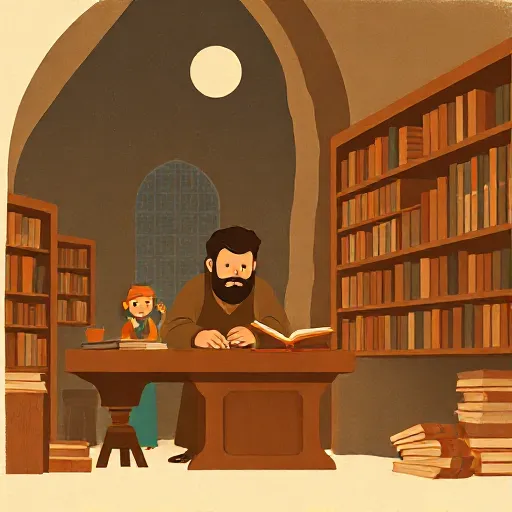
It is around the year 840 CE in Baghdad, the capital of the Abbasid Empire. A translator named Ibn Na‘ima al-Himsi sits in the palace library. The philosopher al-Kindi (c. 801–873) watches closely. What they are about to produce will become one of the most influential — and most misleading — books in history: the Theology of Aristotle.
The book claims right on its first page to be a work by the ancient Greek thinker Aristotle. Its opening lines declare: “The first chapter of the book of Aristotle the philosopher, called in Greek ‘Theologia’, that is, ‘discourse on divinity’.” The preface says it was translated by al-Himsi and corrected by al-Kindi for the caliph’s son, Ahmad ibn al-Mu‘tasim. That little detail lets scholars date the project to the 830s or early 840s.
But here is the twist. The Greek manuscript al-Himsi was working from was not by Aristotle at all. It was written by Plotinus (c. 204–270 CE), a brilliant philosopher who had lived centuries after Aristotle. Plotinus wrote about a supreme, hidden principle he called the One, a divine Intellect, and the Soul that links everything together. After his death, his student Porphyry collected those writings into six groups of nine, which is why they are called the Enneads (from the Greek word for “nine”).
The Arabic version, however, did something strange. Instead of translating the whole Enneads, it jumped around through only the last three groups, rearranged the sections, and added long brand-new passages. Then someone — probably a later, confused copyist — attached the title “Theology of Aristotle.” Al-Kindi’s circle almost certainly knew the text was by Plotinus, but they saw it as a perfect, completing companion to Aristotle’s own ideas. The mislabel stuck, and for centuries the world believed it was Aristotle’s long-lost masterpiece.
Not a Translation, but a Rewrite

When we say the Arabic version “translated” Plotinus, that is not quite right. It is much closer to a creative retelling. The Greek sentences are rarely turned word for word into Arabic. Instead, they are freely paraphrased — rephrased with new emphasis — and spliced together with fresh material that has no basis in Plotinus’ original at all. Scholars call these added chunks interpolations.
One small example shows the difference. Plotinus’ original opens a treatise with: “The One is all things and no one of them.” The Arabic version becomes: “The pure One is the cause of all things and is not like any of them.” Two new ideas slip in: the One as a “cause” and the idea that it is not “like” anything it produces. A subtle change, but it nudges the whole philosophy toward a God who creates and remains utterly unlike creation.
The translators also rearranged the material without following the order of the Enneads. Some chapters of the Theology feel like a collage, stitching together Plotinus’ discussions of the soul, the intellect, and the One with paragraphs that are entirely new. This could have been an accident — loose pages shuffled out of order — or it might have been a deliberate plan to give each chapter a single theme. Both possibilities are still debated.
The most famous interpolation appears in the second chapter of the Theology. It introduces an idea so striking that it grabbed the attention of readers for a thousand years: the notion that there is an ignorance better than knowledge.
The Ignorance That’s Better Than Knowledge

Here is what the interpolation says. The human soul, before it enters the body, grasps things intellectually. But when it tries to think about the highest principle — the First, Ultimate Cause — it cannot really understand it. That failure is not a flaw. The text calls it an ignorance more noble than knowledge. Why? Because if the intellect could completely grasp the One, that would mean the intellect was greater than the One, or even its cause. That, the author says, would be “very repugnant.”
So there are two kinds of superior ignorance. The first is the ignorance the lower has of the higher: your mind cannot fully know God any more than a cup can hold the ocean, and that is exactly right. The second is the ignorance the higher has of the lower: a perfect principle does not need to pay attention to messier things below, and forgetting them is a kind of freedom.
Think of it this way. If you could fit a whole mountain into your pocket, the mountain wouldn’t be very impressive. The best things always exceed our grasp, and sometimes the wisest response is to admit that we don’t — and maybe can’t — understand. This idea became hugely important in what is called negative theology, the approach that says we are more truthful when we deny words to God than when we try to describe Him. The Theology’s bold phrase about an ignorance better than knowledge planted that seed very early.
Making God Both Creator and Pure Thought

The Arabic Plotinus did more than add the startling ignorance passage. It thoroughly reworked Plotinus’ ideas about God to bring them closer to Aristotle. Plotinus’ One is so simple and perfect that it does not think, because thinking would involve a division. Aristotle’s God, by contrast, is a mind that thinks itself and is pure actuality — not something waiting to happen, but something fully and perfectly real.
In the Theology, the One is repeatedly called the originator and the creator. The text freely uses the metaphor of emanation, or flowing out, so that creation pours from God through intellect and soul into the material world. And yet, the Arabic version goes further than Plotinus ever did. It calls God pure actuality (al-fi‘l al-mahd) and sometimes even pure being (anniyya faqat). The intellect, the second-highest level of reality, looks up and tries to imitate that perfect, actual existence.
It is as if the translators took two different recipes for a divine being and mixed them into one. From Plotinus they kept the idea that everything flows from a single source, with the soul returning back upward. From Aristotle they took the claim that the first principle is an awake, thinking, fully actual mind. The result was a God who is both the fountain of everything and the highest intellect — a combination that felt comfortable and powerful to later Islamic, Jewish, and Christian philosophers.
How a “Fake” Book Traveled the World

For a book that was not even by Aristotle, the Theology of Aristotle had an extraordinary career. The tenth-century philosopher al-Farabi (c. 872–950) used it to argue that Plato and Aristotle actually agreed about the creation of the world and the existence of unchanging Forms. Around the same time, a younger text called the Book of Causes — itself a reworking of Proclus, heavily influenced by the Arabic Plotinus — spread Neoplatonic ideas through the Latin West. Thomas Aquinas eventually noticed that the Book of Causes was really from Proclus, not Aristotle, but the Theology kept its famous name.
Thinkers from the Isma‘ili tradition, like al-Sijistani, took the Theology’s negative theology even further, insisting that you must negate even the negation when speaking about God. A later version of the text, called the Longer Version, added a logos or “word” between God and the first intellect, and circulated in both Arabic and Judeo-Arabic manuscripts. By the sixteenth century, the Theology was translated into Latin and read in Renaissance Europe.
The poet-philosopher Avicenna (Ibn Sina, 980–1037) had his doubts about the book’s authenticity, yet he still wrote a commentary on it. Safavid scholars in Iran copied and taught it as late as the seventeenth century. In every setting, the text was never just a passive messenger of Plotinus’ thought. It was an active partner in new conversations.
What makes the story of the Theology so alive today is that it shows how ideas change when they move across languages, cultures, and religions. A group of ninth-century translators, with their own philosophical aims, turned a Greek classic into something fresh — and that fresh version mattered as much as the original. When you read a book in translation, or see a movie based on a novel, you are part of the very same tradition. The changes are not always mistakes. Sometimes they are the beginning of something even bigger.
Think about it
- If someone added entirely new ideas to a famous book and then put a famous name on it, would the result still be worth reading? Could the changes ever be more interesting than the original?
- Is there something important in your life — a feeling, a memory, a person — that you think is better left not fully explained? Or do you think we should always try to put things into words?
- Suppose a translation of your favorite story changed so many details that it told a almost different message. Could that new message be true in a way the original wasn’t?