Why Al-Kindi Believed the World Could Not Be Eternal
A Library in Baghdad
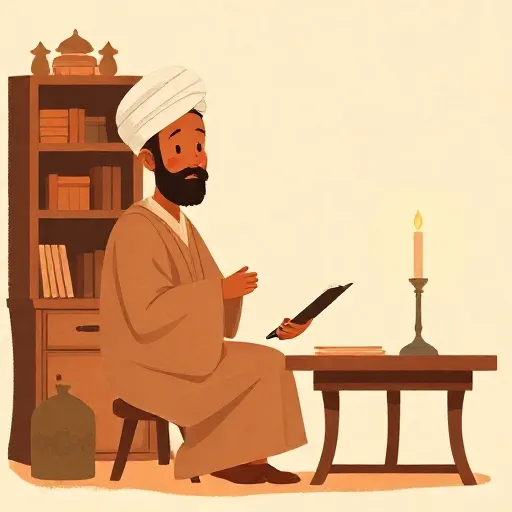
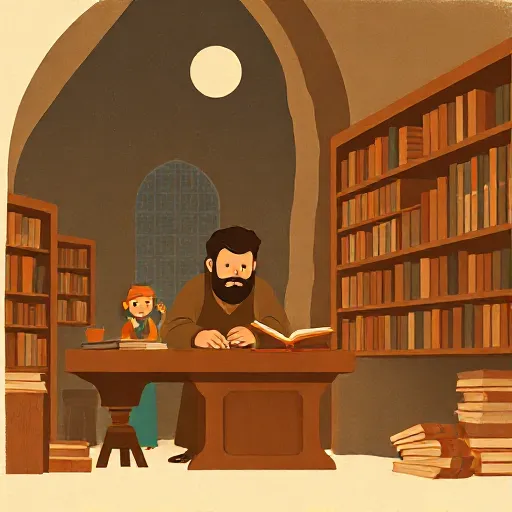
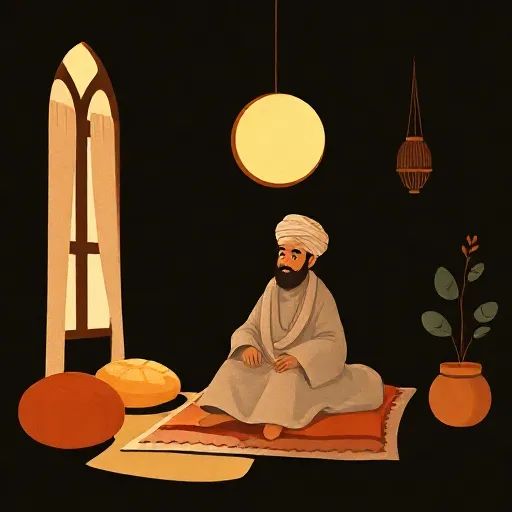
One morning in the 830s, in the bustling capital of the Abbasid Empire, a middle-aged scholar named al‑Kindi sat at the center of a remarkable project. He was surrounded by scribes and translators, most of them Syrian Christians, who were turning Greek manuscripts into Arabic. These books contained the science and philosophy of Aristotle, Plato, Ptolemy, and other ancient thinkers. Al‑Kindi (c. 800–c. 870 CE) believed that these foreign ideas could strengthen, not weaken, the faith of his fellow Muslims. Many in Baghdad disagreed. They thought Greek philosophy was a threat. Al‑Kindi’s life work became a kind of public‑relations campaign for wisdom, showing that reason and revelation could speak the same language.
Born in Basra to the noble Arab tribe of Kinda, al‑Kindi moved to Baghdad and was educated at the caliph’s court. He served the caliph al‑Maʾmūn and later became a trusted scholar under al‑Muʿtaṣim, who ruled from 833 to 842. Al‑Kindi even tutored the caliph’s son. His team translated works of medicine, astronomy, mathematics, and metaphysics. He himself wrote hundreds of treatises, though only a fraction survive today. The most famous of these is On First Philosophy—a work that tries to prove that God exists, that He is utterly one, and that the world had a beginning.
The One Behind Everything

Al‑Kindi thought that the deepest question you can ask is, “Why is there something rather than nothing?” For him, the answer had to be a first cause that explains why anything exists at all. But he approached this not by looking at being itself, but by looking at oneness.
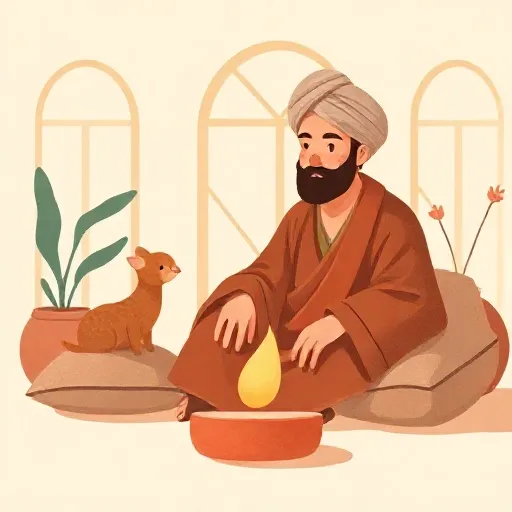
Everything around you is both one and many. A cat is one animal, but it has many parts—whiskers, tail, paws. The species “cat” is one species, but it includes many individual cats. Even a single word like “animal” is one term, yet it covers many kinds of creatures. Al‑Kindi argued that nothing in the universe can be the cause of its own unity, because every thing you can name is already a mixture of unity and multiplicity. If you trace the chain of causes backward, you must eventually arrive at something that is only one, with no parts, no aspects, and no multiplicity at all.
That something is the true One, or God. God is not one among many; He is oneness itself. In On First Philosophy, al‑Kindi showed that any predicate we apply to ordinary things—genus, species, quality, quantity—breaks them into pieces. The true One escapes all such descriptions. It cannot have a shape, a size, a color, or even a definition. God is pure unity, and every other thing borrows its oneness from Him. This idea of divine simplicity closely matches what some Muslim theologians of his time, the Muʿtazilites, were saying: God’s essence has no separate attributes tacked onto it. For al‑Kindi, this was not just a religious claim; it was a conclusion of rational first philosophy.
The Infinity Puzzle: Why the World Isn’t Eternal

Aristotle and most Greek philosophers held that the universe is eternal—it had no beginning, and it will never end. Al‑Kindi disagreed fiercely. He insisted that God created the world ex nihilo, or “from nothing,” with a beginning in time. To defend this, he turned to a surprising ally: a Christian thinker named John Philoponus, who had used Aristotle’s own rules to attack the eternity of the world.
Al‑Kindi’s main argument hinges on the difference between an actual infinity and a potential infinity. An actual infinity is a collection of things that is already complete and yet endless—like a bag that somehow contains an infinite number of marbles all at once. A potential infinity is simply a process that can keep going forever without ever finishing—like counting numbers: you can always add one more, but at any given moment you have only a finite number counted. Aristotle allowed potential infinities, but he denied that any actual infinity exists in the physical world.
Al‑Kindi then pointed out that the body of the universe is finite in size. Time, he said, is something that belongs to this body, just as duration belongs to a spinning top. If the universe itself cannot host an actual infinite, then time cannot be actually infinite either. So the past cannot stretch back without a beginning. If the world had always existed, an infinite number of days would already have passed—and that would be an actual infinity right now. But Aristotle himself said that an actual infinity can never be “traversed,” or crossed. Reaching today would require crossing an infinite past, which is impossible.
Aristotle’s supporters reply that the past is only potentially infinite: no matter how far back you go, you always find a finite stretch of time. Al‑Kindi and Philoponus counter that this misses the point. If you stand at the present moment and look backward, an eternal world would mean that an actually infinite number of years has already elapsed. You can’t complete an infinite series, so the present moment would never arrive. The puzzle is still debated today. Al‑Kindi’s version, whatever its flaws, makes one thing clear: a simple question about time can quickly turn into a labyrinth about the nature of infinity.
How We Think: A Mind That Doesn’t Need Senses

Al‑Kindi did not stop at the stars. He also tried to understand the human mind. In a short but influential treatise called On the Intellect, he became the first philosopher writing in Arabic to sort the intellect into different types. He said the human mind begins as a potential intellect—a bare ability to think, like a blank slate that has not yet been written on. When it actually grasps a pure intelligible form (something like a mathematical truth), it becomes an actual intellect. Later, you can recall that form at will; that capacity he called the acquired intellect.
But where do intelligible forms come from in the first place? Al‑Kindi rejected the idea that we pull them out of sensory experience. Just as your eye needs an actual colored object to see, your mind needs an external source of intelligible forms to spark thinking. That source is the first intellect, an immaterial being that is always thinking, always in act. It acts like a lamp that lights up the contents of your mind. Al‑Kindi’s picture is thoroughly intellectualist: true knowledge is not built from sights and sounds; it is recovered by the rational soul, which already knows the forms and simply needs to be reminded.
This explains his theory of dreams. In On Sleep and Dream, al‑Kindi follows Aristotle in saying that when you sleep, your senses shut down and your imagination runs free. But instead of merely reshuffling daytime images, the rational soul can send genuine glimpses of the future to the imagination—prophetic dreams. The soul, for al‑Kindi, is an immaterial substance that temporarily uses the body. Its highest life is elsewhere, in a “world of the intellect” bathed in divine light. That belief he packaged in a string of supposed sayings by Plato, Aristotle, and Pythagoras, urging readers to cleanse the soul from bodily stains so it can ascend. The ethical lesson was simple: real happiness comes from focusing on what never changes, not on fleeting physical things.
A Map for Reason and Faith

Al‑Kindi’s project looks both foreign and familiar today. He stood at a crossroads where Greek logic met the Quran, and he insisted that they did not have to fight. Instead of treating philosophy as a threat, he used it to explain divine creation, the nature of the soul, and the order of the cosmos. He even interpreted Quranic verses through the lens of heavenly causation, arguing that when the Quran says the stars “prostrate themselves,” it refers to the way they carry out God’s providential commands by moving and influencing our world.
Not everyone was convinced. Later philosophers like al‑Fārābī and Averroes rarely mentioned him by name, though they carried on his mission of engaging with Greek thought. Yet al‑Kindi’s translations and his small circle of students seeded an entire tradition. His version of the intellect, his infinity argument, and his treatises on optics, music, and medicine shaped debates in both the Islamic world and, through Latin translations, medieval Europe.
Why does this matter for you? Al‑Kindi faced a problem many of us recognize: how to hold onto a religious or cultural identity while exploring ideas that come from a completely different world. He responded not by closing the door, but by opening it wider—and then asking hard questions. The next time you wonder whether science and faith can coexist, or whether an argument about infinity can tell you something about real life, you are walking in the footsteps of the philosopher who first tried to prove that the world had a beginning, using only logic and a scroll full of Greek.
Think about it
- If the universe had no beginning, would it be possible for today to ever arrive? Why or why not?
- Can you think of something that is completely one, without any parts, aspects, or qualities? Is it possible to describe such a thing using words?
- Al‑Kindi believed that the best part of you is your mind, not your body. What would change in your daily life if everyone treated the mind as the only thing that truly matters?