Why Nature Looks Like It Was Made on Purpose
The Watch on the Heath
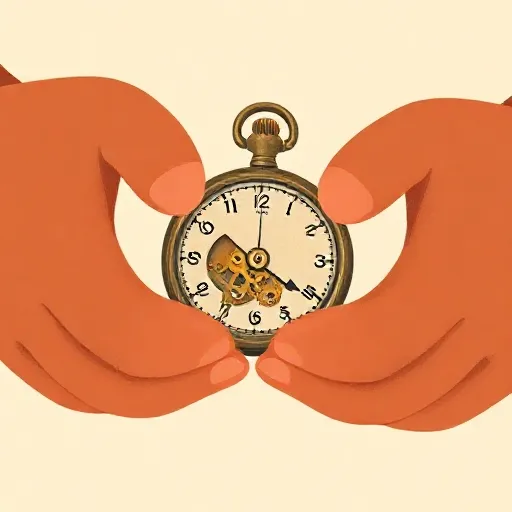
One morning in 1802, the English clergyman William Paley (1743–1805) asked you to imagine crossing a heath. If you tripped over a stone, you wouldn’t wonder where it came from. But if you found a watch lying on the ground, you’d instantly think: someone made this. The watch’s gears, springs, and hands all work together toward a single goal—keeping time. That arrangement of parts for a purpose, Paley insisted, is a mark of design.
Now look at a living eye. Its lens, retina, and optic nerve mesh just as perfectly for a different goal: seeing. Paley argued that the same reasoning applies. Just as a watch implies a watchmaker, the eye points to an intelligent maker. This is the teleological argument (from the Greek telos, meaning “purpose”). It’s also called the argument from design. Paley believed the inference was not a vague analogy but a direct, nearly unavoidable conclusion—if something is clearly put together to do a job, a mind intended it.
For Paley, nature is full of such purpose-built structures. An eye, he wrote, would be alone sufficient to support the conclusion that an intelligent Creator is necessary. The evidence seemed as overwhelming as a signed letter.
Hume’s Tough Questions
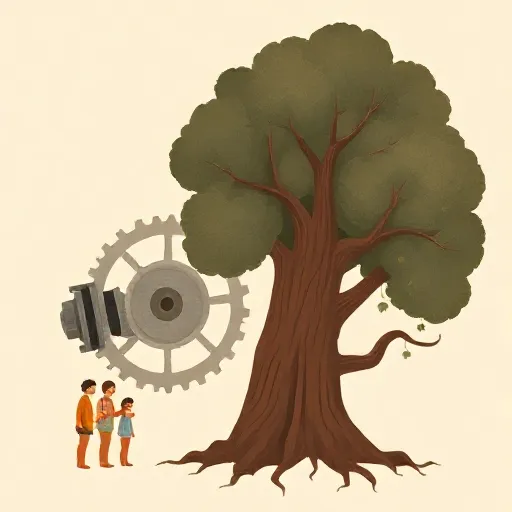
Decades before Paley, the Scottish philosopher David Hume (1711–1776) had already picked apart this kind of reasoning. His first worry concerned the analogy itself. A watch is a lifeless, human-made machine. Living things grow, heal, and reproduce on their own. In fact, Hume suggested, the whole universe behaves less like a machine and more like a giant, self-sustaining organism. If the resemblance is weak, the argument loses force.
Hume had deeper worries, too. Even if we accepted that a designer exists, what could we honestly say about it? The world contains suffering, clumsy arrangements, and waste. A designer might be a beginner, a committee, or even a junior apprentice who messed up. That would be very far from the all-powerful, perfectly good God of traditional religion.
He also questioned whether we could ever reason from just one sample. We have exactly one universe to study. How can we know what a designed universe looks like unless we’ve seen others for comparison? And if a designer explains the universe, what explains the designer? Pushing the question back one step doesn’t make it disappear. Hume concluded that the argument could suggest, at most, some distant, foggy resemblance between the cause of the universe and human intelligence—and not much else.
Darwin’s Simple Idea

For much of the 19th century, Paley’s design argument remained a standard pillar of natural theology. Then Charles Darwin (1809–1882) offered a completely different explanation for life’s intricate machinery.
Darwin’s evolution by natural selection works without any need for a guiding mind. Organisms vary slightly from one generation to the next. Variations that help an individual survive and reproduce get passed on more often. Over millions of years, these tiny advantages accumulate. A patch of light-sensitive cells can slowly turn into a camera-like eye, one modest improvement at a time. What looks like purposeful design is actually adaptation—structures shaped by a blind, unplanned process.
This didn’t prove there’s no designer, but it showed that biological complexity doesn’t require one. Many philosophers argued that Darwin had “explained away” the need for a designer in the living world. Yet design advocates noticed something: the evolutionary machinery itself depends on a very specific cosmic setup. The rules of physics, the existence of stable stars, the chemical building blocks—all had to be just right for life to get started at all. So the debate shifted from biology to the cosmos itself.
The Universe’s Lucky Numbers

In recent decades, physicists discovered something remarkable. Many numbers written into the basic laws of nature appear fine-tuned for life. Tinker with them just a little, and life would be impossible anywhere.
One example: the strength of the strong nuclear force binds protons and neutrons together inside atoms. If that force were stronger or weaker by only 0.4%, the universe would not produce the right balance of carbon and oxygen. No carbon, no complex chemistry—no life. Another example: the cosmological constant controls how fast the universe expands. Change it by one part in 10⁵³, and the cosmos would either fly apart too fast for stars to form or collapse back on itself instantly.
The odds against these values arising by chance seem vanishingly small. Physicist Lee Smolin estimated the chance of star-friendly conditions at about 1 in 10²²⁹. Such staggering numbers feel like they cry out for an explanation. One possibility is a cosmic designer who set the dials.
Other explanations exist. The multiverse hypothesis says our universe is just one of an enormous—perhaps infinite—collection. Each universe has different constants. In such a cosmic lottery, it’s no surprise that at least one universe hits the life-friendly jackpot. But critics reply that we’d need to know whether the lottery machine is fair: if the multiverse is somehow biased against life, the win remains mysterious.
The weak anthropic principle takes yet another path. We shouldn’t be surprised to notice that we live in a life-permitting universe, because if the universe were any other way, we wouldn’t be here to notice. Philosopher Elliott Sober sharpened this point with a fishing analogy: if a net has holes that catch only large fish, catching only large fish tells you nothing about whether small fish exist. Similarly, our very existence might filter the evidence, making it impossible for us to see an unbiased picture. The fine-tuning debate remains wide open.
Why We Still See Purpose Everywhere

Despite centuries of philosophical and scientific pushback, the intuition that nature is somehow intended refuses to disappear. Even the most determined opponents of design arguments feel its tug. The biologist Francis Crick famously warned colleagues that “Biologists must constantly keep in mind that what they see was not designed, but rather evolved.” Biologists still use words like “purpose,” “design,” and “machinery” because living things fit those descriptions so well. The question is whether that language points to a real mind or only to a useful metaphor.
Some philosophers think the design intuition might not be a matter of argument at all. Just as we can’t help believing that the world outside our heads is real, we might be built to perceive purpose in orderly complexity. That would explain why the debate never ends: the feeling comes first, and the arguments follow. Whether that feeling is a trustworthy guide to truth is itself a philosophical question—one that directly touches how we think about meaning, value, and our place in the cosmos. So long as a butterfly wing or a starry sky can leave us speechless, the old fight between design and chance will keep going.
Think about it
- If you found a smartphone on a deserted beach, you’d think an intelligent mind made it. Does that same reasoning work for a human hand? Why or why not?
- Suppose we discover that our universe is just one of trillions, each with different laws. Would that make the idea of a designer pointless, or could a designer still be behind the whole multiverse?
- Why do we naturally sense purpose in a spider’s web or a bird’s nest even when we know they evolved? Is that feeling something we should trust?