Can Science Ever Explain What Makes Art Beautiful?
What Matters More: The Painting or the Painter?

You’re at a museum, staring at a painting. A guide leans in and whispers, “That’s a perfect forgery — so flawless that scientists can’t tell it apart from the original.” Suddenly, the picture feels different. But why? If it looks exactly the same, shouldn’t your experience be the same too?
For centuries, philosophers have wrestled with this puzzle. The fight is simple: can what you know about a work of art change how you see it? And if knowledge does change your experience, does that mean science — which studies brains, not stories — can ever fully explain beauty? To get a grip on these questions, we need to go back to a view that says the only thing that counts is what hits your eyes.
The ‘Just Look’ View: Art Is for the Eyes

The philosopher Immanuel Kant (1724–1804) argued that when we judge something beautiful, we’re paying attention to how it appears, not to what it’s made of or who made it. That later grew into a position called aesthetic empiricism: the idea that aesthetics deals only with what you can perceive. On this view, a forgery that looks just like the original ought to give you the same aesthetic experience. The famous forgery problem doesn’t even get off the ground — because history doesn’t show up in the paint.
But other philosophers pushed back. Frank Sibley (1923–1996) noticed that we describe artworks with words like delicate or dynamic — words that seem to depend on how the work was made, not just how it looks. Suppose you see a thin, trembling line. You call it “delicate” because you assume a human hand drew it. If you later learn a machine stamped it out, the feeling of delicacy often vanishes. The line hasn’t changed; your understanding of it has.
Philosopher Kendall Walton (born 20th century) sharpened the point. Imagine two paintings that are visually identical. One belongs to the category “hand-drawn sketch,” the other to “computer-generated print.” Because the categories are different, the very same visual pattern can strike you as dynamic in one case and static in the other. So maybe you can’t separate how you see a work from what you know about it. And that brings us to a deeper question: when scientists study what people like, are they measuring real aesthetic judgment — or just knee-jerk reactions?
Why Your Brain Likes What It Likes: The Science of Preferences

Psychologists have long run experiments on simple tastes. Gustav Fechner (1801–1887) tried to find out whether people prefer the “golden ratio” over other proportions. More recent work has uncovered surprisingly stable patterns: across cultures, people tend to like saturated blue and dislike colors associated with faeces and vomit. Preferences for symmetry also show up early, and some researchers link them to ancient instincts about health.
But these bottom‑up findings come with a catch. Liking blue doesn’t tell you whether blue is the right color in a particular painting. To move from raw preference to the idea of a good reason — the kind of reason you might give in an argument about art — you seem to need something more.
Yet the science suggests that our reasons are often flimsy. One influential idea is processing fluency: we feel positively toward things we can grasp easily. Rhymed statements feel truer, easy-to-read fonts make arguments more believable, and symmetrical patterns give the brain a smooth ride. So maybe you enjoy a Bach fugue not because it’s profound, but because your brain processes it more effortlessly than you expected. Another finding is the mere exposure effect — simply seeing a picture many times makes you like it more. That, some argue, might explain why certain artworks stay famous: they’re shown often, so they get liked, so they get shown again.
But here’s the twist: one study played people recordings of good and bad art (according to critics). Repeated exposure increased liking for good works but decreased liking for bad ones. That hints that exposure can sometimes train you to see real quality, not just warm up to the familiar. Still, if your taste is shaped partly by fluency or mere exposure, how much of your “aesthetic judgment” is really reasoning, and how much is your brain treating you to a comfortable shortcut?
But What About the Brain Scans? Neuroaesthetics and Its Limits
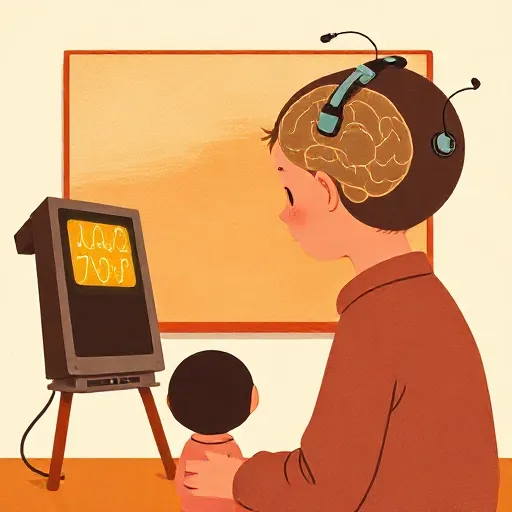
In recent decades, neuroaesthetics has tried to link beauty straight to brain processes. Researchers like David Freedberg and Vittorio Gallese (2007) argue that when we look at a statue, our bodies silently mimic the posture; when we see a brushstroke, our motor system simulates the hand movement that made it. They even point to mirror neurons — brain cells that fire both when you perform an action and when you watch someone else do it — as the hardware of aesthetic empathy.
Critics push back: not everyone has these motor responses, and the responses might just be distractions from what the painting itself has to offer. But even if the brain science is solid, we have to ask a sharper question: are these brain facts part of the aesthetic experience, or are they just evidence that it’s happening?
A helpful example comes from Impressionist painting. Neuroscientist Margaret Livingstone (2002) proposed that the shimmering quality we see in certain colors arises because our visual system processes those colors in a separate brain stream. Does that mean the shimmer is really a brain process? Probably not. What matters aesthetically is the shimmering experience itself — the way the color seems to vibrate. If we had a completely different brain design that produced the same shimmer, the art would still work. The brain story is evidence for that something exists, not the thing itself. So neuroaesthetics can back up claims about what we experience, but it doesn’t replace the experience — or tell us whether it’s good.
Why We Still Argue About Art (and Always Will)

A huge experiment asked more than two thousand people in nineteen countries what they think when two people disagree about whether something is beautiful. The least popular answer everywhere was “one person is right and the other wrong.” That discovery challenged a common claim in philosophy: that we all talk as if aesthetic judgments are objective, like “that tree is taller.” Instead, many people seem comfortable treating beauty as a matter of taste, not truth.
Philosopher Noël Carroll (born 20th century) argued that the way we argue about art does look like a search for right answers. The experiment’s result doesn’t settle the issue — maybe people just need better philosophical training to see the objective side. But it shows that we can’t assume we already know what “ordinary people” think without checking.
This is the heart of the tension today. Science can measure how brains react to symmetry, how often a picture gets liked, or which brain regions light up during a sad song. What it cannot yet do — and what philosophy insists on asking — is tell us whether any of those reactions make a work valuable. A machine can tell you your heart rate went up while watching a scary movie, but it can’t tell you whether that fear enriched your understanding of courage, or just gave you a cheap thrill.
So the fight between science and philosophy in aesthetics isn’t about picking a winner. It’s about noticing that different questions need different tools. The scientist asks, “What do people actually like, and why?” The philosopher asks, “What should we value, and what makes a judgment a good one?” Both questions matter — and you probably switch between them every time you say, “I love this song, but I can’t explain why.”
Think about it
- If a robot painted a canvas that looked exactly like a masterpiece you love, would the robot’s painting be just as meaningful to you? Why or why not?
- Imagine a scientist could prove that your favourite song is popular only because you’ve heard it a hundred times. Would that change how much you value it, or not?
- Suppose two friends see the same movie and one calls it brilliant while the other calls it boring. Is it possible that one of them is simply wrong, or are they just reporting different feelings?