
What Makes a Sentence True? Tarski’s Puzzle
The Simple Question That Tarski Couldn’t Ignore

Your friend says, “It’s raining.” You look outside and see drops hitting the pavement. Without thinking, you know the sentence is true. But what exactly makes it true? Is it because the words match the world? Can we write down a rule that decides, for every possible sentence, whether it is true or false — a kind of truth machine?
That question grabbed hold of the logician Alfred Tarski (1902–1983) in the late 1920s. He wasn’t interested in casual chitchat. He wanted a precise definition of truth for formal languages — the careful, symbolic languages that mathematicians use to build proofs. His goal was to give a recipe that any logician could follow, with no guessing and no hidden tricks. Tarski’s answer, published in Polish in 1933, changed how we think about truth, language, and even what our own minds can safely say.
The Blueprint: Metalanguages and Recipes

Tarski started with a rule that sounds like a safety warning: you can’t define truth for a language while you are standing inside that same language. He called the language you are studying the object language. You examine it from above, using a different toolbox called a metalanguage. The metalanguage has to be strong enough to talk about the object language’s sentences, their grammar, and their truth — but it must not fall into the same traps.
For example, imagine a tiny object language that contains only the sentence “Snow is white.” The metalanguage can talk about that sentence, break it into symbols, and say whether it is true. To be exact, Tarski demanded that the truth definition be formally correct. That means we can write a single statement:
For every sentence s, True(s) if and only if φ(s).
Here True is a new symbol we are defining, and φ(s) is a condition that never uses the word “true” itself. That avoids circular definitions that just say “a true sentence is a sentence that is true.” Tarski called definitions of this shape explicit.
Still, avoiding circles is one thing. How do we know the definition captures what we actually mean by “true”? That’s where Tarski’s most famous demand comes in.
The Magic Ingredient: Satisfaction
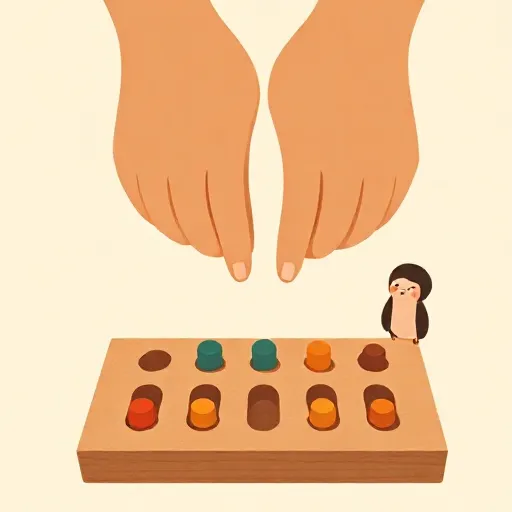
If you look at a sentence like “Every cat is on a mat,” you immediately start thinking about which objects the words pick out. A logician does the same thing, but with a technique called satisfaction. Instead of asking right away “Is this sentence true?”, Tarski first asks: “Given an assignment of objects to the variables in a formula, does that assignment make the formula come out right?”
Picture a formula with a blank: “x loves y.” An assignment plugs in two people — say, Mira for x and Leo for y. We say the assignment satisfies the formula if Mira really does love Leo. For a more complicated formula like “(x loves y and y loves x),” an assignment satisfies it exactly when the same assignment satisfies “x loves y” and also satisfies “y loves x.” That’s a compositional rule: you build the truth of a complex formula from the truth of its parts.
The quantifier “for all” works by imagining all possible assignments that differ only in where x points. An assignment satisfies “For all x, x is a friend” only if, no matter which person you assign to x, that person turns out to be a friend. So the definition of satisfaction unpacks the whole sentence into small checks about assignments.
Once you have satisfaction pinned down, truth drops out naturally. If a sentence has no free variables hanging loose — like “For all x, x is a friend” without any undetermined x — then the sentence is true when every assignment satisfies it. Truth becomes a special case of satisfaction, like a puzzle piece that snaps into the final slot.
Convention T: The Test Every Truth Definition Must Pass
Tarski still needed a way to check that his definition didn’t drift away from what we ordinarily mean by “true.” He invented a test called material adequacy, or more famously Convention T. For every sentence S of the object language, we must be able to prove, using the metalanguage, a sentence of this form:
True(name of S) if and only if ψ,
where ψ is the translation of S into the metalanguage. In the simplest case, “Snow is white” is true if and only if snow is white. The definition must churn out all these T‑sentences as logical consequences.
That requirement might sound small, but it packs a punch. Suppose you tried to define truth by simply listing all the true sentences. For a tiny language that’s possible. But most interesting languages have infinitely many sentences. You can’t write an infinite list. Tarski’s satisfaction account pulls it off because the recursive clauses generate the T‑sentences for every sentence, no matter how complex, as long as you can handle the atomic ones. It is like having a megaphone that relays the definition of truth from simple bricks all the way up to the tallest tower.
The Liar Paradox Strikes Back

Here is where Tarski’s careful scaffolding pays off. Imagine an object language that can talk about its own truth. Then you can build a sentence that says of itself: “This sentence is false.” If it’s true, then what it says must hold, so it’s false. If it’s false, then it must be true. This is the liar paradox, a trapdoor that swallows any language that tries to define its own truth without outside help.
Tarski’s sharp conclusion: a truth definition for a language L must always live in a metalanguage that is essentially stronger than L. You cannot catch the truth of a language from the inside without courting contradiction. That doesn’t mean we can never talk about truth. It means we talk about it in a careful stairway of languages: a metalanguage for L, a meta-metalanguage for that, and so on. Each level stays safe because it never has to pronounce on its own truth.
For mathematicians, this has a humbling consequence. The standard language of set theory is enormously powerful, but Tarski’s result shows you can’t give a fully general definition of truth for set theory inside set theory itself. We can define truth for limited fragments — Azriel Levy later showed how to do it for formulas of certain shapes — but the whole language resists. The tower of truth always needs a higher floor.
Why Tarski’s Tower Still Stands

In the 1950s, Tarski and Robert Vaught (1926–2002) gave truth a new coat of paint. Instead of assuming that a language always interpreted its symbols in the same way, they let the meaning shift depending on the structure — a chosen domain of objects and a way of reading the symbols. This version, now called model theory, lets logicians ask whether a sentence is true in one structure and false in another. That flexibility turned out to be enormous: it became the standard engine for semantics in mathematics, linguistics, and computer science.
Today, when a programming language checks whether a condition is met, or when a search engine parses your question, the machinery behind the curtain often leans on Tarski’s step-by-step definition. His ideas also taught philosophers that understanding truth isn’t about finding a mystical glow inside sentences. It’s about building a clear, testable pattern — piece by piece, with no shortcuts.
The puzzle remains breathtakingly alive. Can we design a language that safely talks about its own truth without collapsing into the liar paradox? Many later logicians, from Leon Henkin to Jaakko Hintikka, have invented clever workarounds for special systems. But the bedrock rules Tarski set down still remind us that defining truth is like building a tower in a marsh: you need solid foundations, and you must never claim the top floor supports itself.
Next time you hear a sentence and instantly know it’s true, you are doing something a machine can mimic only because Tarski showed how to break the magic into small, composable parts. The question that started with rain on a window now lives inside every computer that sorts fact from fiction.
Think about it
- If you built a perfect truth-tester that could judge all sentences in English, would that machine be able to judge the sentence “This sentence is false” without breaking? Why or why not?
- Imagine a friend says, “I am lying right now.” Is it possible to decide, once and for all, whether they are speaking truly or falsely? What would a rule-book have to do to handle such sentences?
- When a computer program checks a statement like “2 + 2 = 4,” it uses a tiny, formal language. Do you think there are things we say in everyday life that a computer could never assign a truth value to, even with a perfect dictionary? Give an example and explain why it might cause trouble.