

What Makes Something Logically Follow? Tarski's Algebra of Arguments
The Consequence Machine: Tarski’s Big Idea

You are solving a mystery from three clues. Clue one: if it rains, the picnic is off. Clue two: it is raining. What follows? The picnic is off. That new statement is a logical consequence of the clues. It has to be true, whether you like it or not.
In the 1930s, the Polish mathematician Alfred Tarski (1901–1983) wanted a single, clear way to describe this “must be true” step for any set of statements. He built an abstract consequence operation — a rule that takes a bunch of sentences and hands you back everything that logically follows from them. Tarski wrote down three simple laws that any good consequence operation must obey.
First, the original statements themselves are always consequences. If you start with a seed, the plant that grows still includes that seed. Second, consequences of consequences add nothing new. If you take all the consequences of your clues and then ask what follows from that, you get the same set — the plant won’t sprout a second plant. Third, every new fact follows from a finite number of the original statements. You never need an infinite pile of clues to draw a single conclusion. Tarski called an operation with this third property finitary.
These three laws became the starting point for a whole new way of looking at logic. Instead of asking what each particular argument proves, logicians could study the general machinery that produces consequences. It was like zooming out from a single chain of dominoes to see the whole factory that makes them fall.
Building Blocks of Reasoning

To make logic work with algebra, we first need a language. In propositional logic, the language is built from simple symbols called connectives: ∧ means “and,” ∨ means “or,” → means “if … then,” and ¬ means “not.” These connectives snap together like Lego bricks. Just as you can write an arithmetic expression like 3 + (x × y), you can write a logical formula like (p ∧ q) → ¬r.
Why treat formulas as if they were algebra problems? Because you can interpret them inside a mathematical structure. Here is how. Imagine a world where every statement is either true or false. A valuation is a way of assigning truth (T) or falsehood (F) to each simple sentence letter. For a compound formula, you compute its truth value step by step, using definitions of the connectives. For example, p ∧ q is T only when both p and q are T. That is exactly what a truth table tells you.
Now think of the formula itself as a kind of algebraic term. If you give it some values for its variables, you can calculate the answer. In logic, the answer is always T or F. So a logical formula is an algebraic expression that lives in the two‑element set {T, F}. This small shift — seeing formulas as algebra — opened the door to a stunning discovery.
Turning Logic into Equations: The Lindenbaum‑Tarski Method
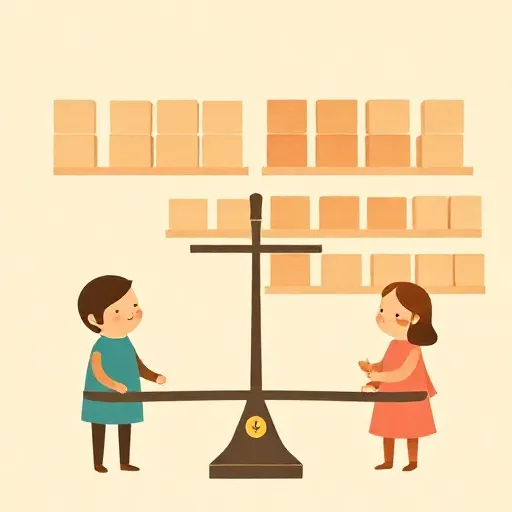
For some logics, the link between reasoning and algebra is so tight that you can translate one into the other without losing a thing. Classical logic is the star example. Its algebra is called Boolean algebra, and the trick is called the Lindenbaum‑Tarski method.
Start with the set of all formulas in your language. Define a relation between formulas: φ and ψ are equivalent if the two‑way conditional φ ↔ ψ is a theorem — a formula that is always true, no matter what truth values you start with. This equivalence acts like saying two expressions are equal. You can then “factor out” this equivalence. The result is a new algebra where each element is a whole class of equivalent formulas. In classical logic, this algebra turns out to be a Boolean algebra.
Now comes the crucial part. In that Boolean algebra, a formula is a logical consequence of a set of premises exactly when, for every valuation, if the premises all equal the top element (TRUE), then the conclusion does too. That is an equation condition. So the consequence relation of classical logic can be completely captured by an algebraic equation. Logics that have this tight correspondence are called algebraizable.
Intuitionistic logic works the same way, but its algebra is a Heyting algebra instead of a Boolean algebra. The pattern is identical: use a biconditional to build an equivalence, take the quotient, and the consequence relation becomes an equation about a special element. Tarski’s abstract idea now had a concrete, algebraic face.
A Hierarchy of Tidy and Messy Logics

Not every logic is algebraizable. A famous example comes from modal logic, which adds words like “necessarily” and “possibly” to ordinary reasoning. The global version of the simplest modal logic, K, is algebraizable; its local version is not. The two share the same class of algebras — modal algebras — yet only one can be expressed as a neat equation about a designated truth value.
This difference forced logicians to draw a map. They developed a classification called the Leibniz hierarchy, named after a key idea. For any logic, you can define a relation — the Leibniz congruence — that tells you when two formulas behave identically in all possible contexts. In algebraizable logics, this congruence is defined by a set of equivalence formulas (like a biconditional). In equivalential logics, there is still a set of formulas that define the congruence, but you might not be able to turn the logic into an equation. In protoalgebraic logics, a set of formulas behaves weakly like an implication, but the translation into algebra is rougher.
Think of it like locks and keys. An algebraizable logic is a lock for which there is exactly one key, cut perfectly. An equivalential logic might have several keys that all open the lock, but you can still describe the key shape. A protoalgebraic logic might have a borrowed key that sometimes jams. And some logics are not even protoalgebraic — like the fragment of logic that uses only “and” and “or” without negation. That fragment is still self‑consistent and useful, but it refuses to be captured by a single algebraic equation.
This hierarchy is not just a labeling game. It helps mathematicians prove bridge theorems: if a logic sits at a certain level, then certain cherished properties — like the deduction theorem or interpolation — come along automatically. The algebraic character of a logic leaks back into its reasoning power.
The Periodic Table of Reasoning
Why does all this matter? Every time you argue — with a friend about whether a movie is scary, or in a math class proving a theorem — you are working inside a logic. Most of the time you use classical logic without thinking. But when you say “it’s possible that aliens exist” or “you should believe climate science because the evidence supports it,” you might be reaching for a different logic, one that handles necessity, belief, or probability.
The algebraic approach gives us a unified way of comparing these logics. By seeing which logics are algebraizable and which are not, we understand why some forms of reasoning feel crisp and mathematical while others feel fuzzy. It also guides computer scientists building automated reasoning systems or programming languages: an algebraizable logic can be implemented with efficient algebraic tools.
Tarski began by asking what makes one statement follow from another. Eighty years later, his question has grown into a vast map of consequence relations, each with its own algebra, its own strengths, and its own quirks. So the next time you notice that some arguments are airtight and some leave room for doubt, you are glimpsing the architecture that Tarski first sketched — a hidden structure behind every “therefore” you ever use.
Think about it
- Imagine you invent a new logic for a board game, where certain moves “force” others. Could you find an algebra that perfectly matches it, or might it be one of the logics that resists being shoe‑horned into equations?
- If a logic is not algebraizable, does that mean it is less useful or just different? Can you think of a real‑life situation where you would want a logic that doesn’t fit neatly into algebra?
- Tarski said that conclusions are already contained in the premises, just waiting to be drawn out. Do you agree? Or do you think a really clever argument can sometimes give you a genuinely new idea?```