Is Life Just a Machine We Can Rewire?
A Room Full of Teenage Inventors

Imagine a room buzzing with excitement. A group of teenagers peers at a petri dish glowing faintly green. They aren’t just growing germs—they programmed these bacteria to turn green when they detect lead in water. They treat DNA like computer code and cells like tiny machines you can redesign. This is the iGEM competition, where students do synthetic biology, a science that aims to build new living things from scratch.
But the bigger question hangs in the air: Is life really just a machine we can rewire? That question links synthetic biology to its “sister discipline” systems biology, which tries to understand life by mapping all the connections inside a cell as if it were a huge electronic circuit. Together, these fields are forcing us to rethink some of the deepest puzzles about what it means to be alive.
Circuits in Your Cells: The Hunt for Design Principles

For decades, biology focused on isolating single genes or proteins, like taking apart a clock to study one gear. Systems biology takes a different approach. It looks at networks—huge webs of thousands of molecules that interact all at once. The goal is to find design principles: simple, reusable rules that explain how living systems work.
Scientists like Uri Alon (born 1965) discovered that certain biological networks contain tiny repeating circuits called network motifs. One example is a “feedforward loop,” a pattern where a signal passes through two paths, one fast and one delayed. In electronics, that can filter out noise. In bacteria, a similar loop might help a cell ignore random chemical blips and respond only to a real food source. Alon’s team found that such motifs appear far more often than chance would predict, not just in bacteria but in many organisms.
Other biologists search for switches, oscillators, and amplifiers—exactly the kinds of parts an engineer would build a radio from. A famous example is the genetic toggle switch, a double-negative feedback loop that flips a cell between two stable states, like a light switch. A synthetic version built in E. coli in 2000 showed that a designed circuit could work inside a living cell. This way of thinking treats a cell as a reverse-engineered gadget: we take it apart (on paper) to figure out how its design could produce complex behavior.
The Machine That Didn’t Obey: When Life Fights Back
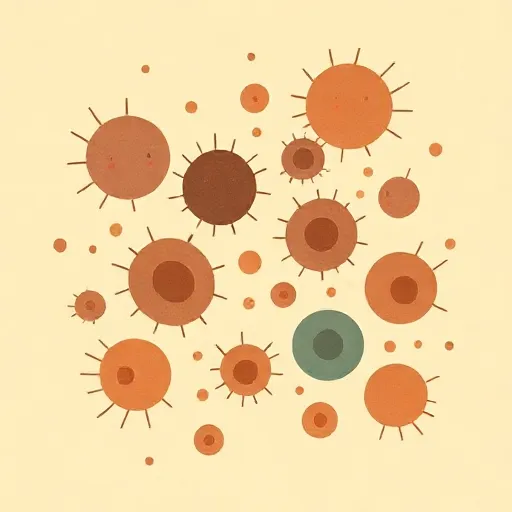
If biology is just engineering, then a designed circuit should behave predictably. That hope ran into trouble with an experiment called the repressilator, built by Michael Elowitz (born 1970) and colleagues in 2000. The repressilator was a synthetic gene circuit designed to make three proteins cycle up and down in a steady, clock-like rhythm. The math was clean. The synthetic DNA was precise. But when they put it into living bacteria, the cells did not blink like a metronome. They flickered unevenly, like a firefly in a thunderstorm.
That failure turned out to be a gift. It showed that living cells are not neat logic chips. They are full of noise—random molecular jitters that engineers usually try to eliminate. In life, however, noise can be useful. It can help cells adapt, or make a population more flexible. The repressilator forced scientists to rethink their engineering ideals and to realize that biology often works by kludging: a clumsy, ugly, dumb but good-enough solution, not a perfect blueprint.
Many now argue that trying to force life into rigid engineering boxes misses something essential. A cell is not a Lego set where every block snaps predictably into place. Instead, parts change their behavior depending on the whole system’s state. Synthetic biology often advances through forward tinkering—building, testing, breaking, and tweaking in endless cycles—rather than rationally designing a finished product from scratch.
Can a Bag of Chemicals Come to Life?

If we can’t perfectly predict even simple synthetic circuits, can we at least figure out what the absolute minimum life is? That question drives protocell creation, where scientists try to build living systems from basic chemical ingredients.
Some experiment with vesicles: tiny fatty bubbles that resemble primitive cell membranes. When certain molecules get trapped inside, they can trigger chemical reactions that maintain the bubble, much like a metabolism. Researchers inspired by the idea of autopoiesis—the system’s ability to continuously produce and maintain itself—wonder whether a bubbling, cycling blob could count as alive.
On another front, Craig Venter’s team (Venter born 1946) set out to find a minimal genome. In 2016, they built a synthetic bacterium with only 473 genes, the smallest set ever shown to keep a cell reproducing. That’s far simpler than any natural free-living organism. Yet a deeper philosophical puzzle remains: Is life just a checklist of parts, or does it need something more—like a self-organizing whole that cannot be reduced to its ingredients? This echoes old questions from Aristotle to Robert Rosen (1934–1998), who argued that living things have a kind of circular causality where the whole both emerges from and constrains the parts.
Some systems biologists call this emergence: a property of the system that cannot be predicted just by looking at its individual components. A heart cell’s rhythm, for example, depends on the whole tissue’s electrical state, not just the ion channels inside it. If that’s right, even a perfect catalog of all your genes may never fully explain you as a living person.
Medicine Just for You—and the Tough Questions

Why does this matter to you? Because systems and synthetic biology are already changing medicine. Systems medicine uses network models to understand complex diseases like cancer. Instead of blaming a single broken gene, researchers map the whole web of interactions that let a tumor grow. That could lead to personalized medicine: treatments tailored to your own molecular profile, not a one-size-fits-all pill.
But this power raises hard ethical questions. If scientists can predict from your DNA that you have a high risk for a disease, should they tell you everything, even if it might cause anxiety without a cure? When synthetic biology creates microbes that produce cheap medicines or clean up pollution, who decides whether the benefits outweigh the risks of these new life forms escaping into the wild? And if we start designing cells that work like tiny machines, does that change how we value life itself? Some philosophers worry that thinking of organisms as engineered gadgets can chip away at our sense of respect for living things.
The teenagers at that iGEM competition already face these dilemmas. They might build a bacterium that devours plastic waste, but they also have to think about safety, fairness, and the difference between fixing a machine and creating something that might evolve in unexpected ways. The line between understanding life and designing it has never been thinner—and it’s our generation that gets to decide where to draw it.
Think about it
- If you could design a bacterium to clean up oil spills, but there’s a small chance it might escape and harm an ecosystem, would you do it? Why or why not?
- If a doctor could predict exactly which diseases you will get by reading all your genetic data, should she tell you everything—even the scary possibilities you can’t change?
- Imagine a synthetic cell that grows, divides, and repairs itself just like a natural cell, but was built entirely from scratch. Does it count as truly alive, or does life need something more that we can’t build?