Can Something That Never Happens Still Be Real?
The Dice That Might Land on 11
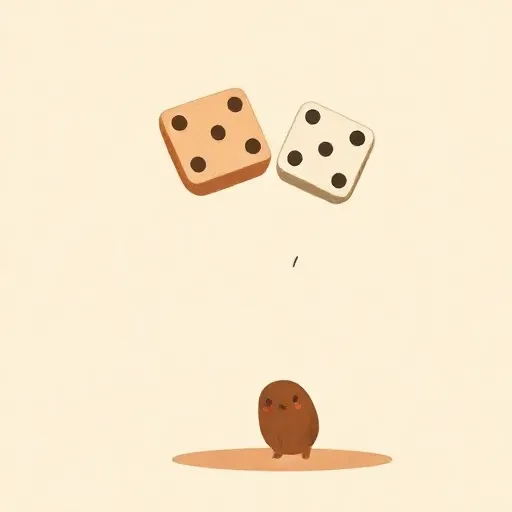
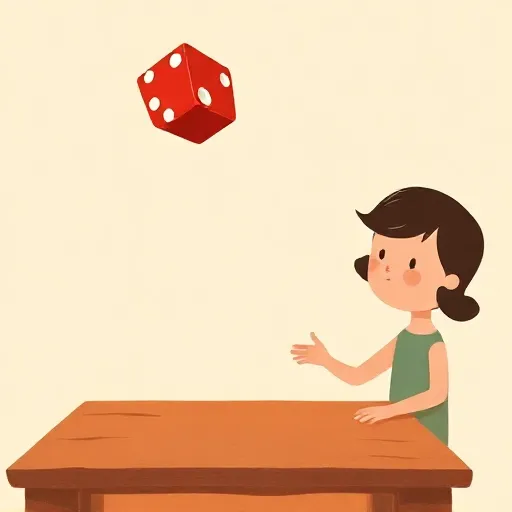
Here is a school exercise. You have two ordinary dice, each with six sides. You toss them onto a table. Before they stop rolling, there are thirty‑six possible ways they could fall. For example, one die could show a 5 and the other a 6. Or the first could show a 6 and the second a 5.
What is the probability that the dice together will show 11? There are only two arrangements that give that total. The ratio is 2 out of 36, or about 5.6 percent. To do the calculation you must treat those outcomes as things that exist right now, even though the dice have not yet come to rest and most of those outcomes will never happen.
The philosopher‑logician Saul Kripke (1940–2022) used precisely this exercise to show that we need a special kind of object: something that is neither a solid fact nor a thought in someone’s head, yet can be probable or possible to a certain degree. He called such objects states of affairs. A state of affairs is a way a part of the world might be. It involves real objects and properties, but it does not need to obtain — to be actually true — in order to exist.
If we could only talk about what is the case, the whole idea of a probability would collapse. We need a space of possible states, like the thirty‑six outcomes for two dice, that are “there” whether or not they ever roll into reality.
What’s a State of Affairs? (Or: Obtaining vs Being True)

A state of affairs is an arrangement of objects and properties. Socrates’ being wise involves Socrates and the property being wise. The die’s showing 5 involves a particular die and the property showing 5. When a state of affairs is actually realized — when Socrates really is wise, or the die really does land on 5 — philosophers say it obtains. If it is not realized, it does not obtain.
This “obtaining” property is crucial. It looks a lot like truth: the state of affairs Socrates’ being wise obtains exactly when it is true that Socrates is wise. So why use a different word?
Philosophers like Adolf Reinach (1883–1917) argued that the difference is about what the object itself is. A state of affairs is not a sentence or a belief; it is a chunk of the world‑as‑it‑might‑be, built from the very objects and qualities out there. Thoughts (also called propositions) are what you believe. They can be true or false. But states of affairs obtain or don’t. One reason to keep the two apart is that states of affairs can exist without obtaining. That is vital for capturing possibility — as the dice showed.
Reinach put it this way: states of affairs, and only states of affairs, can adopt such modalities as probability and possibility. A die cannot be probable. A fact cannot be merely possible — it is actual, period. A state of affairs, however, can carry a degree of probability while remaining unrealized.
Why Can’t We Just Use Facts?

A fact is something that is definitely the case — like the fact that you are reading this right now. Facts cannot be merely possible; they are always actual. If it is a fact that the die shows 5, then the die does show 5, full stop. The moment something is false, the corresponding fact vanishes. There is no fact that the die shows 2 when it actually shows 5.
But to calculate probability before the throw, we needed the possible outcome “the die shows 2” to be available without its obtaining. That is exactly what a state of affairs gives us. A state of affairs can exist whether or not it obtains; a fact exists only when things really are that way.
The Australian philosopher David Armstrong (1926–2014) gave an influential argument for facts as truth‑makers. Consider the true thought “Socrates is wise.” What makes it true? Socrates himself won’t do — he might have been foolish. The property being wise alone is not enough either. Armstrong said what does the job is a special complex that ties the particular and the property together: the fact that Socrates is wise. Facts, for Armstrong, are instantiations — real, existent glue between things.
Notice that a fact never needs the label “obtaining.” It is redundant to say “the fact that Socrates is wise obtains.” To call it a fact is already to say it does. So facts are poor tools for talking about possibilities. If you try to use a fact to represent a way the dice might land, you are forced to pretend that outcome is already actual. That collapses possibility into actuality. So we keep both: facts handle what is; states of affairs handle what could be.
Thoughts Are Great, but They’re Too Specific

If states of affairs are built from objects and properties, then two descriptions that pick out the very same object and property should give us the very same state of affairs. That sounds sensible. But it causes trouble when we compare states of affairs with thoughts — the contents of beliefs, hopes, and fears.
Consider the planet Venus. Ancient astronomers called it Hesperus when it shone in the evening and Phosphorus in the morning, not realizing it was one planet. Today you can believe Hesperus shines while doubting Phosphorus shines, because you might not know they are the same. That shows the two beliefs are different thoughts. If thoughts were made of objects and properties directly, they would be identical — but they are not, because you can hold one without the other. So thoughts must contain modes of presentation, ways of picking out the object, rather than the object itself.
States of affairs work the opposite way. The state of affairs Hesperus’ being a planet is the very same as Phosphorus’ being a planet — it contains only Venus and the property being a planet, no names or perspectives. This coarse‑grained identity makes states of affairs perfect for one big job: pinning down modal properties, like being necessary or contingent.
The philosopher Graeme Forbes explained the difference with pairs of sentences:
| Sentence pair | Truth | Modal status |
|---|---|---|
| “Hesperus shines” / “Phosphorus shines” | Contingently true | Same |
| “Hesperus is Hesperus” / “Hesperus is Phosphorus” | Necessarily true | Same |
Within each pair, the two sentences describe the same state of affairs. That explains why they share the same modal status — one contingent, one necessary. If we used thoughts instead, each sentence would encode a different mode of presentation and we would lose that unity. So states of affairs are the fundamental bearers of modal status. A sentence is necessarily true if the state of affairs it stands for obtains in every possible world.
How Does a State of Affairs Hold Together?
If a state of affairs is built from objects and properties, what keeps them together when the state does not obtain? Take the state of affairs Socrates’ being foolish, which does not obtain. In what sense does it “contain” Socrates and foolishness?
The German logician Gottlob Frege (1848–1925) pointed out a problem with treating states of affairs as ordinary complexes. If the volcano Vesuvius is a part of the state of affairs Vesuvius’ being a volcano, then by ordinary part‑whole logic the lava inside Vesuvius should also be part of that state — which seems absurd. A state of affairs does not weigh anything or have molten rock inside it.
So states of affairs cannot be mere sums of parts. That leads to the unity problem: what makes some objects and a property form a single state of affairs?
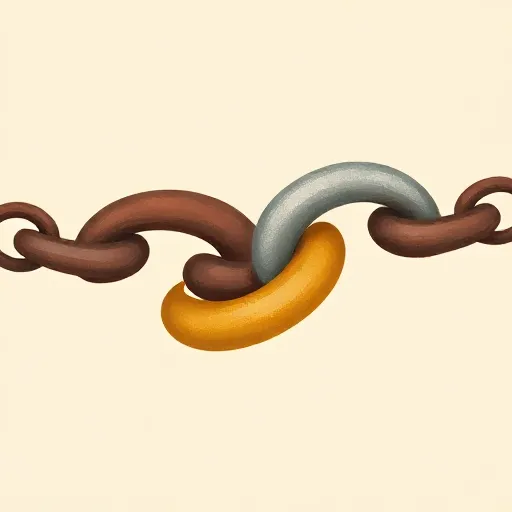
Many philosophers reply that there is no extra “glue” — the unity is internal to the ingredients themselves. Wittgenstein (1889–1951) compared objects in a state of affairs to links in a chain: they are incomplete in their very nature, and they fit together because of what they are. A property like being wise is “hungry” for an object; an object “needs” properties. When the two natures match, the state of affairs exists automatically, whether or not it obtains.
A modern version of this idea says that a state of affairs exists whenever the property is predicable of the object. That does not mean anyone has to speak a sentence; it means that the nature of the two things permits that combination. The state of affairs is then a unique kind of entity — ontologically dependent on the object and property, but not composed of them like bricks in a wall. This solves Frege’s worry: the lava is not part of the state because the state does not literally contain Vesuvius; it only depends on Vesuvius for its identity.
The unity problem is still open. But answering it would tell us exactly what kind of “stuff” possibilities are made of.
Why Bother? (Why States of Affairs Still Matter)

You may never use the phrase “state of affairs” yourself. But you already live in a world full of them. Every time you think “if only I had studied more,” or weigh two choices on a video‑game dialogue tree, you treat unrealized possibilities as things that exist. You compare their consequences; you assign them probabilities; you feel regret about ones that didn’t obtain. Those mental moves depend on the same structure that the dice exercise revealed.
Without states of affairs, the whole notion of probability would be a trick of language. Half of our emotional life — hope, regret, relief — would be aimed at nothing at all, because we would have no way to talk about what could have been except as hallucinations of words.
Philosophers continue to argue about the best way to understand states of affairs. Some identify them with sets of thoughts that are alike in a certain way. Others claim they are mere fictions, convenient but not real. Still others, following a tradition that runs from Reinach to Wittgenstein to contemporary thinkers, insist they are genuine, non‑physical pieces of the world’s architecture — just as real as numbers or laws of nature, and just as indispensable.
The question that launched this article — can something that never happens still be real? — is not settled. But by thinking about it, you are joining a centuries‑long conversation about the very shape of reality. And that conversation is one of the things that make philosophy a permanent human activity.
Think about it
- When you say “I could have chosen chocolate cake instead of vanilla,” what are you referring to? Is it a thought, a fact, or something else — and does it matter?
- If all possible states of affairs already exist, does that mean your future is already fixed? Or could you still have free will?
- Suppose a scientist created a complete computer model of the world that listed every possible outcome of every event. Would that model be the states of affairs, or just a description of them? What’s the difference?