Do Your "What Ifs" Really Mean What You Think?
What If Everything Had Gone the Other Way?
Imagine this: you almost joined your friend for ice cream after school, but you stayed home instead. Later, you think, “If I had gone, I would have gotten a stomach ache.” Is that sentence true? How could you know, when it never actually happened? You are picturing a parallel reality—a world where you did go, where ice cream sat in your stomach, where consequences unfolded. Philosophers call sentences like this counterfactuals. They are “if … then” claims about things that didn’t occur, or that we merely suppose didn’t occur.
Counterfactuals show up everywhere. When we talk about what caused something, we lean on them: “If the driver hadn’t run the red light, the crash wouldn’t have happened.” When we talk about abilities, they sneak in: “If you tried to stand on one leg, you would succeed.” Even big choices about what to believe or do often rest on a silent chain of what-ifs. The puzzle is: what makes these sentences true or false, given that the events they describe are not real?
Philosophers have been wrestling with this question since the 1940s. It might sound like a minor word game, but it touches everything from free will to scientific explanation. The struggle to understand counterfactuals has forced thinkers to build entire invisible universes—and they are still arguing about what those universes look like.
The Problem of the Match That Never Lit
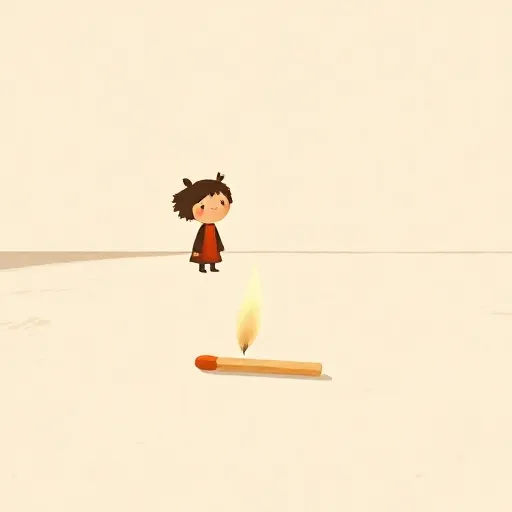
Nelson Goodman (1906–1998) put his finger on a deep problem in 1947. Suppose you never struck a match that was sitting on your desk. You say, “If I had struck this match, it would have lit.” That seems obviously true. But what exactly are you assuming? The match would need to be dry. There must be oxygen in the room. The striking surface must produce enough friction. None of your muscles can spasm. The laws of nature can’t suddenly change. The list goes on and on—an endless pile of background facts that you take for granted.
Now ask: which background facts are we allowed to hold steady, and which must we let go? You cannot simply keep every actual fact except “I didn’t strike the match,” because one actual fact is that the match never lit. Another is that the room was dark, and another is that the match head was perfectly unburnt. If you kept all those, the match couldn’t light. So we have to drop some facts and keep others—but there seems to be no clean rule for deciding which ones. Goodman called the search for a non-circular rule the problem of cotenability. You want to say you keep facts that would still have been true if you had struck the match. But that uses another counterfactual to explain the first one.
The same puzzle appears whenever you imagine history going differently. Consider the Roman emperor Julius Caesar. In one conversation you might say, “If Caesar had been in charge during the Korean War, he would have used the atom bomb”—maybe because he was brutal. In another conversation you might say, “If Caesar had been in charge, he would have used catapults.” Which one is right? The answer seems to shift with the context. That suggests counterfactuals are deeply context-sensitive: their truth depends on what speakers are quietly agreeing to keep fixed in the background.
Two Rival Ways to Build Possible Worlds

To make sense of all this, many philosophers borrow an idea from modal logic: possible worlds. A possible world is just a complete way the universe could have been—down to every last atom. A counterfactual like “If I had gone for ice cream, I would have gotten a stomach ache” means: in possible worlds where I went for ice cream, I got a stomach ache. But which worlds count?
One early answer, defended by thinkers like C. I. Lewis (1883–1964), is the strict conditional view. It says a counterfactual is true only if the consequent holds in every possible world where the antecedent holds. So “If I had gone for ice cream, I would have gotten a stomach ache” would require that in absolutely every possible world where I went, my stomach rebelled—including worlds where the ice cream was made of magic broccoli. That seems far too strong. We don’t normally consider those wild worlds; we only care about worlds that are, in some sense, close to our own.
This insight led to the most popular view today: the variably strict analysis, developed by Robert Stalnaker (b. 1940) and David Lewis (1941–2001). They proposed that we only look at the closest possible worlds where the antecedent is true—the ones that differ as little as possible from reality. “If I had struck the match, it would have lit” is true if, in the most similar worlds where I strike it, it lights. We ignore worlds where a wizard appears or gravity stops. This naturally explains why adding extra details can flip the truth: “If I had struck the match in a room without oxygen, it would have lit” is false, because the closest oxygen-free worlds are ones where the match doesn’t light. The analysis can handle chains of reversed truth values, called Sobel sequences, which are famous in the literature.
The Fight Over Similarity
But similar in what way? This question has caused endless trouble. Kit Fine offered a sharp challenge in 1975. Imagine that President Nixon never pressed the nuclear button. The counterfactual “If Nixon had pressed the button, there would have been a nuclear war” seems true. Yet a world where Nixon presses the button but a tiny electrical short miraculously stops the rockets might be more similar to the actual world—no war, no massive destruction—than a world where the missiles fly. Our ordinary idea of overall similarity seems to pick the wrong world.
Lewis responded by ranking different kinds of similarity. He said we prioritize avoiding big violations of physical laws over matching tiny facts. A small miracle (a short-circuit) is a law violation, so a world with a small miracle is less similar, by the right standard, than one where the laws hold steady and war happens. But critics have piled on more counterexamples. A famous one: you decline to bet on a coin toss; the coin lands heads; your friend says, “If you had bet heads, you would have won!” Intuitively that is true, but any world where you bet heads yet the coin still lands the same way—with no miracle—is extremely similar to the actual world, so the Lewis ranking seems to support the claim. Yet our rough sense of similarity doesn’t always match.
These battles have driven some philosophers to abandon similarity altogether and look for more “objective” grounds, such as laws of nature, objective chance, or causal models. Others think similarity is vague in exactly the way counterfactuals themselves are vague—and that is a feature, not a flaw. The debate remains unsettled, but it has sharpened everyone’s understanding of how our minds slice up possible realities.
Why the Puzzle Follows You Home
You might wonder why any of this matters beyond dusty books. But counterfactuals are the hidden engine of some of the deepest human concerns.
When we say one event caused another, counterfactuals are often right there. Why did a window shatter? Because Suzy threw a rock; if she hadn’t thrown it, the window wouldn’t have shattered. This simple connection between cause and counterfactual has been the starting point for an enormous amount of thinking about science, law, and everyday reasoning.
When we talk about your own abilities—riding a bike, solving a math puzzle—counterfactuals reappear. “You are able to ride a bike” seems to mean something like: if you were to try, you would generally succeed. And when we talk about free will, the same pattern emerges. A choice feels free partly because you believe you could have done otherwise: “If I had wanted to stay home, I would have.” If every future event is already determined by the past and the laws of physics, it’s not obvious that such counterfactuals are true. This tension between determinism and freedom is one of the great philosophical dramas, and it runs on counterfactual fuel.
Even regret and relief are dressed up in what-if clothing. The sting of missing the bus, the warm glow of a lucky escape—both rely on an invisible comparison with a world that never was. Scientists who study depression and anxiety have found that people’s patterns of counterfactual thinking profoundly shape their emotions and their ability to plan for the future. So the puzzle of what makes a counterfactual true is not a side-quest. It is a puzzle about how you navigate regret, hope, and choice every day.
The Conversation Is Still Roaring

There is no single agreed-upon answer. The strict conditional analysis has been revived by clever arguments about how context shifts in conversation, suggesting that counterfactuals might be monotonic after all. Variably strict accounts keep evolving, with some philosophers replacing mushy similarity with precise causal models—networks of equations that let you “intervene” and calculate what would happen, a method now used in artificial intelligence and climate science. Others argue that counterfactuals are fundamentally about chances: “If this coin had been flipped, it would have landed heads with a 50% probability,” and that bare would-claims are either false or merely highly probable.
Meanwhile, a separate debate rages over counterfactuals with impossible antecedents, like “If Hobbes had squared the circle, he would be famous.” Standard theories say such sentences are automatically true because there are no possible worlds where the antecedent holds. But many thinkers find that absurd. The struggle to handle these counterpossibles has forced logicians to consider “impossible worlds” and re-examine the very foundations of logic.
What began as a handful of puzzles about matches and Caesar now sprawls across philosophy, linguistics, psychology, and computer science. The next time you murmur “if only,” you are joining a conversation that has been running for decades, and the last word has not been spoken.
Think about it
- If you could press a button and see exactly what your life would be like right now if you had made a different choice last year, would the answer be a fact about the universe, or more like a story you tell yourself?
- Can two friends both be right when they say opposite things about the same “what if” (“If Caesar were alive today, he’d love Twitter” vs. ”… he’d hate it”), or must one of them be mistaken?
- If all our talk about causes and choices depends on counterfactuals, and counterfactuals turn out to be fuzzy or even false, would we have to rethink who deserves praise or blame for their actions?