
Why Spinoza Thought Your Mind and Body Are the Same Thing
A Strange Question in a 17th‑Century Study
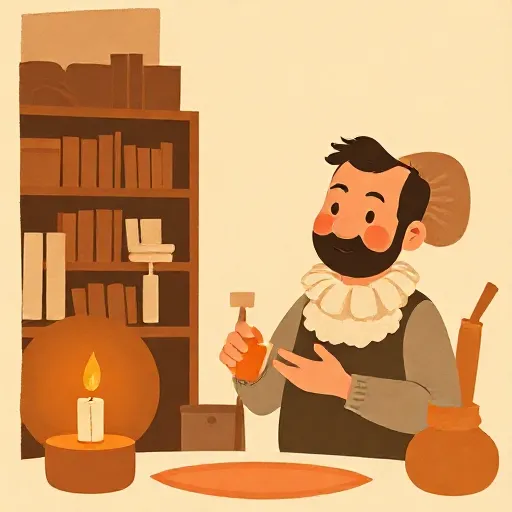
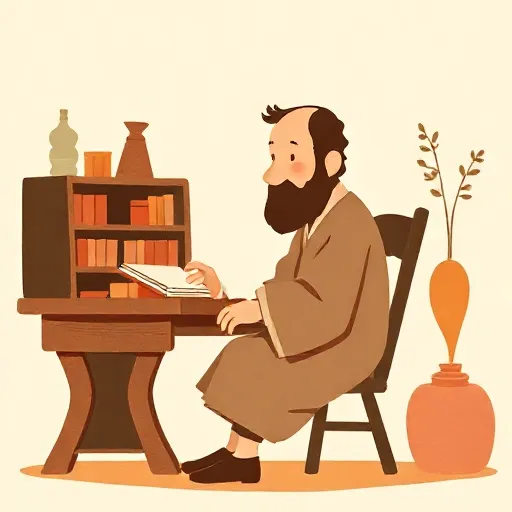
It is a winter evening around 1640. In a small room in the Netherlands, the French thinker René Descartes (1596–1650) sits by the fire. He picks up a lump of wax — cool, white, smelling faintly of honey. He lists its qualities: hard, sweet-scented, making a sound when tapped. Then he holds it near the flame. The wax softens, drips, changes color and smell. Everything he sensed a moment ago has vanished. Yet Descartes knows it is still the same piece of wax. What never changed? Its extension — that it takes up space, with length, breadth, and depth. From this he concludes that the very core, or essence, of a physical thing is simply being extended.
Now he turns inward. Even if he doubts everything else, he notices he is doubting — that is, thinking. Thinking includes understanding, imagining, willing, and sensing. The essence of his mind is thought. So Descartes sees two completely different kinds of stuff: mind (thought) and body (extension). He calls these attributes — the fundamental ways a thing exists. For Descartes, every created substance has exactly one attribute. Minds have thought; bodies have extension. They are really distinct, meaning each can exist without the other.
This leaves a puzzle: if mind and body are so separate, how does your desire to raise your arm actually make it rise? How can a thinking thing touch a physical thing? Descartes struggled with this “union” problem for the rest of his life. A young Dutch lens‑grinder and philosopher, Baruch Spinoza (1632–1677), took the puzzle even more seriously — and his answer would turn the whole picture upside down.
Spinoza’s One Big Substance
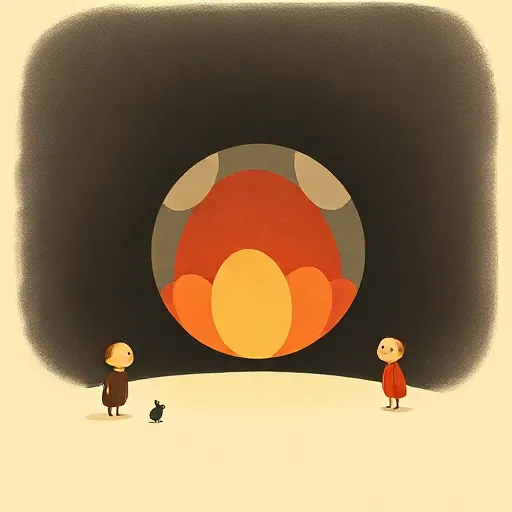
Spinoza agreed with Descartes that thought and extension are attributes and that they are really distinct. But he rejected a key claim: that there are many created substances. Instead, Spinoza argued there is only one substance. He defined substance as something that exists entirely by itself and is understood entirely through itself. That single substance is what he called “God, or Nature” — meaning the whole of reality, not a person‑like creator. It has infinite attributes. Each attribute expresses the substance’s essence in a complete and independent way.
Spinoza’s universe is not made of separate mental stuff and physical stuff. It is one thing, seen through different lenses. An attribute is, in his famous definition, a way the intellect grasps what a substance is (Ethics 1D4). (We will unpack that tricky word “intellect” later.) The attributes we know best are Thought and Extension. But Spinoza held there are infinitely many others, all equally real, though hidden from us.
How can one substance have many attributes without falling apart? Spinoza insists that two attributes can be understood entirely on their own. You don’t need to mention shape to explain a thought. Yet that does not prove they are separate substances. In a startling move, he says the real distinction between attributes does not mean two beings. It means two complete, self‑contained ways of understanding the same being.
Two Ways of Seeing Everything
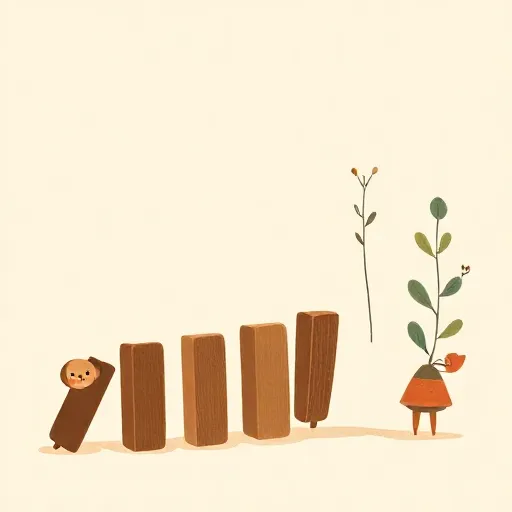
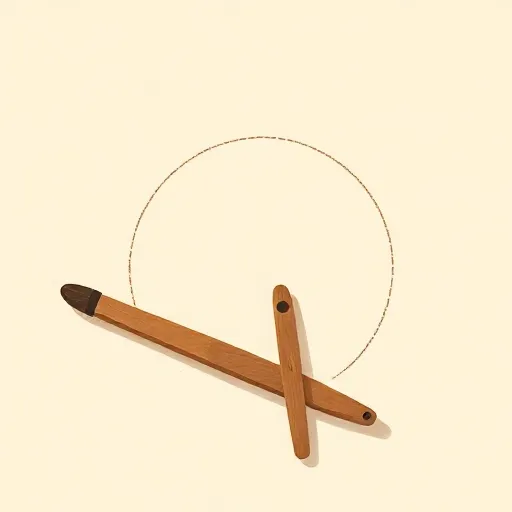
Spinoza offers a breathtaking claim in Part 2 of the Ethics: the order and connection of ideas is the same as the order and connection of things (2P7). Think of a circle drawn on paper. There is the physical circle — ink in a certain shape. And there is the idea of that circle — what a geometer understands about it. According to Spinoza, these are not two separate items. They are one and the same thing, explained through two different attributes. The circle under Extension is the ink shape; the circle under Thought is the idea.
This applies to everything, including you. Your mind is a mode of the attribute Thought: it is the idea of your body. Your body is a mode of the attribute Extension: a physical organism. Under Extension, you are a body among bodies. Under Thought, you are a mind that perceives and desires. But Spinoza says your mind and your body are one and the same mode, just expressed in two parallel ways. There is no ghost driving a machine. There is just one activity, doubling as thought and motion.
This view, often called parallelism, means that whenever something happens in the physical world, the same event happens in the mental world. A cut on your skin is, under the attribute of Thought, the sensation of pain. The two series run in lockstep, with no causal push across attributes. They are not two series at all; they are the same causal chain, seen from different sides.
No Ghost in the Machine
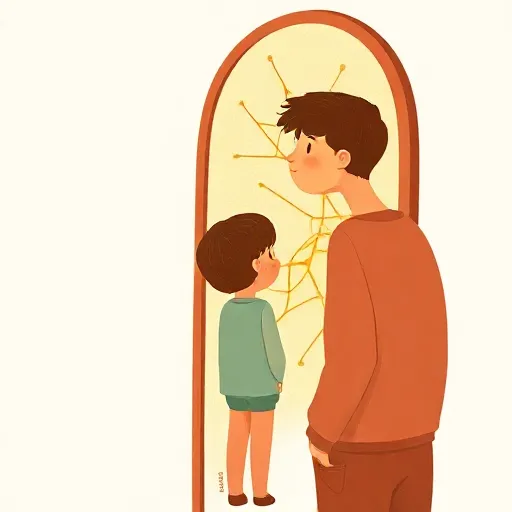
Spinoza takes the logic one step further. If mind and body are the same thing, then one cannot force the other to act. He states plainly that the body cannot determine the mind to thinking, and the mind cannot determine the body to motion or rest (3P2). This sounds shocking. You feel like your decision to raise your hand causes the movement. But Spinoza would say: your conscious decision and the arm movement are two sides of a single event. The cause runs entirely within the mental chain for the decision, and entirely within the physical chain for the motion. There is no mysterious “push” from a spiritual will into the material world.
In practice, this means we never need to cross from one attribute to another to explain anything. A physicist can describe every bodily motion using only size, shape, and motion. A psychologist can describe every feeling and choice using only other feelings and ideas. This separation of explanatory realms was something Descartes wanted for the new science. Spinoza made it absolute, while also ensuring that mind and body remain one and the same individual. Many scholars call this the no cross‑attribute causation rule.
To make sense of this, Spinoza says every finite thing, including you, is a mode — a temporary modification of the one substance. Modes exist and act only through attributes. So behind every physical event, God (as extended substance) is the cause. Behind every mental event, God (as thinking substance) is the cause. The two causal stories match because they are ultimately the same story.
Why Only Two Attributes?
Spinoza insists that God has infinite attributes, yet we human beings know only two: Thought and Extension. Why so few? His answer rests on what the human mind is. The mind is the idea of an actually existing body (2P13). Whatever the body undergoes, the mind perceives. Since our bodies only interact with other extended things and communicate only physical patterns, the mind’s ideas are limited to what the body can register. We can discover the attribute of Thought because we ourselves think. We can discover Extension because we feel our bodies and see other physical things. But if there were a third, fourth, or millionth attribute, our bodies would have no way to encounter it, and our minds could never form an idea of it.
This point has stirred great debate among scholars. One school, the subjectivists, argues that the “intellect” in the definition of attribute is the finite human intellect. Attributes, on this reading, are the ways our limited minds project structure onto God — but God in itself has no real multiplicity. The trouble is, this makes our knowledge of God an illusion, which clashes with Spinoza’s claim that we can have adequate knowledge of God’s essence (2P47).
The rival objectivist view says the intellect in question is the infinite intellect — God’s own understanding. Attributes are genuinely distinct features of the divine substance, not human projections. But objectivists then must explain how one substance can have really distinct essences without breaking into pieces. Solutions range from saying attributes are identical in reality and only rationally distinct, to positing an attribute‑neutral structure that unites them. Each option has costs, and philosophers continue to argue over what Spinoza actually meant. The upshot: Spinoza’s system demands both real multiplicity and profound unity, and no interpretation makes the puzzle disappear entirely.
What This Means for You

Spinoza’s theory of attributes sounds abstract, but it changes how you might see yourself. If your mind and body are one and the same thing, then every ache, every surge of joy, every flash of insight has a physical reflection — and every physical event has a mental side, even if we don’t notice it. The split between “inner” and “outer” starts to dissolve. You are not a lonely mind piloting a clumsy machine. You are a living, thinking knot in the fabric of Nature.
This also alters how you think about God. For Spinoza, God is not a supernatural person who chooses to create. God is the one substance with infinite attributes, expressing itself as everything that exists. Traditional religious language — “omniscience,” “omnipresence” — becomes a way of talking about what is already true under different attributes. Suddenly, the physical world is not second‑class; it is divine, just like thought.
The next time you feel your heart pound before a big moment, you might ask: is that a physical event or a mental one? Spinoza would smile and say, “Yes.” The real question is not which side is true, but how you want to look at the single reality you already are. And that, centuries later, still makes philosophers and kids alike stop and wonder.
Think about it
- If a scientist could scan your brain and predict every decision you are about to make, would that show your mind is nothing but your body, or would your mental experience still be something separate?
- Could there be a sense — like seeing sounds or hearing colors — that would open a window into an attribute no human has ever imagined? What would that do to our idea of what is real?
- If everything is really one substance, does it make more sense to treat other people and nature as parts of yourself, or does that idea worry you? Why?