Why "I Am the Cook" Can Be True and False at the Same Time
A Party Cook’s Tricky Claim

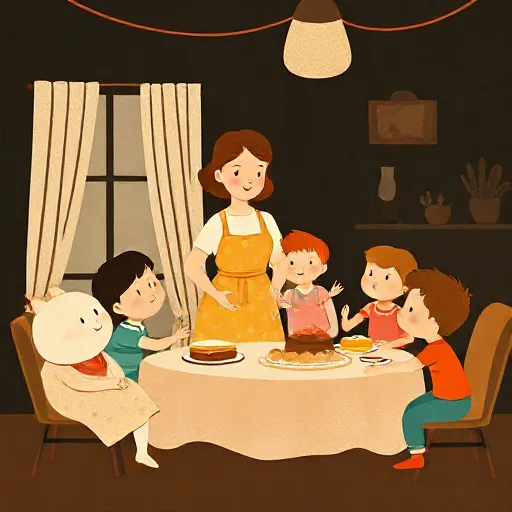
Imagine a party. You and your partner prepared the food together. Someone walks up, takes a bite of your famous cheesecake pastry, and asks, “Who made this?” You say, honestly, “I am the cook.” A few minutes later, another guest, impressed by the whole spread, asks the same question about the entire meal. If you answer “I am the cook” again, that feels like a lie — your partner cooked half the dishes. How can the same sentence be true and false at the same moment?
The philosopher John L. Austin (1911–1960) argued that statements are not about the whole world. They are about particular topic situations — limited slices of reality. In the first case, your claim picked out just the situation of the cheesecake. You cooked the cheesecake, so you spoke truly. In the second, the topic situation was the whole party meal. Since you didn’t cook all of it, you’d be making a false claim. Austin’s insight is that every time we speak, we silently zoom in on a chunk of the world. That chunk decides whether our words are true.
This idea sparked a revolution in the study of meaning. Jon Barwise (1942–2000) and John Perry (born 1943) built an entire situation semantics around it. They argued that sentences are not about possible worlds — enormous complete universes — but about small, manageable situations. This shift solved several long‑standing puzzles about how we see, how we count, and how we understand each other.
Did You See a Poisoning?

Imagine you are Beryl, watching your friend Meryl in the kitchen. You see Meryl sprinkle a white powder onto someone’s dinner. Later you learn something shocking: the white powder was the most deadly poison. Now ask yourself: did you see Meryl sprinkle the most deadly poison? Your gut says no — you didn’t know it was poison at the time. Yet the following little argument seems to force a yes:
- Beryl saw Meryl sprinkle the white powder on the dinner.
- The white powder was the most deadly poison.
- So, Beryl saw Meryl sprinkle the most deadly poison on the dinner.
In many languages, sentences with “saw” plus a plain verb — what linguists call direct perception reports — are transparent. That means you can swap a description for another that points to the same thing without changing the truth of the sentence. If the powder and the poison are one and the same, the situation you saw is the very situation of poison‑sprinkling. You may not have had a name for the stuff, but your eyes took in that exact event.
Barwise’s big move was to treat the verb “saw” in these sentences as a connection to a situation, not to a proposition or a belief. You didn’t form a thought that it was poison. You simply saw a situation — a real past chunk of the world — and that situation happens to be one where Meryl scattered poison. Because the verb grabs a situation, not a label, the inference goes through. The puzzle vanishes.
Things change when you use “saw that…,” as in “Beryl saw that Meryl sprinkled the poison.” This reports a belief. You can’t reach the conclusion that Beryl saw that Meryl sprinkled the poison, because Beryl never held that belief. Direct perception ignores beliefs; it grabs the scene itself. That’s why a security camera “sees” a crime, even though it doesn’t know the law. Situation semantics captures this difference in a clean, simple way.
The Sleep Lab and the Invisible Assistants

Austin’s idea that speech always zooms in on a topic situation doesn’t just fix perception puzzles. It also explains why phrases like “everyone” and “no one” rarely mean literally every human being on Earth. Barwise and Perry imagined a room full of sleeping patients and a few awake research assistants. The lab director looks around and says, “No one is sleeping.” If the topic situation is the whole room, her claim is false — the patients are asleep. But if she is clearly talking only about her assistants, she speaks truly: no assistant is sleeping.
Now consider a trickier sentence suggested by the critic Scott Soames: “Everyone is asleep and is being monitored by a research assistant.” If a single topic situation has to contain both the sleepers and the monitors, we get nonsense: the assistants would have to be asleep while monitoring themselves. But we don’t hear it that way. Instead, we seem to use different resource situations for different parts of the sentence. The word “everyone” can reach back to a situation that contains only the patients, while the phrase about being monitored can recruit the assistants from a slightly wider situation.
This flexibility shows that topic situations are not a single rigid frame. They are more like a team of slices that different words can call up. In other words, there isn’t just one topic situation per sentence; there can be several, each serving a different job. The result is that everyday sentences pack an enormous amount of hidden coordination. Situation semantics offers tools to track all those invisible slices, making sense of language that would otherwise collapse into contradictions.
Donkeys, Minimal Situations, and the Magic of “It”

Sometimes a single pronoun does the work of a whole definite description. Look at this classic donkey sentence: “Whenever a donkey appeared, it was greeted enthusiastically.” The tiny word “it” here means roughly “the donkey that appeared.” The problem is that there are millions of donkeys in the world. How does the listener instantly know which donkey is being greeted?
Situation semantics answers by counting over minimal situations. A minimal situation is the smallest slice of reality that makes a given claim true — nothing extra. The sentence “a donkey appeared” picks out, from the overall topic situation, only those sub‑situations that contain exactly one appearing donkey and nothing irrelevant. When the second part of the sentence uses “it,” it grabs that very donkey from that minimal situation. Because each such slice contains just one donkey, there’s no confusion.
This trick relies on a notion called exemplification. A situation exemplifies a proposition if it doesn’t contain any part that fails to contribute to making that proposition true. Think of a stage set: if the script says “there is a table,” the single table on stage is enough — you don’t need to add a second table, or a piano, to make the scene honest. Similarly, the minimal donkey‑appearing situation is exactly the stage the sentence needs.
The same strategy handles trickier cases: mass nouns (“when snow falls around here…”), amounts (“when a cat eats more than one can of food…”), and even negatives (“when nobody showed up…”). In each case, the situations we count aren’t naively the smallest possible chunks, but the ones that genuinely exemplify the antecedent — they contain just what’s relevant and nothing that messes up the count. That’s why “nobody showed up” doesn’t require a situation with a ghost‑like absence object; it just requires that the actual situation has zero people‑showing‑up, and we consider all pieces of that sort.
How “Only” Sneaks into Everyday Answers

Here is a scene you’ve lived through. You come into the kitchen and ask, “Who brought snacks?” A friend answers, “Leah and Max did.” You immediately understand that only Leah and Max brought snacks. Yet the word “only” was never spoken. Where did it come from?
In situation semantics, a question like “Who brought snacks?” describes a property: being a situation where the snack‑bringers are exactly the ones who actually brought snacks in the real world. The question silently points to the smallest real situation that contains all those snack‑bringers — the exemplifying situation of the question. An answer like “Leah and Max” is understood as a claim about that very situation. For that claim to fit, the situation must contain just Leah and Max being snack‑bringers. If there were also a hidden third person who brought chips, the answer would describe a different, larger situation — and so it would be misleading. The exhaustivity effect (“only”) drops out naturally from the rule that answers are about the minimal situations the question carves out.
If your friend instead says, “Leah and Max did, for sure,” she marks the answer as non‑exhaustive. She is telling you that the situation she describes is part of the bigger question‑situation, but not necessarily the whole thing. Other people might have brought snacks too. This is how tiny changes in wording toggle between exhaustive and non‑exhaustive interpretations. And it’s all rooted in the same idea that sentences, even questions, are about particular, real slices of the world, not about the universe.
Why Slices of the World Matter to You

You rarely, if ever, mean to talk about the entire cosmos. When you say “I’m tired,” you aren’t making a claim about all of history and every galaxy. You’re making a claim about a tiny situation right now — perhaps the hour after gym class, or the moment you climbed into bed. Situation semantics takes this ordinary fact seriously and builds a precise theory of meaning around it.
That theory helps explain why you can truthfully say “I am the cook” about your famous cheesecake while still being a terrible liar about the rest of the dinner. It explains why you can see a person sprinkle poison without knowing it. It explains why “it” in donkey sentences doesn’t leave you drowning in a world of donkeys. And it explains why answering “Leah and Max” to “Who brought snacks?” silently sets up a wall around the snack‑bringers.
Next time you speak, try to notice the invisible situation your words are pointing at. Is it the whole classroom, or just your row? All of yesterday, or only the conversation after lunch? Meaning doesn’t float in the abstract. It lives in the small, concrete slices of the world you pick out every time you open your mouth.
Think about it
- If you say “I am the cook” at your own birthday potluck, can you ever be completely wrong about which situation you meant, even if you feel sure? How do you and your listener silently agree on which slice of the party counts?
- Imagine a strange world where every statement is automatically about the complete universe. What would ordinary conversations sound like? Could you ever say something simple like “the table is messy” without it being false because of a clean table in another galaxy?
- Suppose you see your brother pour sugar into his tea, but later you discover the “sugar” was really salt. Did you see him pour salt? Would your answer change if you had been recording his every move on video?