
Is There a ‘Self’ Inside You, or Just a Bundle of Thoughts?
The Riddle of Oedipus

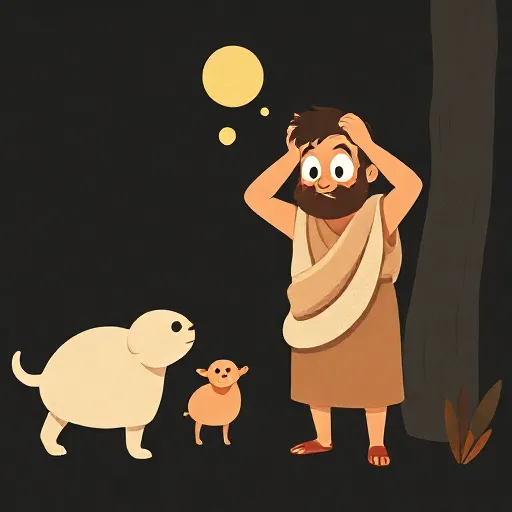
A long time ago, a Greek king named Oedipus knew a lot about himself. He knew he was the ruler of Thebes. He knew a prophecy had once said he would kill his own father. But only later in the story did Oedipus realize something much more upsetting: that he himself was the one who had done it. He moved from knowing a fact about someone to knowing that the someone was him.
That shift—from “someone is this” to “I am this”—is what philosophers call self-consciousness. It’s not just knowing facts about yourself. It’s knowing yourself as yourself. And for over two thousand years, thinkers have asked: what is this “self” we seem to be aware of? Is it something real inside us, or is it just a story we tell?
The Flying Man and the Certain Self

In the 11th century, the Persian thinker Avicenna (980–1037) came up with a wild thought experiment. Imagine a person created all at once, floating in a void, with no senses working—no sight, no hearing, no touch at all. Avicenna argued that this “Flying Man” would still know something: that he himself exists. Even without a body to feel or any outer world, there would be a basic self-awareness.
Avicenna’s idea challenged older views. The Greek philosopher Aristotle (384–322 BCE) thought you could only become aware of yourself by first knowing things outside you—like seeing an apple and realizing you are the one seeing it. The Flying Man suggested the opposite: that the mind is present to itself all on its own, no outer objects needed.
Centuries later, the French philosopher René Descartes (1596–1650) lit a similar spark. In his Meditations, he tried to doubt everything—the sky, his own hands, even his memory. Then he hit a brick wall: “I am, I exist, is necessarily true whenever it is put forward by me.” If you’re thinking, you must exist as the thinker. This became the famous cogito—“I think, therefore I am.” For Descartes, this self-knowledge wasn’t a clever deduction; it was an immediate, unshakeable certainty. You can’t be wrong that you, the thinker, are there.
Hume’s Missing Self

Not everyone was convinced. The Scottish philosopher David Hume (1711–1776) decided to look inside his own mind and report what he found. He described it bluntly: “When I enter most intimately into what I call myself, I always stumble on some particular perception or other, of heat or cold, light or shade, love or hatred, pain or pleasure. I never can catch myself without a perception.”
Hume’s point was startling. No matter how hard he looked, he never met a single, steady “self.” He found only a stream of different experiences—a parade of sounds, feelings, and thoughts, with nobody permanent marching along behind them. According to Hume, our idea of a self is just a habit: we call that heap of changing perceptions “me,” but there is no hidden owner of those experiences.
This bundle theory of the self turned Descartes’ certainty upside down. If Hume is right, then when you say “I,” you aren’t pointing to a special inner object. You’re just pointing to a constantly shifting collection of mental events. The boss of your thoughts isn’t there to be found.
The “I” That Glues Your Experiences Together

The German philosopher Immanuel Kant (1724–1804) read Hume and thought something was missing. Yes, you can’t spot a solid self the way you spot a chair. But Kant noticed that your experiences don’t just happen randomly—they feel like your experiences, belonging to a single point of view. If you see a sunset and hear a violin at the same time, those two experiences belong together as parts of one unified consciousness.
Kant argued that for this unity to exist, a kind of self-awareness must be at work all the time. He called it transcendental apperception—a fancy name for the “I think” that can (in theory) accompany all your thoughts. You don’t see this “I think” directly, but it’s what makes the scattered movie of your mind play as a single show rather than a dozen separate screens. Without it, your mental life would be, as Kant put it, “multi-coloured diverse.”
So Kant offered a middle path: you don’t perceive a self-object inside you, but you must represent yourself as the same subject over time, or else your own experiences wouldn’t make sense as yours.
The Messy Shopper’s Secret

In 1979, the American philosopher John Perry (born 1943) told a story that brought self-consciousness down to earth. He was once pushing his cart through a supermarket, following a trail of sugar, trying to find the shopper with a torn sack. He knew all along that the messy shopper was making a mess. He even knew that the oldest philosopher in the store (himself) was making a mess. Yet he kept walking.
Then it hit him: “I am the messy shopper.” Only at that moment did he stop and check his own cart.
Perry’s point is that there is something special about thoughts that use “I” —what philosophers call first-person thoughts. These thoughts are “self-locating.” If you believe “Smith’s pants are on fire,” pure self-interest won’t make you move unless you also believe “I am Smith.” The content of the thought changes how you act.
Alongside this, thinkers noticed another curious feature of self-consciousness: immunity to error through misidentification. If you feel a pain in your arm and think “I have a pain,” you can’t be wrong about whose pain it is. You might misjudge what the sensation is (maybe it’s cold, not pain), but you can’t feel a pain in someone else’s body and mistakenly think it’s yours. The “I” in certain basic self-ascriptions doesn’t rely on identifying a publicly spotted object—it’s identification-free. This, some philosophers argue, is what makes the first-person point of view so puzzling and special.
Why It Still Matters

So who’s right? Is there a flying man inside you, a pure awareness that exists even without a body? Or is Hume correct that you’re just a heap of sensations? And if there’s no solid self, what makes you the same person you were yesterday?
These aren’t just dusty questions. They sit at the heart of who you take yourself to be. When you make a promise, you trust that the “I” who promises now is the same “I” who will keep it later. When you feel proud or embarrassed, you’re taking ownership of a whole history. Even video games and social media ask you to create avatars and profiles—and behind each one, you still think of a single self doing the playing.
Philosophers today still argue about whether the self is something real or just a convenient story. Some believe we have a sense of ownership—the feeling that your thoughts and feelings are yours—that never goes away, even if you can’t locate an owner. Others study memory, agency, and the brain to see what glues a life together. The debate that started with Oedipus and Avicenna hasn’t ended. It’s happening inside you right now, every time you say “I.”
Think about it
- If you couldn’t remember anything from your past, would you still be the same person today?
- Imagine a machine that copies all your memories into a perfect robot copy of you. Which one—you or the robot—is the “real” you?
- If you feel a thought pop into your head but it doesn’t feel like your own, is it still part of you?