How Can Freedom Grow From Determined Nature?
A Stream That Never Stops
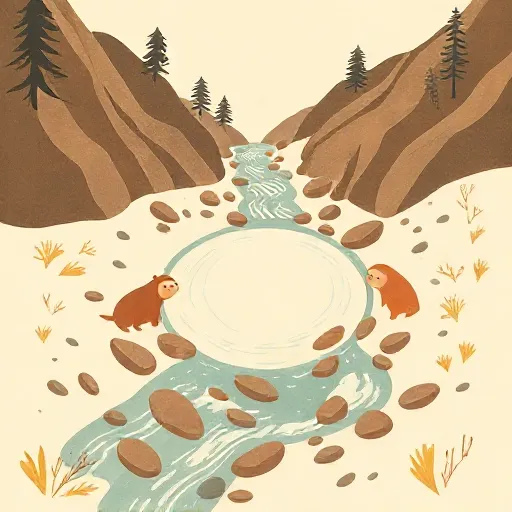
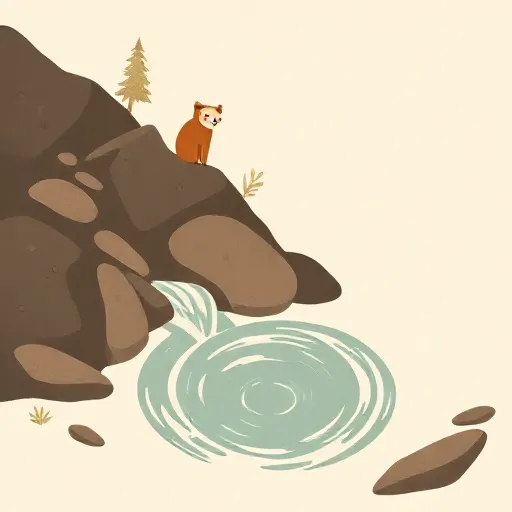
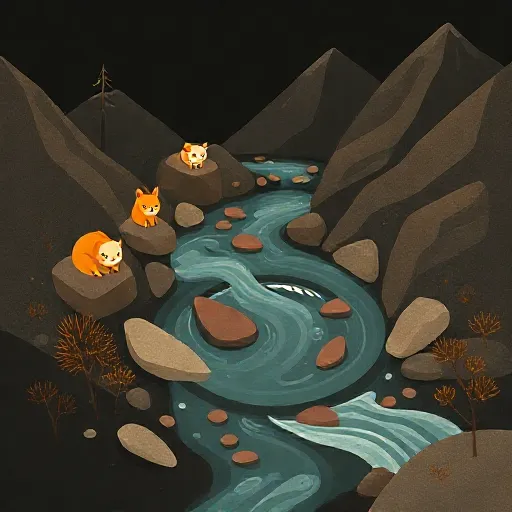
Imagine crouching beside a fast stream on a summer afternoon. You watch the water rush past, and you notice something strange. In one spot, a little whirlpool has formed — a tight, spinning eddy that keeps its shape even though new water pours through it every second. The eddy looks like a thing, but it is really just a pattern of motion. If you could freeze time, the eddy would vanish.
Friedrich Wilhelm Joseph Schelling (1775–1854) spent his whole life chasing a similar puzzle. He looked at the natural world — rivers, mountains, animals, your own body — and saw that everything seems caught in a chain of causes, like one domino knocking down the next. Yet somehow, inside that chain, self-consciousness appears: beings who can stop, reflect, and decide freely. Schelling could not shake one question: how can a determined nature give birth to something that feels truly free?
Most philosophers of his day had tried to split the world into two separate realms — the lawful stuff “out there” and the thinking mind “in here.” Schelling thought that division was a dead end. He became convinced that nature itself is alive with creative energy, and that our own minds are just one way that energy gets expressed.
Kant’s Great Split — and Why It Was a Problem
Schelling’s story really starts with Immanuel Kant (1724–1804). Kant had shown that we can never know the world simply as it is in itself. All we ever experience are appearances — things shaped by our own senses and the categories our minds bring to them. Nature, for Kant, was therefore a system of necessary laws that our understanding imposes. That left a big gap: the thinking subject that does the understanding seems to be free and spontaneous. But how can a free subject pop out of a nature that is completely bound by determinism?
Kant tried to mend the gap in his third major work, the Critique of Judgment (1790). He pointed out that nature produces self-organising living things — an oak tree grows into an oak, not a bicycle — and that we feel a strange, disinterested pleasure when we admire a sunset or a flower. Still, Kant never explained how the free subject comes into existence out of material nature. He just left the two sides side by side, like neighbours who never speak.
Schelling and his friends, including the poet Friedrich Hölderlin (1770–1843) and the young Georg Wilhelm Friedrich Hegel (1770–1831), found this deeply unsatisfying. If the subject is part of nature, the split cannot be the final answer.
Two Tempting Solutions: Fichte and Spinoza
Two roads out of Kant’s dualism seemed open. One was taken by Johann Gottlieb Fichte (1762–1814). Fichte simply denied that there is any mysterious “thing in itself” behind appearances. For him, the whole intelligible world is produced by the absolute I — the free, spontaneous act of the subject. Philosophy, he said, must start with the I positing itself, and only then positing a not-I (the world of objects) as something it can relate to. But Hölderlin spotted a deep problem: an I can only be an I by being conscious of something other than itself. So the absolute I is always already in a relationship, and the whole relationship — subject and object — must be grounded in something prior, which Hölderlin simply called being.
The other road came from Baruch Spinoza (1632–1677). Spinoza argued that there is only one infinite substance, which he called “God or Nature.” Everything that happens is a necessary consequence of this single substance. That avoids Kant’s split, but at a heavy price: human freedom vanishes. If every thought and action is just a link in an infinite chain of causes, you are no freer than a domino. Schelling admired Spinoza’s unified vision but was haunted by a question the young Friedrich Heinrich Jacobi (1743–1819) had sharpened: how can the unconditioned — that which depends on nothing else — ever produce a world of conditioned things, where each item depends on something else? If every explanation just pushes the “why” back one step further, we seem to chase an endless chain without ever reaching solid ground. Schelling spent his career trying to find that ground without losing freedom.
Nature as a Living Artist
In his twenties, Schelling developed a philosophy of nature (Naturphilosophie) that turned the problem on its head. Instead of starting with the thinking subject, he started with nature itself — not nature as a collection of dead objects obeying laws, but as a living productivity. The real essence of nature, he suggested, is never directly visible. What we see are only products — temporary forms that the productivity throws up and then dissolves, like the eddies in our stream. The stream’s constant flow is the unconditioned activity; the swirling patterns are the conditioned things we can point to and measure.
Schelling borrowed an image from magnetism. In a magnet, the north and south poles are absolute opposites, yet they are inseparable: you cannot have one without the other. Nature, he thought, is structured by such polar opposites all the way up — from electricity, to living organisms, to the push and pull of consciousness itself.
In his System of Transcendental Idealism (1800), Schelling told a grand story of how the “absolute I” unconsciously splits itself, producing the material world step by step, until it gradually awakens into consciousness and finally into self-consciousness. The early, unconscious stages of this process are forever hidden from direct view — they are the dark engine room of the mind. How, then, can we ever get a glimpse of them? Schelling’s answer was surprising: art.
A great painting or a poem is not just a thing among things. It is clearly an object, made of canvas and pigment or ink, yet it carries a meaning that cannot be explained solely by its materials or the artist’s conscious plan. In creating, the artist is partly conscious of what they are doing, but the finished work always contains something more — something that emerged from the unconscious flow. Art, Schelling famously wrote, is “the only true and eternal organ and document of philosophy.” It shows, in a way that words and theories cannot, how the unconditioned ground manifests itself in a finite, conditioned object.
The Dark Ground That Reason Can’t Reach
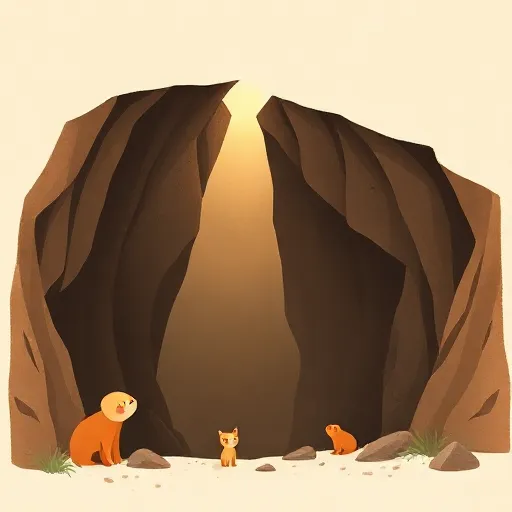
As Schelling grew older, his thinking turned darker. He became convinced that the ground of existence cannot be grasped by reason at all, because reason itself arises from it. In his breakthrough essay On the Essence of Human Freedom (1809) and the unfinished drafts called The Ages of the World, he described two fundamental forces at war within the ground itself.
There is a contracting, dark force — a kind of primal gravity that pulls everything inward and would, left to itself, swallow the world into blank nothingness. And there is an expansive force — light — that spreads outward in generous self-disclosure. A real world can only exist because these two forces never completely win. If contraction dominated, nothing would appear; if expansion ran unchecked, everything would explode into diffuse emptiness. The world we live in is the result of their endless, violent dance. This, Schelling thought, is why “a veil of melancholy” lies over all of nature, and why suffering and tragedy are not just accidental flaws but woven into existence itself.
This led to a direct clash with his former friend Hegel. Hegel had built a magnificent system that tried to show how the whole of reality is the self-unfolding of reason. Every contradictory, finite thing eventually cancels itself and resolves into a higher, more complete understanding. The absolute, for Hegel, is the whole process in which thought comes to know itself by thinking about everything it is not.
Schelling called this attempt a “merely logical” relationship. Hegel’s system, he argued, is a beautiful mirror in which reason admires its own reflection. It can explain the logic of change once a world is already there, but it cannot explain the raw, brute fact that there is a world at all. Human reason, Schelling insisted, cannot ground itself. Wherever you look, the world contains a “preponderant mass of unreason” — things that simply happen for no deeper rational necessity. He called his own late approach positive philosophy, because it starts from the sheer fact of existence, rather than trying to deduce existence from a concept. The moment you try to make reason the foundation of everything, you silently assume exactly what needs to be proved: that thought and being are one. Schelling came to believe that the identity of mind and nature is real, but it is a living, shifting identity that always includes difference and darkness — a secret that thought can point toward but never fully capture.
Why This Still Matters: Freedom, Art, and the Living Earth
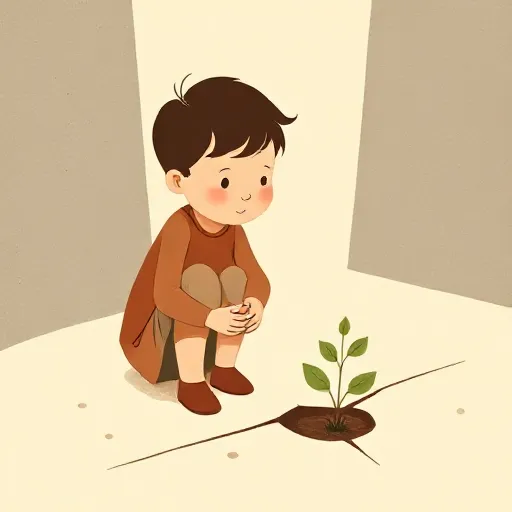
Today, more than two centuries later, Schelling’s worries sound strangely urgent. He once protested against Fichte’s view that nature exists “for nothing more than to be used” — that we should see it only as raw material for our projects. That attitude helped build the industrialised world, but it also brought us the ecological crisis. When nature is nothing but a machine obeying laws, it is easy to treat it as an infinitely available toolbox. Schelling’s alternative, that nature is creative, self-organising, and deeply akin to our own minds, makes it much harder to ignore the damage we cause.
His ideas also speak to the limits of knowledge. We live in an age of astonishing science, and we often imagine that more information and more control will solve our deepest problems. Schelling warns that reason always rests on a dark ground it cannot illuminate. There are dimensions of life — art, music, love, the feeling of standing before something infinite — that cannot be reduced to facts we can list and master. That is not a failure of rationality; it is a reminder that being alive involves more than explaining.
Finally, Schelling gives us a way to think about freedom without pretending we are ghosts outside of nature. We are products of natural forces, but we are also the part of nature that can reflect back on itself. The stream that forms the eddy is the same stream that thinks about eddies. How we hold those two truths together — that we are both fully natural and genuinely free — remains one of the great unsettled questions of philosophy. Schelling did not claim to have solved it. His real gift was to show why the question will never simply go away.
Think about it
- If everything in your body and brain follows physical laws, can you ever make a truly free choice? What would need to be true for a choice to be free?
- Can a song or a painting tell you something true about the world that a textbook of facts cannot? If you think so, give an example and explain what makes that truth different.
- Imagine a supercomputer that could explain every event in history by pointing to a prior cause. Would that explanation ever satisfy you, or would you still ask, “Why is there anything at all?” Why?