The Monk Who Proved Nothing Has a Fixed Nature
A monk’s challenge: what is a chair really made of?

Sometime in the eighth century CE, in a great Indian monastery, a monk named Śāntarakṣita (8th century) made a startling claim. He said that nothing in the whole world — not a table, not a thought, not even your own self — has a fixed, unchanging nature. And he believed he could prove it with a single, elegant piece of reasoning.
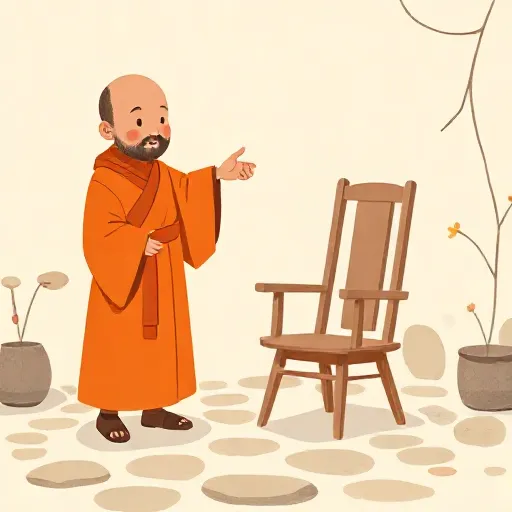
He called it the neither-one-nor-many argument (in Sanskrit, ekānekaviyogahetu). The idea is simple but powerful. Take any object you think exists with a solid essence. Perhaps a wooden chair. If that chair really had a permanent, true nature, that nature would have to be either a single, indivisible thing or a collection of many things. No third option is possible, because “one” and “many” cover all the ways a real nature could be.
Now ask: is the chair truly one? No — it has legs, a seat, a backrest, joints, and fibers. In fact, you can keep dividing it into smaller and smaller parts, down to splinters, cells, and atoms. Something that has parts cannot be truly singular. So the chair cannot be one.
Could it be truly many? That doesn’t work either. “Many” just means a collection of ones. But we just saw that none of the parts is a truly single essence either. If no part is a fixed one, then assembling countless non-fixed things cannot magically create a fixed many. So the chair cannot be many. And since “one” and “many” are the only possibilities, the chair must lack any inherent, unchanging nature at all. That absence of a fixed core is what Buddhists call emptiness (śūnyatā).
Śāntarakṣita didn’t stop with chairs. In his main text, The Ornament of the Middle Way, he marched through every candidate for a truly singular nature proposed by other schools: a creator god, a fundamental cosmic substance, even consciousness itself. Each time he used the same scalpel: if it has parts or produces different effects at different moments, it cannot be one; if it can’t be one, it can’t be many; therefore it is empty of an inherent essence.
Two ways of being real: ultimate emptiness and everyday things
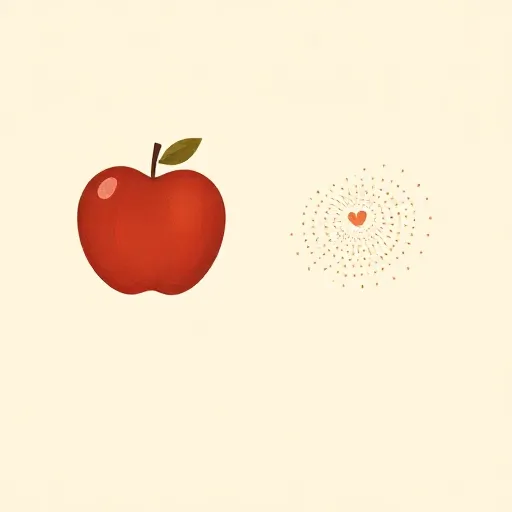
If nothing has a fixed nature, does that mean chairs and apples are just illusions? Śāntarakṣita saw a dangerous trap there. Saying “nothing exists at all” would be an extreme. So he developed a careful account of two truths.
The ultimate truth (paramārthasatya) is that every phenomenon is empty of an unchanging essence. When you search for the thing that makes an apple an apple — a permanent “apple-ness” — you never find it, because the apple is a bundle of parts and changing qualities. But that’s only half the story.
The conventional truth (saṃvṛtisatya) is the world we live in every day. Apples still crunch when you bite them. They can be red or green. They grow, fall, and rot. For Śāntarakṣita, a genuine conventional truth meets several marks: it is known by a mind, it can actually do something (it is causally efficacious), it changes moment to moment, and it cannot survive the kind of relentless analysis that searches for a fixed essence. That is why he described conventional things as dependently arisen — they appear because of ever‑changing causes and conditions, not because they carry a built‑in permanent label.
So the extremes are avoided. You don’t cling to things as if they were eternal and fixed. You also don’t declare that nothing matters at all. There is a middle way: things function, you eat your lunch, you talk with friends, but you slowly see through the illusion that any of it has a frozen, independent core.
Climbing a ladder of views: from mind-only to full emptiness

So far, Śāntarakṣita’s ideas sound much like other Madhyamaka (Middle Way) thinkers. But he added something truly unusual. During his time, a separate Buddhist school called Yogācāra or Cittamātra (Mind-Only) argued that external objects do not exist independently — they are just appearances in consciousness. A mug, they said, is not a solid thing outside your mind; the experience of a mug is simply a ripple inside awareness.
Śāntarakṣita took this and turned it into a rung on a ladder. He wrote that conventional truths are mere consciousness only — that is, from a certain practical perspective, the world of tables and trees is nothing more than mental experience. But then he added a second move. Once a student has gotten comfortable with the idea that outer objects are mind-made, they are ready for the next step: realizing that even the mind itself has no fixed, independent self. By relying on the Mind-Only view, you learn that external entities lack a separate nature. Then, by relying on the Madhyamaka view, you see that not even consciousness has a permanent essence.
This was a radical synthesis. Previous Madhyamaka thinkers mostly used the two truths to describe how things are. Śāntarakṣita used conventional truth as a stepping stone — a provisional acceptance of Mind-Only helped the student’s mind ripen, so they could eventually grasp full emptiness. He famously wrote that you first walk the path of Mind-Only, then you ascend to the Middle Way where no self exists at all, even in mind.
Why argue with everyone? The training of the mind
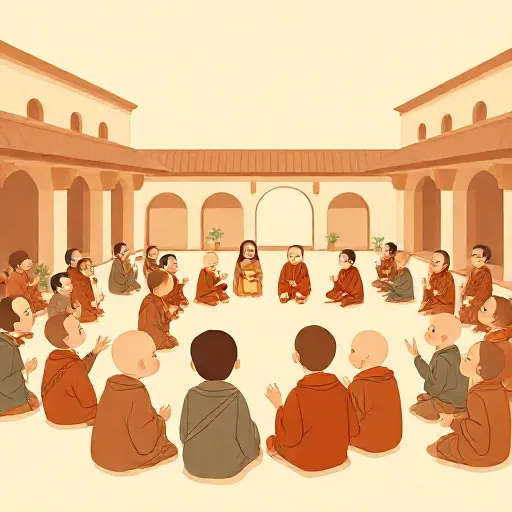
If you read Śāntarakṣita’s works, you’ll notice something else striking. In the first part of The Ornament of the Middle Way, he goes through dozens of rival positions. But he doesn’t just trash them. He seems to slip into each viewpoint, arguing from the inside — first as a follower of one Buddhist school, then another, and finally as a full‑blown Madhyamaka philosopher.
Scholars today see a deliberate strategy here. Śāntarakṣita wanted his readers to provisionally accept the views he would later undermine. He started by examining non‑Buddhist ideas through the eyes of a Sautrāntika thinker. Then, when he turned to Sautrāntika claims about consciousness, he argued as a Yogācāra would. Only later did he put on his Madhyamaka hat and dismantle Yogācāra doctrines too.
Why do that? In his tradition, philosophical inquiry was not just a puzzle game. It was a way of healing the mind. According to the Buddha, suffering comes from misunderstanding reality — from clinging to fixed natures that simply aren’t there. So the job of a philosopher is to guide people gradually out of confusion. By inviting readers to live inside each “lower” view for a while, Śāntarakṣita let them feel its appeal, see its limits, and then naturally climb to a more subtle understanding. The whole process was a kind of mental training, a ladder from confusion to clarity.
Why this matters now: letting go of fixed labels

Śāntarakṣita also explored how language tricks us into believing in fixed essences. When you say “chair,” you don’t point to a mysterious chair-ness floating in the air. Instead, his tradition argued, you use a process of exclusion (apoha). A word works by mentally excluding everything that is not a chair. That double‑negative process lets us communicate without ever touching an unchanging universal reality. Śāntarakṣita even insisted that the mental images we form are themselves exclusions — they are always defined by what they are not. So even our inner concepts don’t lock onto solid essences.
This may sound abstract, but it plays out every day. When a friend changes their look or personality, you can feel confused: “that’s not the person I knew!” You are, in that moment, holding onto a fixed label. If you remember that nothing — not even a close friend, not even your own self — has a permanent, frozen identity, letting go becomes a little easier. The world keeps flowing, and suffering often comes from trying to freeze it.
Śāntarakṣita’s ladder is still climbed today in Buddhist study. Across Tibetan monasteries, his synthesis of Madhyamaka and the logic of valid knowing shaped centuries of thought. He showed that you don’t have to choose between a world that works and a world that is empty. You can see the apple, eat it, and still understand that no fixed “apple” ever stood still long enough to be caught.
Think about it
- If you take apart a table into legs, a top, screws, and then into atoms, is there still a “table”? What makes something a table if every part could be replaced?
- Can you find anything about yourself that stays exactly the same from breakfast until dinnertime — your mood, your thoughts, your body?
- If a word like “cool” only makes sense by excluding what isn’t cool, does it ever pick out one real, unchanging quality? Or does its meaning shift with every group of kids who use it?