Do Words Touch Reality, or Just Help Us Get Along?
The Mirror That Fooled Philosophy

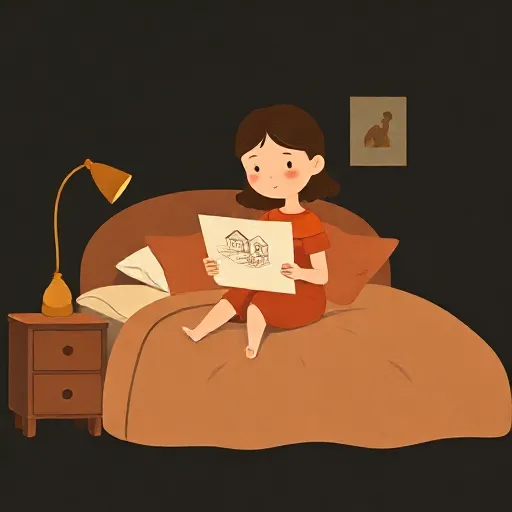
Imagine you try to draw your bedroom. No matter how careful you are, the drawing is never the real room—it’s a flat, crooked version. Now suppose I tell you that all your thoughts and words work the same way. They never “copy” reality exactly; they just sketch it from your point of view. For centuries, many philosophers believed the mind worked like a perfect mirror. Get your ideas clear, they said, and you’ll reflect the world as it truly is.
Richard Rorty (1931–2007) thought that whole picture was a mistake. He grew up in a left‑wing New York family that mixed American patriotism, social justice, and a philosophy called pragmatism—the idea that beliefs are tools for getting things done. After studying at the University of Chicago and Yale, Rorty became a rising star in analytic philosophy. But by the 1970s, he had turned into one of its sharpest critics. His target was epistemology, the branch of philosophy that asks, “How do we know what we know, and when can we be sure our beliefs are right?”
Modern epistemology, Rorty argued, started with René Descartes (1596–1650). Descartes wanted a foundation for knowledge that even the wildest doubts could not shake—something as certain as the idea that thinking proves one’s existence. He pictured the mind as a private space where ideas represent the outside world. The job of the philosopher was to check that the mirror was clean. Rorty’s big claim: that whole mirror‑and‑foundations project is a dead end. Our minds don’t mirror; they cope.
The Myth of the Given and Our Glassy Essence

Rorty called the old picture “Our Glassy Essence”—the idea that the mind is a smooth, transparent thing that simply receives what is out there. He thought two twentieth‑century thinkers had already cracked the glass.
First, Wilfrid Sellars (1912–1989) attacked the notion of the given in his essay “Empiricism and the Philosophy of Mind” (1956). The given was supposed to be the raw, unfiltered stuff that hits our senses—colours, shapes, sounds—before the mind does any work. But Sellars pointed out that you can’t have a thought like “That’s red” unless you already know the language game of colours. Even the simplest sensation is soaked in concepts. There is no pure mirror‑stage; everything we “see” is already interpreted.
Second, Willard Van Orman Quine (1908–2000) in “Two Dogmas of Empiricism” (1951) shook the idea that sentences come neatly divided into “what the world contributes” and “what language contributes.” He argued that our whole web of beliefs faces reality together, not piece by piece. You can’t peel away the conceptual wrapping to find a world‑given core.
Rorty combined these attacks. He said Sellars and Quine were really striking the same handshake between mind and world, one from each side. The upshot: knowledge isn’t about getting representations right. It’s about what your community lets you say. Rorty called this epistemological behaviorism—explaining knowledge by looking at social practices, not by peering inside heads. As he put it, “we understand knowledge when we understand the social justification of belief, and thus have no need to view it as accuracy of representation.”
Words Are Tools, Not Pictures

If knowledge is a social practice, then the words and concepts we use are not attempts to photograph the world. They are tools. Rorty called his view antirepresentationalism. Think of a hammer. You don’t ask whether a hammer is “true to” a nail; you ask whether it drives the nail in. A vocabulary—a whole set of words and ways of talking—is like a toolkit. Rorty liked to say that our vocabularies have “no more of a representational relation to an intrinsic nature of things than does the anteater’s snout or the bowerbird’s skill at weaving.” They evolved to help us cope, not to mirror.
This led Rorty to a striking view of truth. Many people imagine that true beliefs are those that match the world, the way a good photograph matches its subject. Rorty thought that idea of “matching” adds nothing useful. When you have good reasons for a belief—solid evidence, coherent arguments, the agreement of people you trust—calling it “true” is just a way of saying you stand behind it. Truth, he argued, is not a goal you can aim at separately from gathering good reasons. You can’t check your justification against some naked truth‑standard, because you’d need another set of words to do the checking, and you’d never escape language.
That doesn’t mean Rorty thought anything goes. His view has often been called relativism, but he pushed back. Relativism says “true for me” versus “true for you,” which assumes there is still a hidden “true‑in‑itself” that we just can’t reach. Rorty wanted to drop that whole picture. There is no God’s‑eye view, no final vocabulary that locks onto reality. We simply have the conversations we inherit, and we improve them by inventing new words. As he wrote, “what matters in the end are changes in the vocabulary rather than changes in belief”—new ways of describing things, not just new facts within the old story.
The Ironist Who Still Hates Cruelty

If no vocabulary is final, then even our deepest beliefs are the lucky result of a particular time and place. Rorty called this view ironism. An ironist is someone who has “radical and continuing doubts about the final vocabulary she currently uses.” She knows that the words she thinks with—her final vocabulary for what is good, true, and important—could have been different. And because she has no master rulebook to compare vocabularies, she copes with doubt by trying on new descriptions, especially from novels, history, and other people’s lives.
But Rorty was also a committed liberal. He followed the political thinker Judith Shklar (1928–1992) in saying that “cruelty is the worst thing we do.” The ironist, far from shrugging at suffering, uses her awareness of contingency to fight it. Why? Because she sees that the line between “us” and “them” is drawn by the words we use, not by nature. Solidarity—feeling that other people are part of our moral community—is not discovered by reason; it is made by stories. You read a novel about a girl whose life is utterly different from yours, and you find yourself hoping she escapes danger. That twinge of sympathy, Rorty thought, is the engine of moral progress. It widens the circle of “we.”
This helps explain Rorty’s famous distinction between public and private. The tools we use to build a fair society (laws, arguments about justice) are different from the tools we use to create ourselves (poetry, daydreams, personal quests for meaning). He didn’t want to mash them into one huge theory. Instead, he celebrated the liberal ironist—a person who keeps her private search for a fresh self‑description separate from her public duty to reduce humiliation and pain. She fights for equal pay and fair trials by day, and writes strange, untidy poems by night. Neither project has to justify the other.
Changing the Conversation, Changing the World

Rorty called this work “cultural politics.” Instead of looking for a cosmic argument that proves cruelty is wrong, we try to make cruelty look ugly and kindness look attractive. We coin new phrases—like “sexual harassment” or “microaggression”—that let us notice suffering we previously walked past. This takes both guardians of diversity (writers, journalists, artists who show us the lives of overlooked people) and guardians of universality (lawmakers and activists who insist that once you see someone as fully human, they get the same protections as everyone else). For Rorty, that was the real job of the Left: to be “the party of hope,” forever imagining an America—or a world—that hasn’t been made yet.
He thought this had practical economic roots. It’s easy to feel solidarity with strangers when your own family is fed; in hard times, our moral circle shrinks. So any serious effort to widen the “we” has to take money and security into account. Rorty criticized what he called the “cultural Left” of the 1990s for talking mostly about identity while ignoring growing economic inequality. He wanted a return to a hopeful, reform‑minded politics that remembered unions and universities once fought side by side.
In all of this, Rorty never said there is no truth, or that science is fake. He simply said that science, like literature, is a human practice that gives us reliable predictions and control—not a special pipeline to reality. Its authority comes from its open, democratic habits: anyone can check the data, challenge the theory, and demand a better explanation. That, for Rorty, is rationality worth celebrating.
Why It Matters When You Argue with Your Friends

Maybe this sounds like philosophy that lives only in old libraries. But think about the last time you and a friend disagreed about a movie, a rule, or whether a joke was funny. You probably didn’t whip out a set of facts that forced agreement. Instead, you told a story: “Imagine if you felt that way…” or “Here’s why it mattered to me.” You were doing what Rorty described—redescribing the situation to make your point of view more appealing.
Rorty’s world is one where nobody gets to shout “I have the truth and you’re just blind!” and win automatically. That can be scary, because it means we have to keep talking, keep listening, and keep inventing better words. But it also means that the future isn’t fixed by some deep reality we must finally mirror correctly. It can be shaped by new descriptions, new stories, and bigger we‑circles. The drawing of your bedroom will never be the bedroom itself. Yet a new drawing—one with brighter colours or a cleaner line—might make you notice something you’d never seen before. And that, Rorty would say, is what good philosophy really does.
Think about it
- If you and a friend can’t agree on whether a joke is hurtful, could you ever prove who is right without appealing to facts? How would you try to change each other’s mind?
- Rorty thought reading novels makes us more likely to care about strangers. Can you think of a story that made you feel something for a person completely different from you? Did it change how you treat people in real life?
- If all our beliefs come from conversations in a particular time and place, does that make it impossible to criticise a culture’s practices—like slavery or unfair laws—from the outside? Or can you still argue across differences?