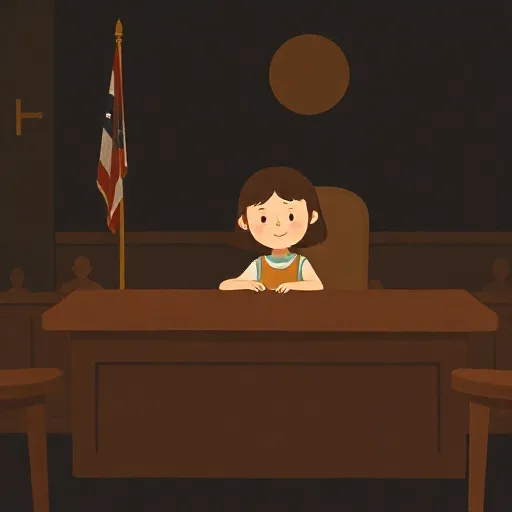
Should Kids Have the Same Rights as Adults?
Imagine You’re 15 and the Decision Is Yours

Picture this: You are 15 years old. Your doctor says you need an operation, but you are scared and want to refuse. The law where you live says your parents get to decide for you. You think you are old enough to make your own choice. Who should have the final say? This question is not just legal. It is a deep moral puzzle about whether children have rights and which rights they have. According to the United Nations Convention on the Rights of the Child (1989), a child is any human being under 18 years old. But being under 18 does not automatically answer the question of what rights you should have. Much depends on capacity — the ability to do something if you are given the chance and the right circumstances. Many philosophers believe that whether you can have a right depends on whether you have the capacity to exercise it. For children, that is exactly what is disputed. To understand why, we need to look at two rival theories of what a right actually is.
Two Rival Ideas About What a Right Really Is

One school of thought, the will theory (or choice theory), says that to have a right is to be in control of a choice. The philosopher H.L.A. Hart (1907–1992) defended this view. A right-holder can enforce or waive a duty — like choosing whether to speak or to stay silent. If rights are protected choices, then only beings capable of making choices can have them. Young children simply do not have that capacity. Therefore, on the will theory, children cannot be right-holders.
The rival interest theory (or welfare theory) says a right protects an interest that matters so much that it places duties on others. Neil MacCormick (1941–2009) argued that children obviously have crucial interests — to be fed, to be safe, to be healthy. If rights protect interests, then children must have rights. MacCormick used children as a test case: the fact that children clearly do have rights shows that the will theory is false.
Hart saw the problem and tried to fix it. He suggested that children could still have rights if adults act as their proxies. Parents or guardians would make choices on behalf of the child, choosing as the child would choose if she were capable. This raises tricky questions: How do we select proxies? How can we know what a child would choose? Who ensures the proxy does the right thing? Some will theorists take a different route. They say adults have duties to protect children, but those duties do not correspond to rights held by children. Instead, the rights might belong to the adults who protect them. In that view, children are cared for, but they are not rights-holders themselves.
The Critics: Why Many Think Children Shouldn’t Have Full Rights

Even if, in principle, children could have rights under an interest theory, many philosophers argue that children should not have all the rights adults have, or even any rights at all. Their case rests on three main points.
First, capacity. Children lack the cognitive and volitional abilities that adults have. They struggle to form consistent beliefs, appreciate the long-term consequences of choices, or act on steady desires. As the philosopher Tamar Schapiro put it, a child is in a ‘normative predicament’ — she cannot authoritatively order her own desires; she is, in a way, a creature of impulse. This lack of capacity seems to rule out liberty rights (rights to choose, like voting or deciding your religion). But it might still allow welfare rights (rights to protection of important interests, like health care). Some theorists, such as Harry Brighouse, argue that children have fundamental welfare interests and therefore at least those rights.
Second, some critics say that rights language is inappropriate for family life. Onora O’Neill (1941–) argues that we should think in terms of obligations, not rights. Parents have perfect obligations (specific, clear duties) and imperfect obligations (general duties of kindness and concern that are not precisely defined). Imperfect obligations do not correlate with rights. If we focus only on rights, we miss the vast web of care and love that morally matters. In a loving family, members do not need to claim rights against each other; they act out of love. Introducing rights-talk might even erode that love and turn the family into a courtroom. Others, like Laura Purdy, add that giving children liberty rights too early would actually harm them. Children need discipline and guidance to develop the character traits they need as adults. Without that, granting rights can prevent them from becoming capable adults.
Liberationists Fight Back: Kids Can Choose, Too

On the other side are the liberationists — thinkers like John Holt (1923–1985), Richard Farson (1926–2017), and Howard Cohen. They argue that children should have the same rights as adults. Their core claim is that children are not as incapable as critics say.
One liberationist move is to define capacity thinly. If making a choice just means expressing a preference, even young children can do that. But critics reply that mere preference is not enough; you need understanding and independence. A dog choosing between two bowls does not have a right to choose. Another liberationist move is to turn the argument around: adults do not meet a thick definition of capacity either. No adult is perfectly rational or fully independent of social influences. So if adults qualify for rights despite their imperfections, children should too.
The charge of arbitrariness is powerful. Why draw the line at age 18? A 17-year-old may be just as competent as an 18-year-old, and some 40-year-olds are less competent. Age is only a rough proxy for capacity. Using a test might be fairer, but testing everyone would be enormously difficult, and tests can be biased or corrupted. Many philosophers reply that a line must be drawn somewhere, and age correlates well enough with developing capacity. But liberationists insist the line should be lower, or that different rights should be gained at different ages — a younger age for simple decisions, an older age for complex ones.
Liberationists sometimes suggest that children could ‘borrow’ capacity by using advisers who help them exercise rights. Yet this runs into the same problems as the proxy model: how do you ensure the adviser truly represents the child’s choices, and does the child have to follow the advice? If not, the adviser is pointless; if yes, the child is not really free.
What Rights Do Children Actually Have?

Most philosophers today, even those who deny children full liberty rights, agree that children do have some rights. Joel Feinberg (1926–2004) offered a helpful map. He divided rights into three groups:
- A-rights: rights only for adults, like full self-determination.
- A-C-rights: rights common to both adults and children, such as the right to life and the right not to be harmed.
- C-rights: rights that children have specifically because they are children.
C-rights include protection from abuse and neglect, and provision of the goods children need (food, shelter, education). Some philosophers add special goods like the right to play and the right to be loved. An especially important C-right is what Feinberg called a ‘right-in-trust’ — a right to an open future. This right belongs to the child now, but it protects the future adult she will become. It means her education and upbringing should not close off important life choices. You don’t have to be taught every possible skill, but you should reach adulthood with a reasonable range of options — enough to shape your own life.
John Eekelaar described similar ‘developmental rights’, focused on ensuring that children enter adulthood without disadvantage. If a child is terminally ill, she may never become an adult, but she still has welfare and protection rights right now. There is a curious question: could someone have an interest in staying a child forever, like Peter Pan? Most philosophers think not. Childhood is a stage meant to be passed through, and a life stuck in childish dependence would be frustrating and less valuable.
The Right to Be Heard and the Gillick Case

Article 12 of the UN Convention says that children who can form their own views have the right to express them freely in all matters affecting them, and that their views should be given ‘due weight in accordance with [their] age and maturity.’ This is a right to be heard, not a full right to decide. It gives children a voice, but not a vote.
One famous legal case shows how this right works in practice. In 1986, the British House of Lords heard the case of Victoria Gillick. She challenged a policy that allowed doctors to give contraceptive advice to girls under 16 without parental consent. The court ruled that a child who has ‘sufficient understanding and intelligence’ to grasp what is proposed can consent on her own. Lord Scarman wrote that parental rights yield to the child’s right to make her own decisions once she reaches that threshold.
This ‘Gillick competence’ set a standard: the child must understand the nature of the act, its consequences, and the ‘moral and family questions’ involved. That is a high bar — probably higher than what is required of many adults. And oddly, later English courts suggested that a child who is competent to consent might not be competent to refuse treatment. This puzzles many philosophers. If you truly understand the choice and it is the same decision in both directions, why would refusing need more understanding? The tension shows that even when children are recognized as having rights, the state often prioritizes its view of the child’s best interests over the child’s own expressed wishes.
Why It Still Matters Today
These philosophical debates are not just dusty puzzles. They shape real laws and affect you directly. How old should you be to vote? Twelve? Sixteen? Some countries are lowering the voting age. When can you refuse medical treatment? Should you have a say in which parent you live with after a divorce? Can you join a protest or walk out of school to demand action on climate change? Every answer reflects a view about children’s capacity and rights.
The UN Convention on the Rights of the Child has been ratified by almost every country, but interpreting it is full of disagreement. Some see it as protecting children from harm; others see it as empowering young people to be agents of their own lives. You are living through an era in which the line between child and adult is being challenged like never before. The question from the start — who decides when you are ready to decide? — is your question, too.
Think about it
- If a 10-year-old can understand a medical procedure as well as an adult, should she have the same legal right to refuse treatment? Why or why not?
- Imagine a society where nobody under 18 has any legal rights, but adults are perfectly loving and protective. Would anything important be missing?
- Is it fair to use a birthday as the cutoff for rights like voting, even though some 17-year-olds are more informed than some 40-year-olds?