Should You Trust the Math or Your Gut? The Puzzle of Smart Bets
A Gamble at the Fair
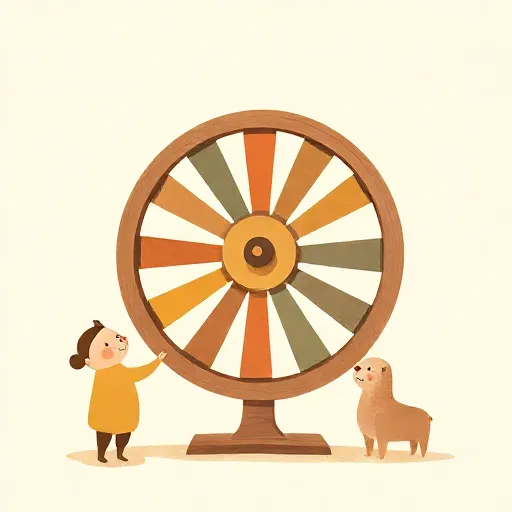
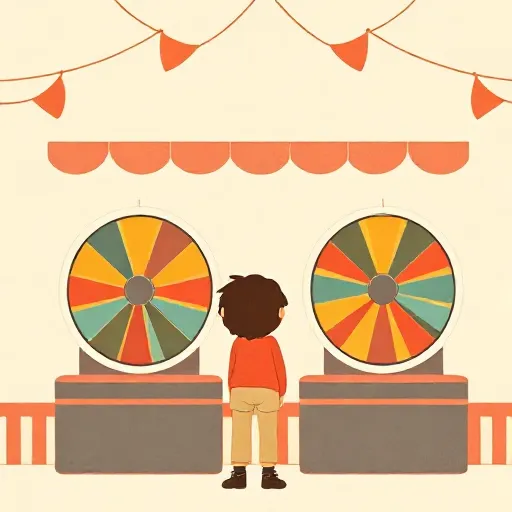
Imagine you’re at a town fair. One game offers a sure thing: you pay $1, and the booth immediately hands you $10. No tricks. The booth next door runs a spinning wheel. If the pointer lands on the right slice, you win $100. But the wheel has 1,000 slices, and only one slice pays. Which game do you play?
Your answer might depend on how much you value a guaranteed win, how scared you are of losing your only dollar, or just how lucky you feel. Philosophers who study decision theory want to know: is there one right way to decide?
The most famous answer is called expected utility theory. It says a rational person should always choose the gamble with the highest “expected utility”—a number that balances what you could gain against how likely each gain is, adjusted by how much you actually care about the outcomes. But the theory runs into trouble when values go infinite, when choices can’t be compared, when the odds are truly unknown, or when your fear of loss isn’t just about the money. These troubles suggest that being rational may not be as simple as doing the math.
The Recipe for a Smart Bet
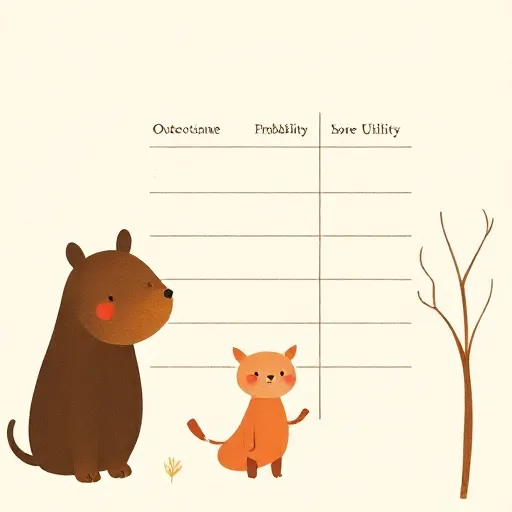
To use expected utility theory, you need three ingredients. First, a utility function—a personal thermometer that gives every possible outcome a number showing how much you value it. If you love orange soda, that outcome gets a high utility; if you hate being soaked by rain, that one gets a low number.
Second, you need probabilities. In some gambles, the odds are fixed, like a fair coin. In others, you must use your own degrees of belief, called subjective probabilities—how sure you are that your friend’s new pet lizard won’t escape.
Third, you combine them. The expected utility of a choice is the sum of (utility × probability) for each possible result. The theory’s rule is short: pick the act with the highest expected utility. If a gamble’s expected utility is higher than the safe option, you take the risk.
Mathematicians John von Neumann (1903–1957) and Oskar Morgenstern (1902–1977) proved something remarkable in the 1940s. If your personal preferences follow a few sensible rules—like being complete (you can always compare any two options) and being independent (adding the same extra possibility to both sides of a choice shouldn’t flip your preference)—then your choices can be pictured as if you are maximizing expected utility. Leonard Savage (1917–1971) later extended the idea to subjective probabilities. The representation theorem doesn’t force you to think about numbers; it shows that if your gut picks consistently, numbers will automatically tell your story.
That seems tidy. But each ingredient can fail in ways that break the whole recipe.
When Values Jump to Infinity

What if an outcome is so good it’s worth more than any number? The philosopher Blaise Pascal (1623–1662) argued that believing in God has infinite expected utility, because an eternity of bliss outweighs any finite pleasure. If he’s right, then even a tiny chance of such a reward justifies any sacrifice—and the usual rules break, because infinity can’t be compared with ordinary numbers.
Even without God in the picture, infinity causes trouble. The St. Petersburg paradox, noticed by Nicolas Bernoulli (1687–1759) in 1713, imagines a coin toss that keeps doubling your prize until the first heads appears. The expected monetary value is infinite: ($2 × ½) + ($4 × ¼) + ($8 × ⅛) … → ∞. Yet no sensible person would give away their whole life savings to play. Daniel Bernoulli (1700–1782) suggested a fix: money brings less and less extra joy as you get richer. A diminishing marginal utility for cash makes the expected utility finite. But if the prizes are paid in utility itself, the paradox returns—you could face an infinite-utility gamble, and then the continuity axioms of the theory collapse. Some philosophers now explore number‑like systems beyond the real numbers, such as hyper‑real or surreal values, to tame infinity. Others argue we should just ignore incredibly tiny probabilities, treating them as zero. The puzzle remains open.
Apples, Oranges, and Sartre’s Choice

The completeness rule demands that for any two things, you must either prefer one, prefer the other, or find them equally good. But think of the French philosopher Jean‑Paul Sartre’s (1905–1980) famous example: a young man must choose between caring for his ailing mother or joining the Free French to fight in World War II. Neither option is clearly better; they aren’t equal either. This state—where things can’t be ranked on a single utility scale—is called incommensurability.
Faced with incommensurable options, many philosophers reject the completeness rule. Instead of a single utility function, they represent your preferences with a set of possible utility functions, each like a different advisor. Then you must decide not only what to choose but also how to use a divided committee. One rule, called E‑admissibility, says an option is allowed if at least one advisor would pick it. Another, called maximality, says an option is okay as long as no other option beats it unanimously. Neither rule gives a single ranking—they just mark some choices as sensible. The deep question is whether some pairs of things really are incomparable, or whether we just haven’t found the right measuring stick.
The Urn of Unknown Odds
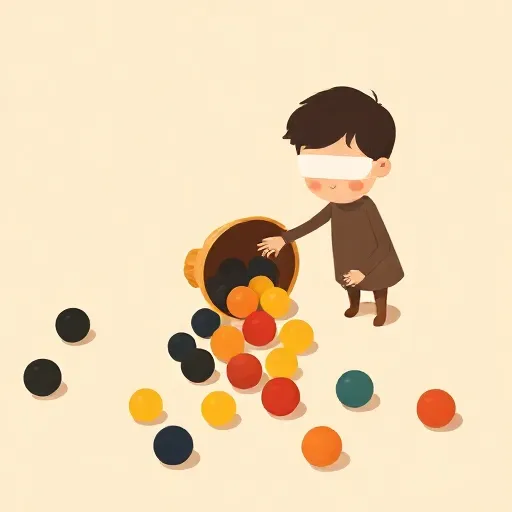
In 1961, Daniel Ellsberg (1931–2023) presented a now‑famous gamble. An urn holds 90 balls: 30 are red, and the remaining 60 are some mix of black and yellow—you have no idea how many of each. You get $100 if your chosen color is drawn. Most people strictly prefer to bet on red, where the odds are known, rather than black. And they prefer to bet on “black or yellow” (which guarantees a ⅔ chance) over “red or yellow” (where the chance could be as low as ⅓). These choices feel natural, but they violate a key rule of expected utility theory, the Sure‑thing Principle. The violation suggests that people dislike ambiguity—situations where probabilities are imprecise or unknown.
To capture this, decision theorists sometimes replace a single probability number with a whole set of probability functions. Then a rule like Γ‑maximin says: look at the worst‑case expected utility for each option, and pick the one whose worst case is best. That matches the Ellsberg preferences. Other rules, such as Choquet expected utility, reweigh the probabilities so that unlikely good outcomes get even less attention—a bit like an extra safety net for the cautious. The debate now is whether it’s rationally required to have sharp probabilities. Some argue that evidence simply doesn’t always fix a single number, so a wise person stays imprecise.
Hating Losses More Than You Love Gains

Imagine two coffee lovers. Alex gets shaky after one cup, so a second cup brings barely any added pleasure. Jamie can drink cup after cup with the same delight, yet still hates risky bets—a fifty‑fifty shot at two cups feels worse than one certain cup, even though the average amount is the same. Both turn down the gamble, but for different reasons. Expected utility theory can explain Alex’s behavior with a utility curve that flattens out, but it can’t easily handle Jamie’s simply by adjusting the utility of coffee. Jamie’s preferences seem to violate the independence axiom, as the French economist Maurice Allais (1911–2010) famously demonstrated.
This mismatch has led some philosophers to propose theories that add an extra ingredient: a risk function that describes how much a person cares about outcomes that happen in worse‑case scenarios versus better ones. In risk‑weighted expected utility theory, you still have probabilities and utilities, but you also give extra weight to the bottom part of the possible outcomes. A person with a “convex” risk function is more focused on avoiding the worst result—they are risk‑avoidant in a way that goes beyond just valuing dollars differently. Allais’s paradoxical preferences can be rationalized this way: a person rejects a slightly risky gamble for a big prize because they care disproportionately about the small chance of heartbreak. The debate continues over whether that extra weight is truly rational or just a predictable mistake.
Why Your Own Choices Echo This Puzzle

You probably won’t face an urn of colored balls or an infinite coin‑toss today. But you do face decisions where the odds are blurry: how to spend a free afternoon when both options sound fun; whether to try a new shortcut home when the old route is reliable; or how much of your savings to risk on a cool new hobby that might not pan out. Expected utility theory offers a clean ideal, but the challenges show that being “rational” might mean different things: sometimes it means being cautious with unknown odds, sometimes it means admitting that two choices aren’t really comparable, and sometimes it means trusting your own fear of loss even if the numbers scream “go for it.”
The fact that smart people still disagree about the right rule—after three centuries—tells you something important. Deciding well isn’t just about cold calculation; it’s about knowing what you value, what you can afford to lose, and when you’re allowed to look at the math and still say “no thanks.”
Think about it
- If a friend offered you a gamble that could win you an infinite amount of happiness but had a tiny chance of total disaster, would you take it? What would make the choice hard?
- When you can’t decide between two equally tempting ice‑cream flavors, does that mean they are truly incomparable, or are you just missing some hidden scale? How could you tell?
- Imagine a machine that tells you all the precise probabilities of every outcome in your day. Would having those numbers make your life easier, or would something still be missing?