Can a Clever Bookie Prove Your Beliefs Are Irrational?
The Betting Booth and Your Inner Odds-Maker
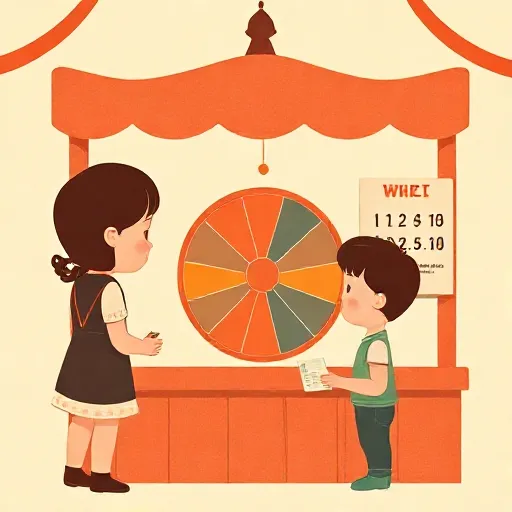
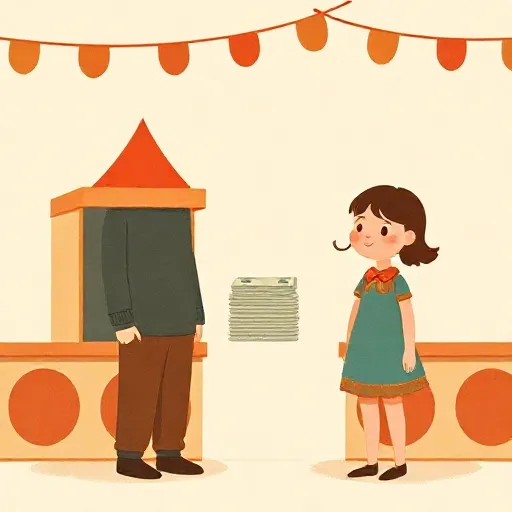
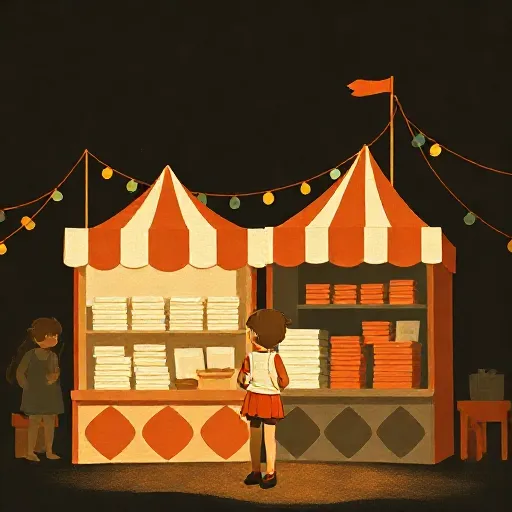
You are at a school fair. A man behind a booth says, “I’ll pay you $1 if this coin lands heads, but you pay me $1 if it’s tails. What price will you pay to play?” You think the coin is fair, so you’d pay 50 cents — exactly what feels right half the time. That number, 0.5, is not just a coin trick; it is your degree of belief, the strength of your confidence that something will happen.
Philosophers call these personal confidence levels credences. You don’t just have them about coins — you have them about whether it will rain tomorrow, whether your team will win, whether a story is true. In the 1920s and 1930s, thinkers like Frank Ramsey (1903–1930) and Bruno de Finetti (1906–1985) asked: is there a sensible rule that all those inner odds must follow? They arrived at the probability axioms, the basic math of chance, and argued that your credences should obey them. The axioms say three simple things:
- Non‑Negativity: Your confidence in any statement must be between 0 (impossible) and 1 (certain). You can’t have a negative probability — that would make no sense.
- Normalization: If a statement is a guaranteed truth, like “2+2=4” or “every triangle has three sides,” you must be 100% sure of it. That’s probability 1.
- Finite Additivity: If two statements can’t both be true at once — say, “the coin lands heads” and “the coin lands tails” on a single flip — then your confidence that at least one happens should equal the sum of the two separate confidences. So if you’re 0.5 sure of heads and 0.5 sure of tails, you should be 1.0 sure that one of them lands. The numbers must add up.
Together, these rules define a coherent set of credences — one where your inner odds fit together like a neat puzzle. Violate any of them, and your beliefs are incoherent, even if you’ve never heard the word before.
How a Clever Bookie Can Trap You

Here’s the twist. Ramsey and de Finetti noticed that if your credences break those axioms, someone can build a Dutch Book — a set of bets, each of which looks fair to you, that together guarantee you lose money no matter how the world turns out. The bettor doesn’t need to know the future; they just need to know your odds.
To see how, imagine your betting quotient for “heads” on a fair coin is 0.6. That’s the fraction of the stake you’ll risk — if the stake is $1, you’d pay $0.60 for a bet that wins $1 if heads comes up. If you’re also oddly 0.5 confident in tails (maybe you misjudged), a bookie can sell you a heads bet for $0.60 and a tails bet for $0.50. You pay $1.10 altogether, but you can only win $1 back, because only one side can win. You lose at least $0.10 no matter which side shows. The bookie pockets your certain loss.
The Dutch Book theorem shows that for any violation of the probability axioms, a similar trick exists. If you assign a negative probability (yes, that would be incoherent), you’re basically paying someone to let you lose. If you give less than 1 to a sure thing like “1+1=2,” a bookie can sell you a bet that costs less than $1 but promises $1 on that truth — you pay, and since the statement is true, you collect the dollar; but the bookie simply sells you the bet at your discounted price and takes the difference. If you break additivity, the bookie can mix bets on mutually exclusive claims to drain your wallet in every possible outcome. The idea is that incoherence opens a door to being exploited.
The argument for probabilism — the rule that rational credences must obey the probability axioms — goes like this: your degrees of belief should match your betting quotients, you would accept bets that are fair according to those quotients, and therefore incoherent credences make you vulnerable to a guaranteed loss. Since that vulnerability is bad, you ought to be coherent.
But Is It Really Irrational to Break the Rules?

Hold on, though. Plenty of philosophers have pushed back. The first problem is the gap between your inner confidence and actually reaching for your wallet. You might have a messy degree of belief in some complicated idea — say, you’re only 80% sure of a tricky logic puzzle — yet you’d never accept a bet on it, because you know you’re not an expert. Or you might simply refuse to gamble at all. The Dutch Book argument usually assumes that you will accept any bet that looks fair or favorable based on your credences. But in real life that’s often false.
Even if you would accept those bets, the guaranteed loss isn’t an actual loss unless someone really tricks you. You could live on a desert island with no clever bookies. The philosopher Alan Hájek pointed out that just as a Dutch Book can guarantee a loss against an incoherent person, a “Czech Book” can guarantee a gain — the bookie could accidentally set up bets that hand you a profit. If vulnerability alone makes you irrational, then the possibility of a sure gain would seem to make incoherence rational, which is absurd. So the mere existence of a Dutch Book can’t settle the matter.
Another blow comes from our ordinary uncertainties about necessary truths. Suppose you’ve never studied advanced mathematics, and someone asks, “What’s your credence that Fermat’s Last Theorem is true?” You’ve heard it was proven, but you can’t follow the proof. You might reasonably be 90% confident, not 100%. Yet the probability axioms demand full certainty for any logical truth. If you follow the axioms blindly, you’d have to be just as sure of that theorem as you are that 2+2=4, even though your evidence is weaker. That seems to punish honest ignorance. So critics say the axioms sometimes demand too much from a real thinker.
The Big Debate: Logic or Loss?

Some defenders of the Dutch Book argument respond that the real point isn’t about money at all. In their view, the betting story is merely a vivid way to show that incoherent credences are inconsistent — they clash with each other in the same way that believing “It’s raining” and “It’s not raining” at the same time clashes. They call this pragmatic inconsistency. If your degrees of belief guide your actions, then an incoherent set will lead you to evaluate the very same option in two conflicting ways, a kind of mental faultline.
Under this reading, even if you never meet a bookie, the problem is already inside your head: you’re committed to a system of evaluations that can’t all be fair. The Dutch Book merely diagnoses the illness. This would make the probability axioms a standard of logical hygiene for your credences, just like the rule that you can’t believe a contradiction.
But critics point out that even this version leans on heavy assumptions. It presumes that your credences are tightly linked to how you assess bets in the first place — that you treat them as your own fair prices. Not everyone agrees that having a degree of belief must mean you’d accept any corresponding wager. And even if you do, you might value money or other goods in weird ways that break the neat link between fairness and a single price. So the argument may not prove that sheer incoherence is always irrational, only that under very special conditions it creates an evaluative snag. The debate remains wide open.
Why It Still Matters for Your Everyday Thinking

You might never meet a bookie at a carnival, but you’re already living with probabilities. When the weather app says there’s a 30% chance of rain, you decide whether to carry an umbrella based on what you’re willing to risk. When you split a treat with a friend, you figure the odds of who gets the bigger piece. In all these moments, your brain runs a tiny betting booth, offering quick prices.
The Dutch Book argument pushes you to ask: are my inner odds consistent? If you think there’s a 40% chance of rain and also a 70% chance of no rain, something is off — and a crafty adversary could take advantage of that crack. The bigger lesson isn’t that you must always be a perfect probability machine. It’s that coherence is an ideal, a way your thinking fits together without secretly fighting itself. Philosophy hasn’t settled whether the threat of a Dutch Book proves you are irrational when you fall short. But it has shown us that your beliefs are a kind of currency: they buy your decisions. Keeping that currency from contradicting itself is one way to be a more careful and trustworthy thinker, even if you never place a single bet.
Think about it
- If a friend offered you a bet that seemed fair based on your own gut feelings, but you suspected they knew something you didn’t, would you still take it? What does that say about trusting your own odds?
- Imagine you have no clue whether a distant star has planets, but you’re forced to put a number on it. Is it more reasonable to say 50% or to refuse to give a number at all? Why?
- If a guaranteed loss only happens when you actually agree to a string of bets, can the possibility of that loss make your beliefs inconsistent, or is it just a practical danger?