Why You Can’t Always Pin a Number on Your Belief
A Carnival Game That Trips Up Probability
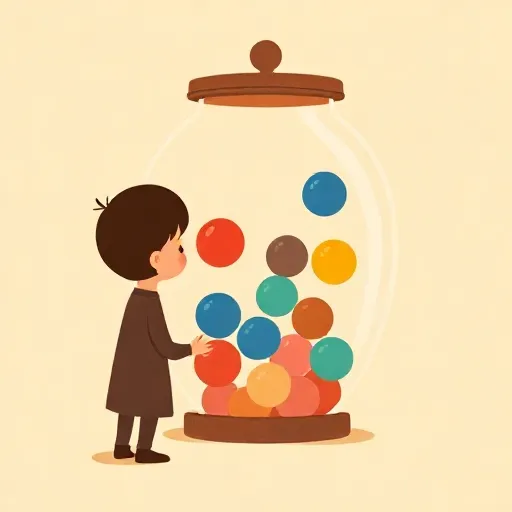
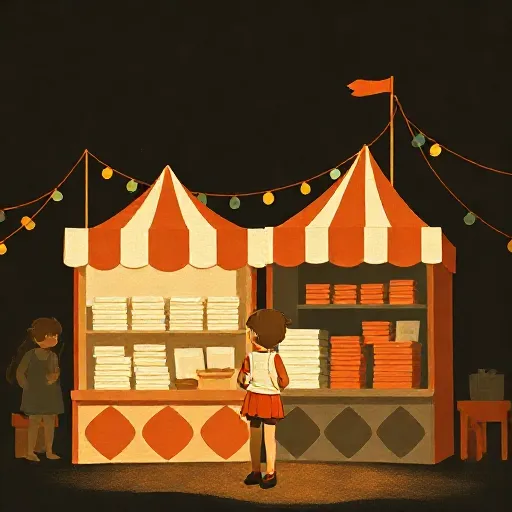
Imagine you’re at a street fair. A game-master shows you an enormous glass urn with 90 marbles: 30 are red, the rest are blue or yellow, but you don’t know how many of each. He offers you two bets. Bet on red pays $10 if a red marble is drawn. Bet on blue pays $10 if blue is drawn. Which do you prefer?
Many people choose to bet on red. The reason is simple: the chance of red is clear—30 out of 90, exactly 1/3. The chance of blue, however, is a total mystery. It could be anywhere from zero to 2/3. Blue feels ambiguous, and that makes people uncomfortable. Yet if you follow the usual rules of rational belief, you are supposed to have a single, precise number for your degree of belief in every statement—including the chance of drawing a blue marble. You’d have to pick some number, like 0.4 or 0.5, even though your evidence gives you no good reason to choose it.
As far back as the mid‑nineteenth century, the mathematician George Boole (1815–1864) was already uneasy about this. He wrote: “It would be unphilosophical to affirm that the strength of that expectation, viewed as an emotion of the mind, is capable of being referred to any numerical standard.” This uncomfortable feeling gave rise to the idea of imprecise probability (IP)—the view that your degrees of belief sometimes can’t be pinned down to a single sharp number.
What Precise Beliefs Look Like
In the standard picture of rational belief—often called Bayesianism—your attitude toward any claim is represented by a real number between 0 and 1. This number is your credence. A credence of 0 means you’re completely certain the claim is false; 1 means you’re completely certain it’s true. A fair coin, for example, would earn a credence of 0.5 for heads.
Your entire belief state is a probability function—a rule that assigns credences to all possibilities in a consistent way. For instance, if two events cannot happen together, the credence for “one or the other” must be the sum of their separate credences. When you learn something new, you update by conditionalization: your new credence in an event becomes your old credence in that event, given the evidence you just learned.
This model has been amazingly successful in statistics, science, and everyday reasoning. But it demands that you have a precise number for everything, no matter how little evidence you have. Is it always reasonable to force yourself to have a sharp number when your information is thin or fuzzy?
A Committee in Your Head

Imprecise probabilists offer a different picture. Instead of a single probability function, they say your belief state is a set of probability functions. Isaac Levi (1930–2018) called this set a credal set; others call it a representor. Think of each function as one member of a “credal committee” inside your head—each member has a sharp opinion, but they don’t all agree. Together they represent your overall belief.
Now you don’t get a single number for how likely an event is; you get a range: the lowest and highest numbers among all the committee members. For the carnival urn, many IP thinkers would say your belief about drawing a blue marble is the entire interval [0, 2/3]. The lowest possible credence is 0; the highest is 2/3. You don’t commit to any one number in between. The bottom of the range is called your lower envelope; the top is your upper envelope.
This set‑of‑functions approach makes room for a mental move that precise probabilism can’t easily express: you can genuinely suspend judgment. Instead of being forced to pick a number when the evidence is meager, you can say your belief is broad and non‑committal. That turns out to be useful in many real‑world puzzles.
Why Would Anyone Want Fuzzy Beliefs?
Philosophers give several reasons to welcome imprecise probabilities.
Ambiguity is real. The Ellsberg problem, with the urn you faced, shows that many people avoid bets whose odds are unknown (ambiguity) and prefer bets with known chances (risk). If you prefer red over blue, and also prefer “not blue” over “not red,” no single set of precise numbers can capture your choices—the math simply doesn’t add up. But an IP set can: red is sharply 1/3, while blue is [0, 2/3]. That range explains why you steer clear of ambiguous bets, and it matches what experimenters often observe.
Sometimes you just can’t compare. Mark Kaplan (born 1944) argues that being undecided between two options is different from being indifferent. Indifference means you judge two things equally good; indecision is when you genuinely don’t have a judgment. In standard precise probability, you must always be able to compare any two gambles—one must be at least as good as the other. But real people often find themselves without any preference, and that isn’t irrational. IP lets you represent an incomparable attitude honestly.
Weight vs. balance. Economist John Maynard Keynes (1883–1946) noticed that a probability of 0.5 feels very different when it’s backed by lots of evidence versus almost none. Toss a fair coin a hundred times and get roughly 50 heads: your credence of 0.5 has weight behind it. Toss a coin with completely unknown bias once: symmetry still suggests 0.5, but your belief has almost no weight, only balance. IP captures this difference: the first case is {0.5}, the second is [0,1]. A single number can’t tell you how solid the ground under you is.
When Imprecise Beliefs Get into Trouble

IP is not without problems. One famous trouble is dilation. Imagine a fair coin whose heads side contains a hidden message: someone wrote either “Yes” or “No” there, but you don’t know which. The paint is scraped off so you can see the word. The coin is flipped, and you observe that the visible side says “Yes.” Intuitively, this tells you nothing about whether the coin landed heads—it seems utterly irrelevant. Yet if your prior belief about which word was written is imprecise, your credence about heads can widen from a sharp 1/2 to the whole range [0,1]. Dilation makes your beliefs fuzzier when you learn something that feels like it shouldn’t matter.
Some philosophers say this shows IP is flawed. Others reply that the seeming irrelevance is a trick of the setup: the sharp 1/2 you started with wasn’t based on weighty evidence but on a symmetry that could easily be wrong. Once you acknowledge that you don’t know what was written, the new evidence can indeed change how strongly you should believe the coin landed heads. The debate is still lively.
Another worry is belief inertia. If your credence in some hypothesis is totally vacuous—[0,1]—then no matter what evidence you get, it can stay that wide. You can’t learn from complete ignorance. IP defenders typically respond that real learners never start from nothing; your prior always rules out at least a few extreme possibilities, and that’s enough to get learning going.
Decision-making also raises hard questions. When your beliefs are ranges, two bets might be incomparable: each has an expectation range like [−10, 15]. Should you refuse both? If you face a sequence of bets, refusing both can make you miss a guaranteed profit, which looks irrational. Researchers are still debating the best rules for choosing when options can’t be neatly ranked.
Why This Matters for How You Think

You probably aren’t a professional gambler or statistician, but you face uncertainty every day: weather forecasts, medical test results, or deciding whether to trust a rumor. You’re often given a single percentage, like “30% chance of rain.” But think about what that number really means when the forecaster has very little data. Imprecise probability teaches that sometimes the most honest answer is a range—or even a frank “I don’t know.”
This idea encourages epistemic humility: admitting when your evidence is too weak to pin down a number. Self‑driving cars, medical AI, and climate models all wrestle with deep uncertainty; researchers are turning to IP‑inspired ideas to avoid making overconfident predictions that could cause serious harm. So next time someone asks you how likely something is, pause and ask yourself: does my evidence really justify a single sharp number, or should my belief stay comfortably fuzzy?
Think about it
- If a doctor says there’s a “30–50% chance” a treatment works, is that more honest than saying “40%”? Why might a range be better, and why might it make deciding harder?
- Suppose you’ve never seen a coin before and someone asks you to bet on heads. Is it smarter to refuse the bet entirely? Or would you accept it if the odds were extremely favorable? What does your answer say about your belief?
- Can you remember a time when you really had no idea about something, but somebody pressured you to pick a number? Would giving a range have been better than staying silent? Why or why not?