
How Can You Choose Wisely When You Don't Know What Will Happen?
The Gamble That Drives Philosophers Crazy
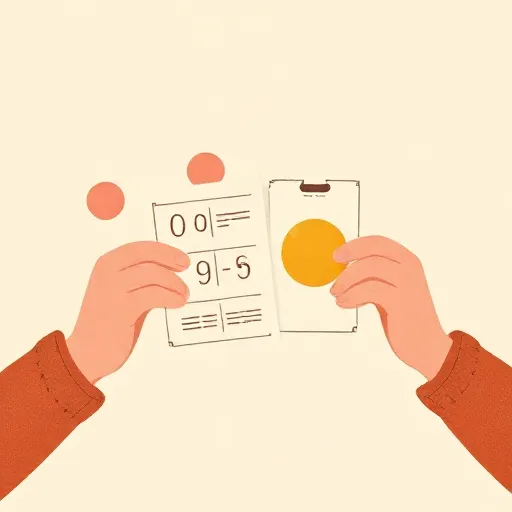
Imagine you are at a game booth. The host offers you two tickets:
- Ticket A gives you $2,400 — guaranteed.
- Ticket B gives you a 33% chance of $2,500, a 66% chance of $2,400, and a 1% chance of $0.
Which would you choose? Most people grab Ticket A. The tiny chance of getting nothing feels scarier than the small bonus of an extra $100.
Now the host changes the game. You get two new tickets:
- Ticket C gives you a 33% chance of $2,500 and a 67% chance of $0.
- Ticket D gives you a 34% chance of $2,400 and a 66% chance of $0.
This time, many people switch and pick Ticket C. But wait — the pairs are inconsistent. Both Ticket A and Ticket C offer a 33% shot at $2,500, while B and D offer a 34% shot at $2,400 (plus a tiny chance of zero). So if you prefer A over B, you should also prefer D over C. Yet people often do the opposite. This puzzle, called the Allais paradox after French economist Maurice Allais (1911–2010), shows we do not always follow the simple “multiply chance by value” rule. Philosophers and mathematicians have been arguing ever since: is our gut feeling wrong, or is the rule too strict?
The Two Unbreakable Rules for Wanting Things

Before we tackle risky choices, let us think about the simplest wants: which option do you like more? A preference is just a comparative attitude — you take one option to be at least as good as another.
For your preferences to make sense, most thinkers say you need two rules:
- Transitivity: If you prefer cake to ice cream, and fruit to cake, then you must prefer fruit to ice cream. If your wants formed a loop — cake beats ice cream, ice cream beats fruit, fruit beats cake — you would be in trouble.
- Completeness: You must be able to compare any two options. For any pair, either you prefer one, or you find them equally good.
Why should transitivity be a rule of rationality? Imagine you violate it: you strictly prefer A over B, B over C, but C over A. Start with A. Because you prefer B to A, you would gladly trade A for B. Then, preferring C to B, you would trade B for C. Finally, since you prefer A to C, you would trade C for A plus a dollar — and you are back where you started, minus a dollar. A slick trickster could repeat this, turning you into a “money pump.” Transitivity saves you from those sure losses. (As Donald Davidson and others argued in the 1950s.)
Completeness is more debatable. Do you really have to compare “two more people become literate” with “two more people reach age sixty”? Many philosophers say no. But when the options are similar — say, different holiday destinations — completeness feels natural. Even if your preferences are incomplete, Richard Jeffrey (1926–2002) argued they should be coherently extendible — you could fill in the gaps without breaking transitivity.
How to Number Your Desires — Even When You Can’t Count Them

Once your preferences are orderly, we can assign numbers to represent them. The weakest kind of number is ordinal utility — it only tells you the order. If you rank three vacation spots as Amsterdam < Bangkok < Cardiff, you could assign utilities of 0, 1, and 2 — or 0, 10, and 100. Both represent the same order.
But sometimes we want to know how much you prefer Cardiff to Bangkok compared to how much you prefer Bangkok to Amsterdam. That needs a cardinal utility, where differences matter. How can we measure that? The trick, invented by Frank Ramsey (1903–1930) and later refined by John von Neumann (1903–1957) and Oskar Morgenstern (1902–1977), is to introduce lotteries — choices with probabilities.
Suppose you are indifferent between a sure trip to Bangkok and a lottery that gives you a p chance of Cardiff and a (1−p) chance of Amsterdam. If you would accept the lottery when p is 3/4, then Bangkok’s utility is 3/4 of the way up the scale from Amsterdam to Cardiff. You can assign Amsterdam utility 0, Cardiff utility 1, and Bangkok utility 0.75. That number comes from expected utility: 0.75 = (3/4 × 1) + (1/4 × 0).
For this to work consistently, your preferences over lotteries must obey two extra axioms:
- Continuity: No outcome is so terrible that you would not take a tiny risk of it for a chance at something better. (Even crossing the street to pick up a $10 bill carries a minuscule risk of death, and you do it.)
- Independence: If two lotteries share a common part, that part should not affect your choice. Your preference should depend only on the different branches.
The Allais paradox from the opening directly violates Independence. In the first pair, the common part is the 66% chance of $2400 (and the 1% zero), which should cancel out — but our gut says it matters. So either Independence is too strong, or we are not describing the outcomes richly enough (maybe the regret of getting nothing feels worse when you could have had a sure thing). This tension is why decision theory is alive with debate.
When You Don’t Know the Odds: The Mountaineer’s Puzzle

So far we have assumed you know the probabilities (like a lottery wheel). In real life, you often face uncertainty without given numbers. Should a mountaineer attempt a dangerous summit given only vague weather forecasts? This is where subjective expected utility theory comes in, aiming to capture both your beliefs and your desires from your choices.
Leonard Savage (1917–1971) built an influential theory in 1954. He imagined choices as acts that map states of the world (rain, no rain) to outcomes (miserable wet stroll, comfortable stroll). If your preferences over all possible acts satisfy certain axioms — including the Sure Thing Principle, which is like Independence for states of the world — then a unique probability function representing your beliefs and a cardinal utility function representing your desires can be read off from your preferences. You then maximize expected utility relative to them.
The catch? To prove his theorem, Savage needed your preferences to be defined over every possible pairing of states and outcomes, even absurd ones (like an act that gives you “miserable wet stroll” in the state “no rain”). That is not how our minds work. Richard Jeffrey offered an alternative: treat all options, including acts, as ordinary propositions you have beliefs and desires about. His formula for desirability avoids the need for separate state/outcome partitions and does not require probabilistic independence between acts and states. The trade-off: Jeffrey’s theory does not yield a unique probability function — multiple probability–utility pairs can represent the same rational preferences. Some see this as a flaw, others as a realistic feature: your beliefs should not be forced into a single number just by how you choose among a few options.
Breaking the Rules on Purpose: Regret, Caution, and Stubborn Holes
The Allais paradox isn’t the only challenge. Some philosophers argue that Completeness is too demanding — sometimes you genuinely cannot compare options, like two careers that excel in different dimensions. One response is to represent your incomplete preferences with a set of utility functions and probability functions, and then choose only if an option is not dominated by another across all pairs. This leads to cautious decision rules like Maxmin (pick the option with the best worst-case expected utility).
Lara Buchak (born 1981) developed a theory, risk-weighted expected utility, that allows your attitude toward risk to influence choices without breaking transitivity — explaining Allais-type preferences while keeping most of the structure. Others have incorporated regret directly into the evaluation of outcomes: getting nothing feels worse when you could have had a sure gain, so the description of the outcome should include that feeling.
Then there is the precautionary principle: when facing possible catastrophes (like extreme climate change), should you ignore tiny probabilities because the worst outcome is so bad? EU theory’s Continuity axiom says you must always accept a tiny risk of disaster for enough gain somewhere else. Some philosophers reject that axiom, proposing lexicographic theories where certain bad outcomes simply cannot be outweighed by any amount of ordinary good. These debates shape real-world policies.
Why It Matters Next Time You Pack an Umbrella

Every day, you make decisions under uncertainty: should you take the bus or walk if the weather app says 40% chance of rain? The logic of expected utility gives you a tool: picture the outcomes, weigh them by how much you would like them, and multiply by how likely you think each is. But the philosophical debates show that being truly rational is not just about the math. It is about knowing what you really want, how sure you are of your beliefs, and when it is okay to be extra careful.
Decision theory also helps us build fairer systems. It guides algorithms that recommend movies, self-driving cars that must avoid pedestrians, and governments that set climate policies. The questions philosophers ask — Should we ever ignore a tiny risk of catastrophe? Can we compare completely different values? — are the same ones that engineers and lawmakers wrestle with. So next time you face a tough choice, you are not just picking an option. You are testing a theory of your own mind.
Think about it
- If you could press a button that gives a 90% chance of your favorite dessert and a 10% chance of nothing, or another button that always gives a dessert you like but not love, which would you press? Could anyone prove you chose irrationally?
- Imagine your friend trades a chocolate bar for a granola bar, then the granola bar for a fruit leather, then the fruit leather for the original chocolate bar — plus a dime. Is your friend being foolish? How could you help him see the pattern?
- Some people say you cannot compare the joy of a perfect autumn day with the satisfaction of finishing a big puzzle. Do you think it is reasonable to refuse to compare them, or should you force yourself to pick one? What might you miss out on if you never decide?