
The Beautiful Equation That Can’t Explain Your Lunchtime Bet
The Equation That Promised Perfect Choices
Imagine you’re on a game show. You can walk away right now with a million dollars, no strings attached. Or you can spin a wheel: an 89‑percent chance of the same million, a 10‑percent chance of five million, and a 1‑percent chance of nothing. Almost everyone grabs the sure million. That feels sensible.
Now a second round. You must choose between an 11‑percent shot at a million (89 percent nothing) and a 10‑percent shot at five million (90 percent nothing). Suddenly, many people prefer the five million gamble. That flip feels just as natural. But to a mathematical theory of decision‑making, it looks like a crack in a mirror.
For decades, the most admired model of rational choice was subjective expected utility, or SEU. Its core idea came from Leonard Savage (1917–1971), building on earlier work by Frank Ramsey, John von Neumann, and Oskar Morgenstern. SEU says that whenever you face a choice with uncertain outcomes, you act as if you assign each result two numbers: a utility (how much you desire it) and a subjective probability (your personal degree of belief that it will happen). Then you pick the act with the highest sum of (probability × utility). If your preferences follow a few simple rules, Savage proved, they can always be described by that equation.
One of those rules turned out to be a bombshell: independence. It says that if you prefer lottery A over lottery B, mixing each of them with the same third lottery in the same proportion shouldn’t change your mind. Your choice between A and B should stand on its own, no matter what extras get stirred in.
The Allais Paradox: When a Sure Million Breaks the Rule

In 1952, the economist Maurice Allais (1911–2010) asked Savage himself to play two pairs of gambles. The first pair was the million‑dollar game show problem. Most people, including Savage, chose the sure million (call it Option A) over the risky wheel (Option B). The second pair was the follow‑up: an 11‑percent chance of a million (Option C) against a 10‑percent chance of five million (Option D). Common sense often picks D, and Savage did too.
But here’s the twist. If independence were true, preferring A over B forces you to prefer C over D. To see why, notice that both A and B secretly share a common consequence with C and D — a big chunk of the wheel that gives the same outcome. In A and B, that common part is an 89‑percent shot at a million. If you ignore that shared piece (independence says you should), the choice reduces to the same small‑scale gamble that appears in C versus D. So a rational agent who likes A over B must like C over D. Yet real people routinely switch, and Savage himself, after a moment’s embarrassment, later called his own flip a mistake.
Allais saw a pattern many others confirmed: people treat a certainty differently from a high probability, even when the numbers say they’re almost the same. The puzzle became known as the Allais paradox, and it delivered a sharp blow to the idea that our gut obeys the independence axiom.
Ellsberg’s Urn: The Fear of Unknown Odds
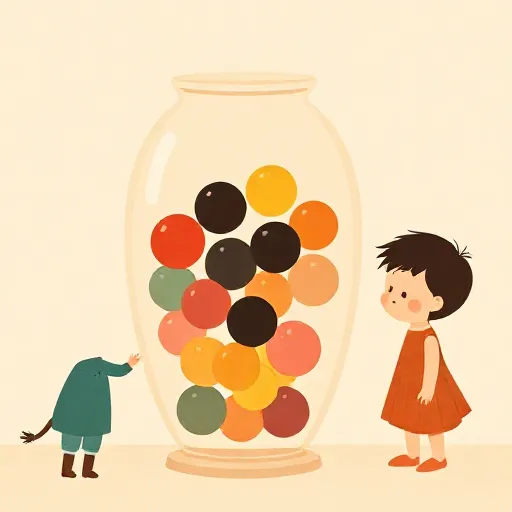
A second crack emerged a few years later. Daniel Ellsberg (1931–2023) asked people to imagine an urn with 30 red balls and 60 more balls that are either black or yellow, in unknown proportions. You get to bet on the color of a single draw.
First, choose between Bet f₁: you win $100 if the ball is red (you know the chance is exactly 1 in 3), and Bet g₁: you win $100 if the ball is black (the probability is completely unknown — it could be anything from 0 to 2/3). Most subjects pick f₁.
Next, choose between Bet f₂: you win $100 if the ball is red or yellow (but you don’t know the yellow proportion), and Bet g₂: you win $100 if the ball is black or yellow (the chance is exactly 2/3, because there are 60 black‑or‑yellow balls out of 90). Now the popular choice flips to g₂.
This pattern violates another key SEU rule — the sure‑thing principle — because the pairs differ only in whether “red” or “black” is linked to a known probability. The puzzle is called ambiguity aversion: people strongly prefer betting on events whose odds they know, even when the unknowns don’t obviously change the numbers. Ellsberg’s simple urn showed that many of us do not act as if we carry a single, neat set of subjective probabilities for every event.
Reshaping the Equation: How Your Brain Twists Probabilities

If SEU doesn’t describe real choosers, what does? Dozens of theories have been built to absorb the paradoxes without throwing away all structure. One family keeps the ranking of lotteries orderly but replaces raw probabilities with decision weights — numbers that reflect how your mind feels about chances.
A major success story is rank‑dependent utility (RDU), and its even more famous cousin, cumulative prospect theory, developed by Daniel Kahneman (1934–2024) and Amos Tversky (1937–1996), which earned Kahneman a Nobel Prize in 2002. In these models, a tiny probability (like that 1‑percent shot at zero in the Allais problem) looms much larger than its actual size, while a middling probability gets squashed. A certainty occupies its own special slot — exactly what Allais suspected.
The mathematics involves a probability weighting function that bends the scale. A jump from 99 percent to certainty feels gigantic, which is why people pay a premium to eliminate any sliver of risk. A jump from 0 to 1 percent also feels outsized, which makes lotteries with long‑shot jackpots attractive. These models can reproduce both the Allais and Ellsberg patterns without calling their followers irrational.
Another approach tackles ambiguity head‑on. Instead of one probability, you hold a set of possible probabilities — a range of guesses — and you make decisions as if you look at the worst case inside that range. That style, called maxmin expected utility, captures the cautiousness of someone who hates not knowing the odds. You can even adjust how much you fear ambiguity, from total caution to reckless optimism.
The Deep Fight: Should Your Gut Overrule the Equation?

The experimental blowback left a much bigger question dangling: are these deviations mistakes that a rational person should correct, or are they simply a different, equally valid way of being reasonable?
Allais took a strong stand. He argued that no deep logical principle forces someone to obey independence; the only firm requirements for rationality are that your preferences can be placed in a consistent order and that you never pick an option that is clearly worse in every possible world (a rule called stochastic dominance). Everything else, he said, must be settled by looking at how thoughtful people actually choose. Since many reflective persons exhibit the paradox preferences, independence is not a commandment of reason — it’s just one taste among others.
Savage saw it differently. When his own choices clashed with his axioms, he felt the same sting as finding two contradictory beliefs in his head. The clash meant something was broken, and the rational move was to revise his gut feeling to match the principle. He wasn’t alone; later experiments have shown that when people are told their choices conflict with independence, some do change their minds, especially when they get feedback on the outcomes of repeated decisions.
Yet the most famous studies, including work led by Kenneth MacCrimmon and Paul Slovic, found that Allais‑style and Ellsberg‑style preferences are stubborn. Many people hang onto them even after hearing the arguments on both sides. As a result, the quarrel between “the equation is the true north of good choice” and “the equation is too stiff to capture human wisdom” has never been fully settled. Philosophers and economists still argue about whether experimental data should count as evidence for norms of reasoning — a debate that echoes older fights about how we justify any rule of good thinking, from logic to induction.
Why It Matters for Your Own Decisions

You probably won’t face a million‑dollar game show tomorrow. But you confront versions of these puzzles all the time. Picking a safe homework strategy or a high‑risk, high‑reward one. Deciding whether to try a new food that might be delicious or awful. Figuring out how much to trust a stranger who could be friendly or tricky.
When your gut shouts, “take the sure thing” but the numbers murmur something else, SEU and its rivals give you two different ways to listen. SEU asks: are your probabilities sensible, your desires consistent, and your choices aligned? The alternative models say: your mind has built‑in amplifiers for rare dangers and certainties — that’s just how you’re wired, and maybe that’s okay.
Philosophy doesn’t hand out a final scorecard. Instead it sharpens your ability to notice when a decision feels one way but looks another under the lamp of logic. The puzzles that cracked the beautiful equation still crackle with life today, every time you weigh a bet. And they leave you with the most personal question of all: when your heart and the math disagree, which one are you willing to retrain?
Think about it
- If you could take a pill that would make you always follow the expected‑utility equation in every choice, would you take it? Why or why not?
- When is it smarter to trust your gut even when the numbers say otherwise? Can you think of a real example where the “equation” would lead you wrong?
- Is there one correct way to make decisions, or can reasonable people honestly disagree about how to weigh risks? What would you say to someone who made the opposite choice in Allais’s puzzle?