
Does Quantum Physics Live in Atoms or in Your Head?
The Atom That Won’t Make Up Its Mind
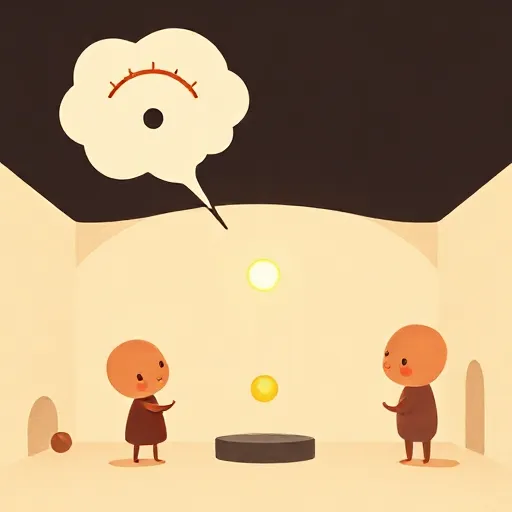
Picture a single radioactive atom. Quantum physics cannot tell you exactly when it will decay, only a probability: after a very short time, the chance is fifty-fifty. Most physicists treat that probability like a fact about the atom itself — a hidden coin toss that nature still has to flip. But what if the probability isn’t about the atom at all? What if it describes how you should bet on what you’ll see?
That is the starting point of QBism (pronounced “cubism”), a radical way of understanding quantum theory. In the early 2000s, physicists Carlton Caves, Christopher Fuchs, and Rüdiger Schack began arguing that a quantum state — the mathematical list that tells you what to expect from a measurement — doesn’t belong to the particle. It belongs to the person using the theory. A quantum state, they said, is a catalog of an agent’s credences, her degrees of belief about her own future experiences.
To get the feel of this, think of placing a bet. When you say “I am 70 percent sure the cafeteria will serve pizza Friday,” that number isn’t a property of the cafeteria. It’s a snapshot of your mind, based on everything you’ve seen before. QBists say the same is true for the numbers we assign to an electron: they are an agent’s personal, subjective betting odds, encoded in the quantum state. The world outside does not force those odds on you; they are your way of navigating uncertainty.
Your Quantum Betting Guide: The Born Rule as a Rule of Rationality

Every gambler needs a rule for updating bets, and QBists have one: the Born rule. In standard quantum mechanics, the Born rule is a formula that spits out probabilities for measurement outcomes once you know the quantum state. Most physicists see it as a law of nature, like gravity. QBists disagree. They treat the Born rule as a norm of rationality — a wise constraint on how an agent’s beliefs should hang together, not a description of how particles behave.
To make this work, QBists rewrite the rule without mentioning a quantum state at all. They imagine a special, all-purpose measurement called a SIC (symmetric informationally complete). You never actually perform it; it’s a hypothetical reference. An agent first decides what she believes would happen if she were to do that SIC. Then, using the Born rule in its new form, she can calculate her fair betting odds for the real, physical experiment in front of her. Christopher Fuchs describes the whole theory as “a users’ manual that any agent can pick up and use to help make wiser decisions in this world of inherent uncertainty.” Instead of telling you what the world is, it tells you how to keep your head straight when the world refuses to give you certainty.
Even the famous Schrödinger equation, which tracks how a quantum state changes in time, gets a new job. QBists say it does not describe the evolution of some physical thing. It’s a synchronic consistency check — a rule that tells you whether the beliefs you hold right now, across different possible times, fit together without contradicting one another. An equally rational friend could use the same data and wind up with a different state. That is fine: you each have your own private betting manual.
Solving the Spooky Puzzles: No Collapse, No Spooky Action

Quantum mechanics has two famous headaches. The measurement problem asks: if everything obeys the Schrödinger equation, why do we always see a single, definite outcome? And nonlocality asks: do particles really influence each other instantly across huge distances? QBism dissolves both puzzles by putting the agent in the driver’s seat.
The measurement problem arises only if you think a quantum state is a real thing that has to collapse. QBists deny that. To them, updating a state after you spot a result is just like updating your belief that the cafeteria will serve pizza after you actually read the menu — your knowledge changed, not the cafeteria. No mysterious physical collapse ever happens; the agent simply revises her personal credences in light of new experience. Quantum mechanics is a “single-user theory,” and any agreement among users is simply shared information, not a shared hidden reality.
Nonlocality, meanwhile, depends on the idea that two distant experimenters, Alice and Bob, are witnessing objective, far-apart events that somehow talk to each other. A QBist sees it differently. Alice never directly experiences an event in Bob’s lab. When she hears Bob’s report, that is an experience happening where she is, not at Bob’s location. All the correlations quantum theory predicts are correlations among a single agent’s own spatially-coincident experiences — the flashes, clicks, and printouts that occur in her personal stream of consciousness. With no need to connect two distant objective happenings, the specter of spooky action vanishes.
Are You the Only Real Thing? Objections to QBism

Unsurprisingly, QBism provokes strong reactions. A common cry is solipsism — the idea that only your own mind exists. If all I ever work with are my own experiences, isn’t that where physics stops? QBist David Mermin (1935–) replies that we do exactly what we always do in daily life: infer that other beings are like ourselves. He writes that his experience of you leads him to hypothesize that you are a being very much like himself, with your own private experience, and that science is a collaborative human effort to find, through our individual actions on the world and our verbal communications with each other, a model for what is common to all of our privately constructed external worlds. Solipsism would be forgetting that you already build a shared world out of voices and texts every day.
A deeper worry is that QBism can’t explain why solids conduct electricity or why the sky is blue. If a quantum state is just my private credence, how does it tell me anything about a real material? Philosopher Chris Timpson presses the point: “Ultimately we are not interested in agents’ expectation that matter structured like sodium would conduct; we are interested in why it in fact does so.” QBists reply that scientific explanation is often a matter of fitting your beliefs into a tight, economical web — probability theory already explains patterns without having to point to hidden causes. But the charge stings: forfeiting a physical story about the world can feel like giving up on explaining the world at all.
Another label is instrumentalism — the view that theories are just tools for prediction, never true or false. QBists resist this label by offering participatory realism. They believe the world is stunningly rich and real, but quantum theory doesn’t photograph it. Instead, by acting on the world and updating your beliefs, you help bring new facts into being. Reality, they say, isn’t a finished movie you’re watching from the back row. It’s a story you are writing, together with every other agent.
A Pragmatist Compromise: Without the Subjectivity

QBism isn’t the only game in town for those who think quantum states aren’t pictures of the world. Philosopher Richard Healey offers a pragmatist approach that keeps much of QBism’s machinery but strips out the personalism.
Healey agrees that a quantum state does not describe an object. It functions as a source of objectively good advice. The advice is objective not because it mirrors the physical world, but because applying the Born rule to the correct state gives you odds that any rational agent in your physical situation should accept. Different agents can assign different states to the same particle — not because of their private whims, but because they have access to different physical information. The state is relational: it depends on your angle of view, just as a map’s usefulness depends on which trails you have already walked.
In this picture, measurement outcomes are real, objective events, not private experiences. Probabilities are not personal credences; they are objective prescriptions that exist even in a universe without any minds, waiting to guide agents who might show up. Healey dissolves the measurement problem the same way QBism does, by relativizing the state to the situation, and he defuses nonlocality by showing that the statistical patterns never require a signal to travel faster than light. The result is a world with firm, shared facts, yet one that still refuses to hand us a single, non-relational snapshot of what is “out there.”
Why You Can’t Escape: Science Is Your Story

These debates matter far beyond the laboratory. If QBism or pragmatism is right, then every time you design an experiment, take a measurement, or even just notice a rainbow, you are not a passive camera. You are an active participant whose actions and expectations help shape what comes next. That doesn’t mean the moon stops existing when you aren’t looking at it — the moon is a solid part of your shared world — but it does mean that the ultimate engine of discovery is your struggle to organize your own stream of experience and communicate it to others.
Even Albert Einstein, often painted as the ultimate realist, once said that the whole of science is nothing more than a refinement of everyday thinking. QBism takes that seriously: the concepts you invent — particle, field, probability — are tools for tying your past experiences to your future ones. When you puzzle over why a chunk of sodium conducts electricity, you are weaving a story that must hold together for you, your lab partner, and anyone else who checks. That story will never be a perfect transcript of a hidden world, but it doesn’t have to be. It just has to be good enough to keep the conversation going.
Think about it
- If a friend had totally different beliefs about the outcome of your next chemistry experiment, would that mean one of you is wrong, or just that you are playing by different personal rulebooks? How could you decide?
- Imagine you could see through someone else’s eyes and feel their sensations directly. Would their “quantum state” still be private to them, or would it become yours too?
- A weather forecaster says “there’s a 30 percent chance of rain.” Is that number a fact about the sky, or about what you should pack in your bag? Could it be both at the same time?