Are Colors Just in Your Head, or Do They Belong to the World?
The Tickle That Isn’t in the Hand
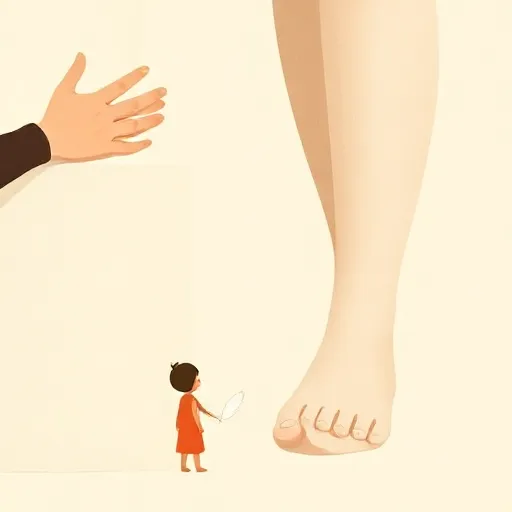
In 1623, the Italian scientist Galileo Galilei (1564–1642) invited his readers to imagine a strange experiment. Run your hand across a marble statue. Then run the same hand across the sole of someone’s foot, or the inside of an arm. Your hand does exactly the same thing both times — it moves and it touches. Yet the bare foot produces a burst of tickling laughter, while the statue feels cold and hard. The hand, Galileo argued, contributes nothing new to the world except motion and contact. The tickle is not a property of the hand, or even of the foot. It belongs entirely to the person who feels it. Remove the living, sensing creature, and the tickle vanishes as if it never existed.
Galileo used this tickle example to raise a much larger question: what qualities belong to objects themselves, and what qualities exist only because there are creatures like us to perceive them? This puzzle launched a philosophical debate that has lasted four centuries. It is a debate about where colors, tastes, smells, and sounds live — in the world outside your skin, or in the dance between the world and your brain.
Galileo’s Shocking Proposal
Galileo, a founder of modern science, believed that the book of nature is written in the language of mathematics. If you want to understand what is really real, you must look for things you can measure: size, shape, position, number, and motion. He called these primary affections, and later thinkers called them primary qualities. You cannot imagine a physical object without these features. Try to picture a rock with no size, no shape, no location. You cannot. Primary qualities are inseparable from what a body is.
But what about color, taste, scent, warmth, and sound? Galileo said you can perfectly well imagine a world without them. If there were no eyes, tongues, noses, or ears, would sweetness, blue, or the smell of roses exist? For Galileo, the answer was no. These secondary qualities are not in the objects that seem to have them. They are sensations that arise inside a living body when primary qualities — tiny invisible particles with shape and motion — bump into sensitive organs. Heat, for example, is not in the fire as a quality like size. According to Galileo, fire is a swarm of fast-moving particles. When they strike your skin, you feel warmth, but the warmth itself is only in you. The same reasoning applies to every color, every taste, every sound. If you remove the animal, all these qualities are annihilated — they become mere names with nothing real behind them.
This idea threatened the common-sense picture of the world. Yet Galileo did not blame the senses for fooling us. He blamed the way we use language. We give the same name to the sensation and to the supposed quality in the object — “red,” “sweet,” “loud.” Over time, we come to believe the quality is really out there, just like shape or motion. Galileo’s remedy was a new kind of natural philosophy that measured only primary qualities and treated secondary qualities as effects in the perceiver.
John Locke and the Snowball’s Hidden Powers

Half a century later, the English philosopher John Locke (1632–1704) gave the distinction its most famous form. In his Essay Concerning Human Understanding, published in 1689, Locke defined a quality as a power in an object to produce an idea in your mind. When you hold a snowball, it produces ideas of white, cold, and round. The quality is that power, which belongs to the snowball. The idea is what you experience.
Locke then sorted qualities into two kinds. Primary qualities are those that a body must have no matter what you do to it: solidity, extension (size and shape), motion or rest, and number. Grind the snowball into powder; every tiny grain still has these features. They are utterly inseparable from matter. Secondary qualities are also powers, but powers to produce sensations of color, taste, sound, smell, and heat by means of the primary qualities of insensible particles. The snowball’s color is not something spread over its surface like paint. It is a power, grounded in the ball’s microscopic texture, to cause the idea of whiteness in you.
Locke added a bold claim that became famous as the Resemblance Thesis. Ideas of primary qualities, he said, really do resemble the qualities in the object — your idea of a circle matches the shape of a coin. But ideas of secondary qualities do not resemble anything in the object itself. There is nothing like the feeling of warmth inside a flame; the flame only has a violent motion of particles. Locke drove the point home with a homely argument: a flame produces ideas of both heat and pain, yet nobody thinks the pain is in the flame. Why, then, should we think the heat is? The same kind of reasoning applies to sweetness and bitterness, colors and sounds. All of them are effects in the perceiver, not pictures of the world.
To make this vivid, Locke invited readers to consider a piece of porphyry, a deep red stone. In the dark, the porphyry has no color — the redness disappears until light returns. Porphyry does not change internally when the lamp goes out, so the color must depend on a relationship between its surface, light, and our eyes. Likewise, an almond tastes sweet, but pound it into paste and the taste turns oily and sharp. The almond’s primary texture has been altered, and so its power to cause the old sweet sensation has changed. In every case, secondary qualities are only powers that ride on the back of primary qualities.
Thomas Reid Asks: What Do You Actually Perceive?
Not everyone agreed with Locke’s tidy split. The Scottish philosopher Thomas Reid (1710–1796) thought the whole way of thinking about ideas was a disaster. Reid rejected the assumption that you never directly perceive objects, only ideas in your mind. He argued that in normal perception, your mind reaches right out to the thing itself.
Reid still found a deep difference between primary and secondary qualities, but he located the difference in how we know them. Press your hand against a tabletop. You have a faint sensation of pressure, but what you notice is the table’s hardness — a property that belongs to the table. Reid said the senses give us a “direct and distinct” notion of primary qualities. Hardness, figure, motion: we know what these are in themselves, simply by perceiving them. They are open to view.
Now smell a rose. You have a vivid, pleasing sensation, and you know the rose has some quality that causes it. But Reid insisted that you do not know what that quality is in itself. The quality is an unknown cause of a known effect — the sensation. You can only conceive of the rose’s smell by thinking back to the sensation it produces in you. Your notion of it is “relative and obscure.” This, according to Reid, is the true difference between the two kinds of qualities: primary qualities are understood directly; secondary qualities are hidden powers known only by their effects on our senses. You will never discover the nature of a color the way you discover the shape of a coin just by handling it. You have to investigate, test, and guess — and that is what scientists do when they study light, nerves, and brains.
Why This Debate Still Has Teeth
Galileo’s tickle, Locke’s porphyry, and Reid’s hard table are not just museum pieces. They are live questions in today’s science. When a neuroscientist explains that color is the brain’s way of coding wavelengths of light, she is translating Locke’s secondary qualities into the language of neural signals. When an engineer designs virtual reality goggles that make you flinch at a digital cliff, she relies on the fact that your experience of space and motion is constructed by your senses, not simply handed to you by the world. The puzzle has even reached into the food industry: food scientists know that “taste” is an interplay of texture, aroma, temperature, and expectation — primary qualities of molecules combining to create flavors that exist only in the perceiver.
The philosophical question remains wide open. If secondary qualities are mind-dependent, what about primary qualities? Some philosophers after Locke argued that even space and solidity cannot exist without a perceiver. Are there any qualities that belong to the world entirely on its own, with nobody looking? The clean division Galileo and Locke drew has been smudged, repaired, and redrawn many times.
Still, the starting insight is as sharp as ever: when you bite into an apple, some of what you experience reaches beyond the fruit into the living machinery of your own body and brain. Philosophy cannot tell you whether to say the apple is sweet or merely tastes sweet — but it can show you why that tiny difference matters, and why it might always feel like a riddle.
Think about it
- If a robot with camera eyes and pressure sensors measures an apple’s size, weight, and color, does it perceive the same qualities you do? Could it ever taste the apple?
- Imagine a world with no living creatures at all — no eyes, no ears, no skin. Does the ocean still have the color blue? Would it make a sound if a wave crashed on a rock?
- Could there be a quality that is not primary but also not secondary — something that is neither measurable shape nor a power to produce a sensation? What might it be?