
What Is It Like to See Red? The Mystery of Qualia
The Woman in the Black-and-White Room

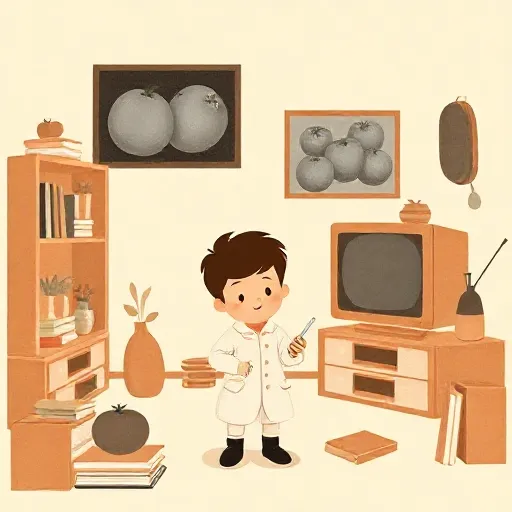
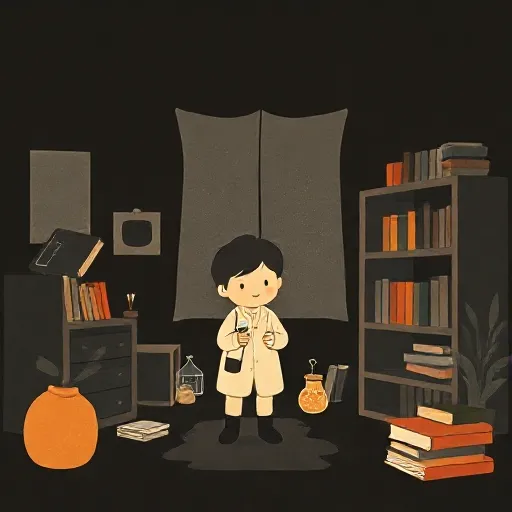
Imagine a scientist named Mary. She is locked in a room where everything—walls, furniture, books, even her own skin—is black and white. She has never seen a color. Through black-and-white televisions and books, Mary studies the science of color vision completely. She learns every physical fact: how light waves hit the eye, how signals travel to the brain, how different wavelengths get processed. She becomes the world’s leading expert on color. Yet she has never actually seen red, or green, or blue.
One day her captors let her out. She walks into a garden full of flowers. She sees a red rose for the first time and whispers, “So that is what it is like to experience red.” In that moment, Mary seems to discover something new—something no textbook gave her.
What Mary Found: The ‘What-It’s-Like’ of Experience

Mary’s discovery wasn’t a new scientific fact about light or brains. She already knew all of those. What she discovered was phenomenal character—the distinct, felt quality of an experience. When you see a turquoise patch, taste chocolate, or feel the cold of ice, there is something it is like for you. That something-it’s-like is what philosophers call a quale (plural: qualia). Qualia are the redness of red, the bitterness of coffee, the tingle of a touch.
This thought experiment, created by philosopher Frank Jackson in 1982, became a powerful challenge for physicalism—the view that everything in the world, including your mind and feelings, is purely physical. If Mary already knew every physical fact about color, but she still learns something new when she sees red, then maybe qualia are not physical facts at all. That’s the heart of the knowledge argument. It suggests that your inner world of feelings hides something science cannot capture.
Could She Already Know Without Knowing?

Some physicalists answer Mary’s story by saying she didn’t gain new information—she gained new abilities. According to the ability hypothesis, Mary leaves the room with the know-how to recognize colors by sight, to imagine them, and to remember them. She already knew all the facts; she simply got new skills, like learning to ride a bike after reading about balance.
But many think this reply misses something. Suppose you stare at a very specific shade of red (say, red‑17) on a rose. You know exactly what it’s like while you see it. Yet after the flower is gone, you can’t reliably recognize red‑17 among similar shades, and you can’t call up a perfect mental image of it. So having the ability isn’t what explains your knowledge of the quale while it’s happening. The ability hypothesis seems to stumble.
Another physicalist idea is that Mary lacked special phenomenal concepts—ways of thinking about her experience from the inside. When she sees red, she gets a new concept that points to the same physical brain state she already knew about under different, objective concepts. So she does make a real discovery, but what she discovers isn’t a brand-new non‑physical property; it’s an old physical property seen in a new way. Yet even this move is hotly debated: some insist that a new feeling must mean a genuinely new property, which would be non‑physical after all. The argument isn’t settled.
Zombies and the Impossible Gap

Even if Mary could be explained, another puzzle looms. Can you imagine a creature exactly like you molecule for molecule, living your same life, but with no inner experience whatsoever? It flinches when it touches a hot stove, laughs at jokes, says “ouch”—but inside there is darkness. This is the idea of a philosophical zombie. If such a being is even possible, then your feelings can’t be identical to your physical brain states, because the zombie has the same brain states and zero feeling.
Most physicalists reply sure, we can imagine zombies, but that doesn’t mean they can really exist. Many things are imaginable (like a square circle in a cartoon) that are impossible in reality. The question is whether this particular idea shows a true gap in the world or only a gap in our understanding.
That gap—between brain facts and felt experience—has a name: the explanatory gap. No matter how much we learn about neurons firing, we still don’t see why those firings should feel like the smell of coffee or the sting of a bee. Some philosophers think this gap will never close, meaning consciousness has irreducibly non‑physical ingredients. Others believe the gap is just a trick of our own concepts, and someday we’ll bridge it, perhaps with ideas we can’t yet form. For now, it’s an open wound in our picture of the mind.
Why Your Inner Life Matters
This isn’t just a distant puzzle for scholars in towers. Qualia touch everything you are. Every pleasure, every ache, every flash of color or pang of sadness is a quale. If qualia aren’t physical, your mind can’t be just your brain. If they are physical, we owe a tremendous explanation for how wet, salty brain tissue conjures the taste of strawberry ice cream.
The debate also shapes how you think about animals, artificial intelligence, and even yourself. Does a dog feel a sunset? Does a clever robot that cries out in pain actually hurt? Are you just a complex machine with the lights on, or is there something more? As you watch a movie, bite into a pizza, or feel your heart race before a test, you’re living the very mystery Mary stumbled into that day in the garden. You are a creature who not only thinks and acts but also feels—and no one yet fully understands how.
Think about it
- If you built a robot that behaved exactly like a person in pain, would you treat it as if it really suffers? Why or why not?
- Suppose you could describe every brain cell firing when you taste your favorite food. Would that description capture what the taste is actually like? What would be missing?
- If Mary had never eaten pizza but knew all the chemical and physical facts about flavor, does she learn something when she tastes it for the first time? How would you argue the opposite side?