If Jesus Knew Peter Would Deny Him, Was Peter Free?
The Problem Bursts onto the Scene

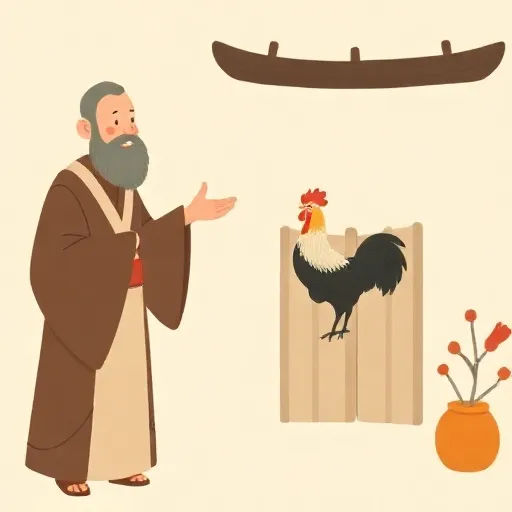
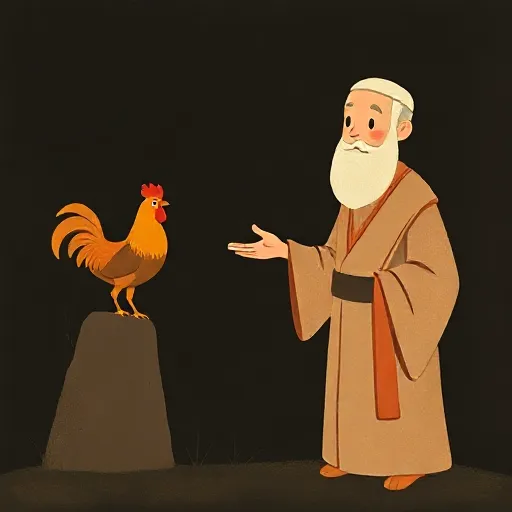
On the night before his arrest, a teacher named Jesus made a startling prediction about his friend Peter. Before the rooster crows the next morning, Peter would deny three times that he even knew Jesus. And that is exactly what happened.
But here’s the puzzle. If Jesus could not be wrong — if that prophecy had to come true — then was Peter’s later denial really a free choice? When we think of free actions, we picture moments that could have gone another way. In philosophy, such an event is called contingent: it is not determined to happen, and it is not determined to fail to happen. If the prophecy made Peter’s denial unavoidable, then it wasn’t contingent. And if it wasn’t contingent, how could Peter have freely chosen it?
The problem is not just about Peter. It’s about any prophecy that claims to announce a future free decision. As soon as the prophecy is spoken, it becomes a fixed fact in the past — something already done. And if that fact guarantees a particular future, then the person in the prophecy never seems to have the power to do otherwise. Welcome to one of philosophy’s most tangled riddles.
Option 1: Ditch Free Future Choices

Some philosophers look at this puzzle and decide the easiest way out is to give up one half of the problem: the idea that there really are contingent events. They say that nothing in the future is truly open in that way. Every event, including every choice, is already determined by prior causes. This view is called determinism.
Other thinkers are compatibilists. They believe free will and determinism can go together. You can be free as long as you act on your own desires and intentions, even if those desires themselves were caused by earlier things. So you don’t need real contingency — you don’t need the possibility that things could absolutely turn out otherwise.
A third group points to God’s complete control. If God designed and guides every detail of the world, then nothing is left to chance. On this picture, it makes no sense to say Peter “could have” avoided the denial. When Jesus prophecies it, there is simply no philosophical shock.
For many, though, this solution feels too cheap. It erases something we seem to experience every day: the sense that future choices are genuinely open, not already sealed shut.
Option 2: Maybe God Doesn’t Know the Future

Another bold solution is open theism. Its defenders, such as the philosopher William Hasker, claim that God does not know what humans will freely choose ahead of time. The future exists only as a set of possibilities. If it’s not fixed yet, there is nothing to know. So prophecies can’t force a free action because there simply isn’t infallible foreknowledge behind them.
But how does open theism explain real-sounding prophecies like Jesus’s words to Peter? Hasker offers a three-part reply. First, many prophecies are conditional — “If a nation keeps doing this, then that will happen” — and a free future can still branch in different ways. Second, many predictions rest on strong evidence. Jesus knew Peter’s character, his fear, and the pressure he would face. That gave Jesus a very educated guess, not a no-excuses guarantee. Third, some prophecies reveal what God himself plans to do. Since God controls his own actions, he can know those contingent acts even if he doesn’t know human free choices.
Critics like philosopher Thomas Flint push back hard. Flint argues that specific predictions like Jesus knowing that Judas would betray him are too detailed to be a guess. The odds that any one person would do exactly that thing, in exactly those circumstances, are tiny. A guess based on trends would not be solid enough. Open theists, Flint worries, either make God’s knowledge too weak or secretly rely on the future being more predictable than their own view allows.
Could Peter Have Made the Past Different?

The medieval philosopher William Ockham (c.1285–1347) had a very different idea. Ockham grants that once a prophecy is truly spoken, its existence in the past is “necessary” — you can’t erase the fact that the words were said. But what the prophecy reveals, he insists, is still contingent. How? If Peter had freely chosen not to deny Jesus, then Jesus would never have uttered that specific prophecy in the first place.
In other words, Peter can do something now such that, if he did it, the past would have been different. Philosophers call this counterfactual power over the past. The past fact — that Jesus said those words with that meaning — depends on what Peter freely does later. If Peter resists, the whole history leading up to the moment unravels slightly: a different prediction would have been given.
Not everyone is comfortable with this picture. Some say it means God would have to undo the actual causal history of the world, or that prophecies could end up being deceptive. Others point out that if only the present moment is real, you can’t change a past that no longer exists. Ockham’s solution is clever but leaves many philosophers dizzy.
God Outside Time — Does That Fix It?

Another strategy is to put God completely outside of time. Proponents of atemporal eternity, such as the early philosopher Boethius (c.480–524), say that God does not live moment by moment. He sees all of time — past, present, and future — in one eternal glance. This means God never “foreknew” Peter’s denial. He simply knows it, timelessly, just as you might see a whole parade from a rooftop rather than marching in it.
But a new difficulty appears. When Jesus makes a prophecy in time, at a particular moment, God’s timeless knowledge seems to get dragged into the world’s past. It sits there as a fixed fact, making Peter’s later free choice look impossible. The philosopher David Widerker argued that the advantage of God’s timelessness evaporates the instant a time-bound prophecy is given.
Defenders of the atemporal view, such as Eleonore Stump and Norman Kretzmann, have replied. They stress that most real prophecies are conditional and leave room for different outcomes. When a prophecy is very specific, they admit it might make an action inevitable — but, they add, an action can be inevitable and still be free. If Peter already deeply wanted to deny Jesus, and no outside force or brain disturbance pushed him, then his will was free even though the outcome was unavoidable. The debate, though, is far from settled.
Molina’s Three Kinds of Knowledge

In the 1500s, the Spanish thinker Luis de Molina (1535–1600) offered a sweeping solution that many still find attractive. Molina imagined three “shelves” in God’s mind.
The first shelf is natural knowledge — truths that could not be otherwise, like 2 + 2 = 4, which God does not control.
The second shelf is free knowledge — contingent facts that are completely up to God, like “iguanas live in South America.” God could have made that false.
The third shelf is middle knowledge, sitting between the two. This is knowledge of contingent truths that God does not control. It consists of subjunctive conditionals of freedom — statements about what any possible person would freely choose in any possible situation. For example: “If Peter were placed in the courtyard of the high priest, with a fire, strangers, and fear, he would freely deny Jesus.”
On Molina’s picture, God used his natural knowledge to see every possible world, his middle knowledge to see how free people would act in every scenario, and then his free knowledge to choose which world to make real. Jesus prophesied Peter’s denial because God knew, through middle knowledge, exactly what Peter would freely do in those conditions.
Critics have two main worries. First, are these middle-knowledge statements really true before anyone actually makes a choice? If Peter is never placed in that situation, what would make the claim “Peter would freely do X” true? It seems to float without any ground. Second, even if such truths exist, could anyone — even God — reliably tell the true ones from the false ones? These challenges keep the debate lively.
Why This Still Matters

The problem of prophecy might seem like an ancient puzzle about sandals and roosters, but it points to something you face every day. Whenever you feel that your next choice is wide open, and then someone says, “I already knew you’d do that,” a little voice might ask: Was my choice actually free?
Think of a friend who predicts you’ll pick chocolate over vanilla. Or imagine a super-intelligent machine that scans your brain and announces every decision you will make before you even consider it. Even if the prediction is perfect, does that turn you into a robot? Philosophers and theologians are still arguing, and the stakes are high. If the future is already known with certainty, does it make sense to praise, blame, or punish people for what they do?
Peter’s denial, a courtyard, a rooster — a story from long ago continues to ripple through the big questions about freedom, knowledge, and whether the future is something we shape or something already told.
Think about it
- If a supercomputer could predict your every move with 100% accuracy, would you still feel like you make free choices? Why might that feeling matter?
- A friend says, “I knew you’d pick the chocolate chip cookie!” Does that weaken your sense that you could have chosen the oatmeal raisin one? Explain.
- If you learned that every important decision you’ll ever make is already known by someone, would that change how you think about praising or punishing people? Why or why not?