Should We Always Help the Saddest Person First?
A Father’s Impossible Choice

Imagine you are a parent with two children. One child is healthy and full of energy. The other has a serious medical condition that needs regular treatment. You have to move to a new home, and you have only two choices. If you move to the suburbs, your healthy child will thrive — they will have space to play, better schools, and a happier life overall. But your other child will have less access to doctors. If you move to the city, your second child gets the treatment they need, but your healthy child loses the suburban benefits. The gain for the healthy child in the suburbs is bigger than the gain for the child who needs treatment in the city.
This is not a made-up puzzle from a video game. The philosopher Thomas Nagel described this exact situation in 1979, and another philosopher, Derek Parfit (1942–2017), brought it into the spotlight in a famous 1991 lecture. Most of us would lean toward the city — toward helping the child who is worse off. But why? If the total benefit is smaller, what makes that choice feel right? Parfit’s answer gave a name to a powerful idea: prioritarianism, or the Priority View. It is the idea that helping people matters more the worse off those people are.
The Utilitarian Math: Just Add It Up
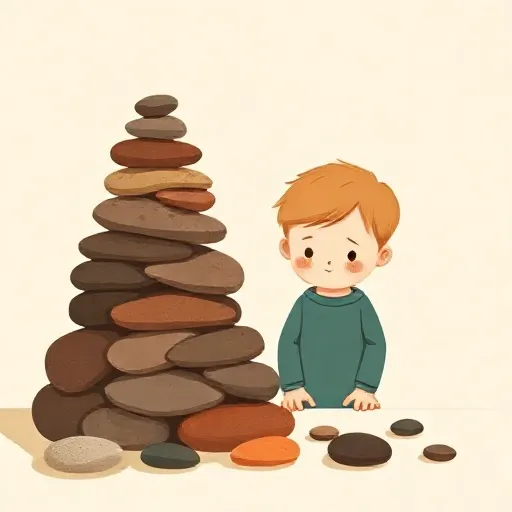
To see what makes prioritarianism special, you need to meet its main rival: utilitarianism. Utilitarianism is a theory about how to make choices that affect groups of people. It says: in any situation, pick the outcome that produces the biggest total sum of well-being. Well-being is just a term for how good or bad a person’s life is going. If you assign each person a well-being number, the utilitarian rule is simple — add up everyone’s numbers, and do whatever makes the total largest.
Think of it like this. Suppose you have a bag of snacks and three friends, and you measure how much they enjoy each snack with points. If option A gives the three of them 10, 5, and 2 points, the total is 17. If option B gives them 8, 8, and 8 points, the total is 24. The utilitarian says: go with option B; it makes the biggest pile of happiness overall. This sounds fair in a mathematical way. But notice what it ignores: in option A, one person started at 2 — much worse off than everyone else — and ended up with only 2. In option B, everyone ended up equal. The math alone does not tell you who needed the points most.
Now go back to Nagel’s dilemma. Give the children well-being numbers, just like the snack points. In the city, the first (healthy) child gets a 20, and the second (sick) child gets a 10. Total: 30. In the suburb, the first child gets a 25, and the second child gets a 9. Total: 34. Utilitarianism says: move to the suburb. The total sum is bigger. But many people, including Nagel, felt that this answer missed something essential — the fact that the second child is already worse off. This is where prioritarianism enters the conversation.
A Weighted Scale: The Birth of Prioritarianism
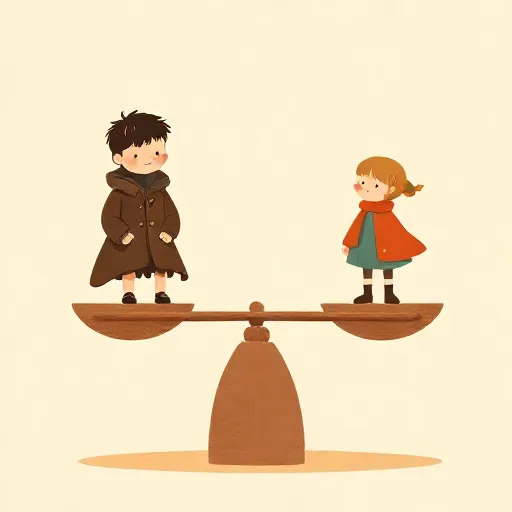
Parfit, writing in his 1991 lecture, named this alternative way of thinking the Priority View. Later thinkers called it prioritarianism. The core idea is simple to say, but it upends the utilitarian math: “Benefiting people matters more the worse off these people are.” You do not just add up the well-being points and call it a day. You adjust those points. An improvement to someone who is struggling counts for more than the exact same improvement to someone who is already comfortable.
Imagine you have a concave transformation function. That sounds terrifying, but picture it as a curved lens that bends well-being numbers before you add them. The lens bends more sharply at the lower end — where people are worse off — and flattens out at the upper end — where people are already doing well. If a very well-off person gains three points, the lens flattens those three points into, say, just one moral-weight point. If a worse-off person gains the same three points, the lens bends them into seven moral-weight points. The total score for an outcome is the sum of these transformed numbers. This is the mathematical engine inside prioritarianism.
| Child | City (raw) | City (weighted) | Suburb (raw) | Suburb (weighted) |
|---|---|---|---|---|
| First (healthy) | 20 | medium | 25 | medium-high |
| Second (sick) | 10 | high | 9 | slightly lower |
| Total moral score | higher | lower |
Using a weighted lens, the city choice can come out ahead, even though the raw total is smaller. The gain to the sick child gets amplified because they are worse off. Parfit saw this as a way to make sense of our instinct without falling into a trap — the trap of caring about equality itself.
The “Leveling Down” Trap

Some people think fairness means making everyone equal, full stop. This view is called egalitarianism. An egalitarian might look at a gap between the rich and the poor and say: the gap itself is bad, even if nobody is absolutely suffering. Parfit saw a problem with this. He called it the Levelling Down Objection.
Picture this: a classroom has two groups. Group A has ten cookies; Group B has two cookies. An egalitarian sees the inequality and wants to fix it. One way to fix it is to give Group B more cookies. But another way — the leveling down way — is to take cookies away from Group A until they also have only two. No one in Group B is better off, and Group A is now worse off. Yet the inequality has disappeared. Is that really a better outcome in any respect? To many people, the answer is an immediate “no — that’s absurd.” Destroying good things for no other reason than to erase a gap does not make the world better.
Egalitarians have answers to this objection (they rarely support actual leveling down; they care about raising up the worst off), but Parfit used it to draw a sharp line. Prioritarianism, he argued, avoids the trap entirely. A prioritarian never sees leveling down as an improvement because what concerns them is not the relative gap between people, but the absolute level of each person. Someone being worse off than others matters only because it signals that the person is at a lower absolute level — and that lower absolute level is what makes helping them more urgent. When a prioritarian helps a struggling student, it is not because they care about the comparison to the top student; it is because the struggling student’s own level calls out for a bigger response.
Two Big Guts: Separability and the Emperor of China

Prioritarianism has a feature that sounds technical but grabs hold of a deeply practical question: should the well-being of unaffected strangers change the moral score of your own community’s choices? This feature is called Separability. It means that when you are ranking two outcomes, the well-being levels of people whose lives are completely unchanged between those outcomes — the unaffected individuals — should not affect your ranking. Prioritarianism says yes, they should be ignored; utilitarianism agrees. Some rival theories, like certain generalized-Gini rankings, say no, they matter.
Think of it this way. Suppose you are deciding between two ways to distribute a new playground budget in your town. Option X gives everyone a decent playground; Option Y gives one neighborhood a spectacular one and another neighborhood a worse one. Now imagine we learn that on Mars, some Martians are extremely well-off. Does that fact about Martians — who are totally unaffected — change which playground plan is better? Or suppose we learn that the ancient Egyptians had very high well-being. Does Egyptology research make Option Y suddenly worse than Option X? That sounds ridiculous. This is the Egyptology Argument, made famous by Parfit in his earlier book Reasons and Persons. The prioritarian says: our rules for fairness should not depend on the well-being of distant, unaffected people, because that would make moral thinking impossible to use in daily life. Separability is a shield against irrelevant information.
Where Does the Math Lead Us?

Like any big idea, prioritarianism produces strange results when you stretch it to outer limits. One famous test is the Repugnant Conclusion, a puzzle about population size crafted by Parfit. Imagine a world of ten billion people, all living incredibly happy, thriving lives — call it World A. Now imagine a much larger world, World Z, with an enormous population where everyone’s life is only barely worth living, just above zero. If you keep adding people, do enough tiny positive lives eventually outweigh a smaller number of amazing lives? Total utilitarianism says yes — and that feels repugnant to many. Prioritarianism, because it gives extra weight to improvements at the bottom, also says yes, and in fact can reach that conclusion even faster, because the tiny gains at the low levels get amplified.
This might feel like a flaw. But priority thinkers argue that no theory of fairness works perfectly at every edge of the imagination. Some respond by tweaking the math: they propose a sufficiency threshold, a level of well-being below which priority applies fully, but above which everyone’s gains count equally, like in utilitarianism. Others argue that when we compare worlds with different numbers of people, we need entirely separate rules. These debates are still alive.
So why does this matter for you, right now? Because every time a school decides whether to spend extra money on gifted programs or on struggling students, a version of this math is running in the background. Every time a family discusses whether to give a bigger allowance to the child who needs it more or to the one who will use it best, they are doing philosophy without calling it that. The question Parfit sharpened — should we always help the saddest person first? — does not have a single answer that satisfied everyone. But having the words and the mental models to notice the trade-off changes how you see the world.
Think about it
- If you had a bag of extra dessert and two friends, one who has already had three slices and one who has had none, does the prioritarian idea feel right — that the second friend’s slice matters more? Can you imagine a situation where the total enjoyment matters more instead?
- Imagine a huge future city where everyone’s life is just okay, but the population is enormous. Do you think a smaller town where everyone is truly joyful could be the better world? Why or why not?
- In your own life, do you think people deserve more help when they are worse off, even if helping someone else who is already doing fine would produce a bigger total boost in happiness? What rule would you set for a school principal?