
Should You Always Do Whatever Makes the Most People Happy?
The Happiness Calculator
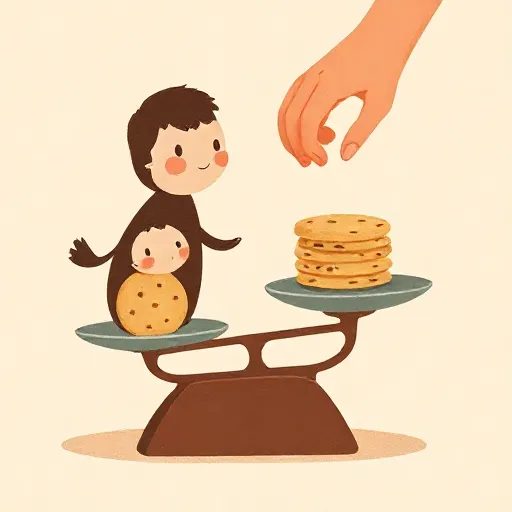
Imagine you’re at a bake sale, holding the last chocolate chip cookie. Two friends watch you. Sam’s eyes light up at the sight of chocolate. Alex likes cookies but not nearly as much. You could eat it yourself, give it to Sam, or give it to Alex. Who should get it?
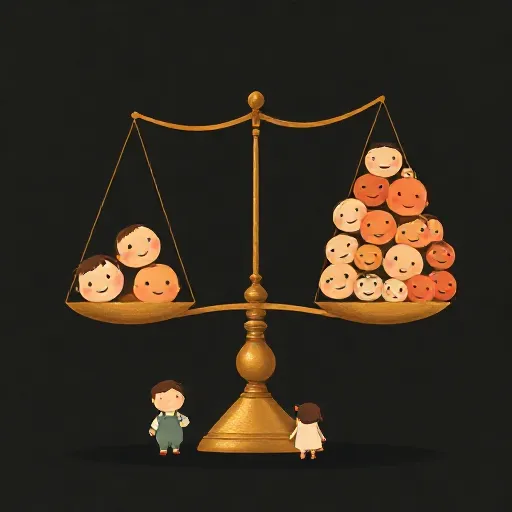
A moral theory called utilitarianism gives a clear answer: choose the option that adds the most happiness to the world, counting everyone’s happiness equally. Jeremy Bentham (1748–1832) and John Stuart Mill (1806–1873) thought this was the key to right and wrong. They said goodness is pleasure and badness is pain. Morality, for them, was a giant math problem: add up all the pleasure an act would cause, subtract the pain, and do the act with the highest total. This idea is part of a bigger family of views called consequentialism — theories that judge acts solely by their results, or consequences. And the relevant result is overall net benefit, which philosophers call welfare.
So if giving the cookie to Sam creates more pleasure — maybe Sam is having a terrible day and Alex isn’t — the happiness calculator says that’s the right thing to do. Simple. But trouble starts when you take that calculator seriously in every situation. What if you could make many more people happy by breaking a promise? What if you could steal a bike, sell it, and donate the money to a charity that saves lives? The calculator seems to say: go ahead. That made many philosophers very nervous.
Why a World Without Rules Would Fall Apart

Suppose you promised to help your friend study, but then you learn that skipping it to volunteer at a soup kitchen would feed ten hungry people and create far more happiness. The pure happiness calculator says break the promise. Yet that feels wrong. Most of us think that some acts — breaking a promise, lying, hurting an innocent person — are wrong even if they would produce a tiny bit more good.
This intuition pushes some philosophers away from the simple act-by-act version of consequentialism, called act-consequentialism. Act-consequentialism says an act is wrong only if some other act you could have done would have produced more good. To avoid the scary conclusion that you should sometimes harm innocent people for a slightly better outcome, another approach arose: rule-consequentialism.
Rule-consequentialism says we shouldn’t judge each act individually by its consequences. Instead, we judge rules. An act is right if it follows a rule that, if widely accepted, would lead to the best overall results. Rules like “don’t lie,” “don’t steal,” “keep your promises,” and “help those in need” are the ones that, if most people followed them, would make the world much happier and safer. So even if burying a promise in one case would bring a little more good, you still shouldn’t break it. The rule “keep your promises” is part of the best overall set of rules.
Philosophers like Henry Sidgwick (1838–1900) and many later thinkers argued that we need such rules because of what they called the expectation effect. Imagine a world where everyone tried to calculate the best act moment by moment. You’d constantly worry: will my friend break her promise to me if she decides it will bring more good? Will someone steal my lunch if they calculate they can create more happiness that way? Trust would evaporate. And a world without trust has far less welfare, not more. Moreover, humans are terrible at calculating consequences on the fly. We’re biased, we lack perfect information, and we make mistakes. Even if we wanted to use the act-by-act calculator, we’d often mess up.
So rule-consequentialists say: internalize a set of simple, familiar rules, and use them as your decision procedure — your everyday way of deciding what to do. Don’t harm innocent people. Don’t steal. Keep your word. Pay special attention to the needs of your family and friends. Help others. Following these rules, even when occasionally a specific act wouldn’t have the very best consequences, will produce far more good in the long run than trying to improvise.
Won’t the Rules Just Collapse Back Into “Always Calculate”?
For decades, critics aimed a sharp weapon at rule-consequentialism. They said: if you choose rules based on their consequences, then whenever a rule leads to a slightly suboptimal result, you’ll be tempted to add an exception. “Don’t steal” could become “don’t steal except when it produces more good.” Soon you’ll have a rule with so many exception clauses that it tells you to do exactly what act-consequentialism would have told you all along. This is the collapse objection. If rule-consequentialism collapses into the very theory it was trying to escape, it’s just a more complicated way of saying the same thing — pointless.
Rule-consequentialists have a strong reply. They say: when we choose which rules to accept, we must consider not just the benefits of following them, but also the costs of getting people to internalize them. A rule with dozens of exception clauses is very hard to learn and remember. People will make mistakes. Worse, they’ll use those exceptions to justify breaking the rule when it’s self-serving, even if they convince themselves it’s for the greater good. That destroys the trust and predictability that rules provide. So a simpler code, even if it sometimes leads to acts that don’t maximize good in that moment, has higher expected value overall. Expected value means the good you can rationally expect, given probabilities — not the good that actually happens by luck.
This also answers a related worry: that rule-consequentialists would blindly follow rules even when disaster threatens. The theory includes a rule to prevent disaster, so you can break a rule if sticking to it would be catastrophic. But you can’t break rules just for a tiny gain. The system remains stable without collapsing into act-consequentialism.
What’s Really Good? (More Than Just a Cookie)

So far we’ve talked about “good” as happiness. But what is happiness, exactly? Bentham and Mill thought it was pleasure minus pain. This view is called hedonism. Yet many people care intensely about things that don’t produce pleasure for them. You might desperately want to know a difficult truth, even if finding out makes you sad. You might care about your friend’s wellbeing not just because it makes you happy, but for its own sake. Hedonism struggles to explain these feelings.
A rival theory is the desire-fulfillment theory of welfare: your welfare increases whenever any desire of yours is fulfilled, even if you never learn about it or get any pleasure from it. But that runs into trouble too. Imagine I desire to count every blade of grass on my street. If I get fun out of doing it, that fun benefits me. But the bare fulfillment of that odd desire — just that it is done — does not seem to add to my welfare. And what if I desire that starving people far away get food? Fulfilling that desire is a good thing for them, but does it really make my own life go better? Most philosophers think it doesn’t; it’s not about my welfare.
The philosopher Derek Parfit (1942–2017) and others proposed a third view: there is a list of things that are objectively good for anyone — pleasure, friendship, knowledge, achievement, autonomy. This is called the objective list theory. On this view, your welfare consists in having these things, regardless of whether you desire them or get pleasure from them. It captures why we admire someone who learns a brave truth or accomplishes something hard even if they suffer. Consequentialists who embrace such a list still judge acts by the overall good produced; they simply have a richer picture of what “good” includes.
Fairness: Should We Help the Worse Off More?

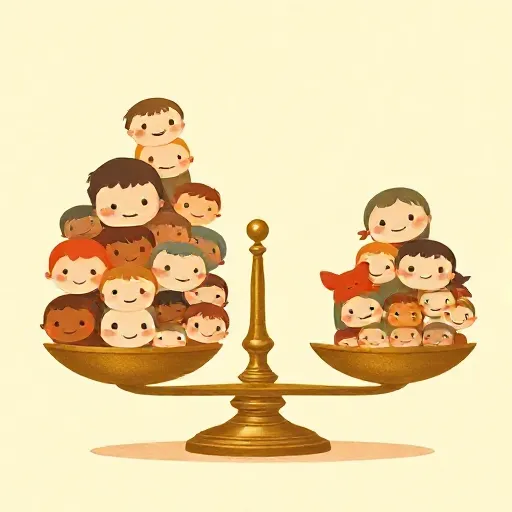
Utilitarianism counts everyone’s welfare equally. But some people think we should tilt the scales toward those who have less. Imagine you own ten bicycles and ten winter coats, while your neighbor has none. If you give her one coat and one bicycle, your loss is tiny. Her gain is enormous, because the first unit of a resource matters much more than the tenth. This pattern is called the law of diminishing marginal utility — the more you have of something, the less each additional unit benefits you. An impartial morality feels pressure to redistribute from the richer to the poorer, because that would boost total welfare.
But what if we care about equality of welfare itself? Suppose the only way to make everyone equally happy is to bring the better-off down — say, making everyone equally blind so that all have the same poor eyesight. Parfit argued that this “levelling down” feels terrible. We don’t value equality for its own sake; we value helping those who are worse off. This view is called prioritarianism. It says: the worse off a person is, the more important it is to benefit that person. So giving a coat to someone freezing counts far more than giving a tenth coat to a collector. Prioritarianism has tremendous intuitive appeal. But it faces hard questions: exactly how much more should we weigh the worse off — five times, ten times? And does treating some people’s welfare as more important than others violate the rule that everyone matters equally? These debates are alive and unresolved.
Why This Old Puzzle Lives in Your Backpack
Every day you face tiny versions of this enormous argument. Should you share your snack with a friend who forgot theirs? Should you keep a secret that would embarrass someone, even if telling would get you a laugh? The rules at your school — no cheating, no pushing — are they there because they make the school happier overall? And when you see someone with much less than you, do you feel a pull to help because it matters more to them than it would to you?
The fight between act-consequentialism and rule-consequentialism isn’t just for dusty books. It hums quietly behind your own conscience. Understanding it doesn’t hand you a cheat code for right and wrong. But it does show you why the simplest question — “Should I do that?” — has no simple answer.
Think about it
- If someone could prove that telling one small lie would make ten people much happier, would it be right to tell it? Why or why not?
- Is it ever okay to break a school rule if you’re absolutely sure it would lead to a better outcome for everyone? Where would you draw the line?
- When you share something you have plenty of, do you think you’re doing it because you care about fairness, or because you imagine how the other person feels? Could both reasons matter?