
The Philosopher Who Argued with His Teacher Over God and Free Will
A Letter That Turned the World Upside Down

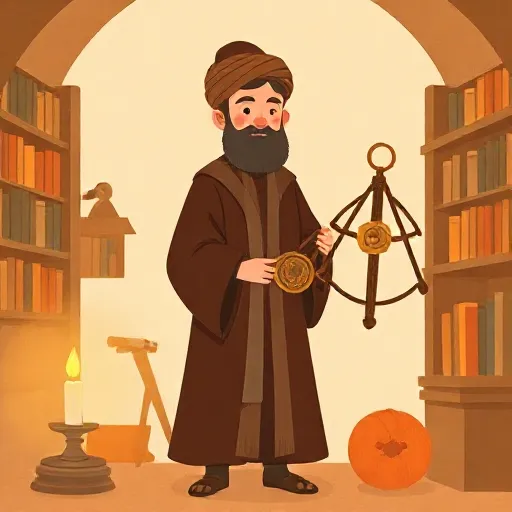
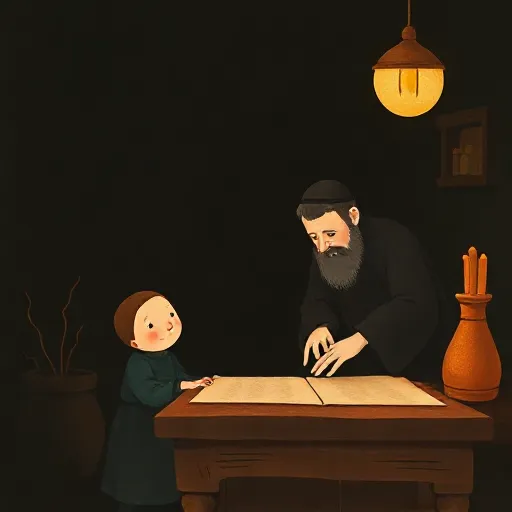
Sometime in the early 1300s, the Jewish philosopher Isaac Polqar (late 1200s–early 1300s) received a painful shock. Abner of Burgos, the man who had once been his teacher, had abandoned Judaism and become a Christian. Worse, Abner was now writing fierce attacks on his former faith—and using Jewish sacred texts to argue that Christianity was the one true religion. Polqar had to decide: should he stay silent, or should he pick up his pen and fight back with the sharpest weapon he knew? He chose philosophy.
Polqar lived in northern Spain and belonged to the Jewish Averroist tradition, a school of thought that believed Aristotle’s ideas, as explained by the Muslim thinker Averroes (1126–1198), fit perfectly with Judaism. For Polqar, a true religion could never contradict the firm proofs of reason. So when Abner claimed that doctrines like the Trinity and the Incarnation were not only true but philosophically respectable, Polqar saw a double danger: a threat to Judaism and a threat to clear thinking itself.
The argument that followed became one of the sharpest intellectual duels of the medieval world. It wasn’t just about which stories were right. It was about whether you can use philosophy to judge a religion—and whether human beings have any real freedom at all.
Can God Be Three-in-One Without Breaking Logic?

Abner set out to prove that the Trinity—the Christian belief that God is one being in three persons—did not break the philosophical rule that God must be utterly one. He turned to a rabbinic commentary on Psalm 50. The verse mentions three names of God: El, Elohim, and YHVH. The midrash says God created the world with three attributes—Wisdom, Understanding, and Knowledge. Abner argued that these three are not separate things; they are all the same divine substance, just as a single mind can be at once the thinker, the thought, and the act of thinking. He even borrowed Aristotelian logic: the Active Intellect and the structure of a syllogism (a three-part logical argument) show, he said, that three-ness can exist inside perfect unity.
Polqar was not impressed. For him, any true religion must uphold three non-negotiable principles that philosophy had already proved: God exists, God is absolutely one, and God has no body (this is called incorporeality). Christianity, with its Trinity and its claim that God became a human being in Jesus (the Incarnation), smashed directly into the second and third principles. You can’t call a religion true, Polqar insisted, if it forces you to believe things that contradict what reason has demonstrated. He didn’t need to invent new proofs; he just needed to show that Christianity’s central ideas failed the test of basic metaphysics. While Abner tried to smooth the contradiction with clever analogies, Polqar saw a crack that no argument could glue shut.
Who Gets to Interpret the Ancient Sages?

Abner’s most unsettling move was quoting the Talmud and other rabbinic writings to support Christian beliefs. He claimed that the ancient Sages secretly accepted doctrines like the Trinity but hid them from ordinary people who weren’t ready. When the texts didn’t fit, he accused the Sages of being unclear or even dishonest.
Polqar didn’t answer each quotation one by one. Instead, he built a general method for reading Jewish sources that made Abner’s whole strategy collapse. He taught that the word “Talmud” properly refers only to legal discussions—the halakha—that explain how to follow the commandments. All the other stories, legends, and imaginative teachings (called aggadah) are not binding law. If a non-legal passage seems to contradict a fundamental principle of reason or the core of the Torah, you are free to interpret it differently or set it aside.
Moreover, Polqar placed the sources themselves in a clear hierarchy. At the top sits the Torah of Moses, which he considered universal truth. Lower down come the legal rulings of the Sages, binding on Jews but not proofs of basic philosophical truths. Abner was picking and choosing aggadic snippets and treating them like final proofs—exactly the mistake Polqar warned against. For Polqar, the Sages sometimes wrote for two audiences: the sharp student who could grasp deep meanings, and the simple learner who needed concrete stories. Abner, in his zeal, had confused the two.
Has the Messiah Already Come?

Debates about theology can feel abstract, but Polqar brought the argument down to earth with a simple question: if the messiah had already arrived, why does the world still look so broken? He turned to the Hebrew prophets and picked out three predictions that any fair observer could check.
First, the prophet Ezekiel said the people of Israel would dwell securely in their land forever, with a descendant of David ruling them in peace. But in Polqar’s day, Jews were scattered in exile, and foreigners controlled the land. Second, the prophets foretold a climactic war of Gog and Magog, after which God would never hide his face again. The suffering of the Jewish people showed that this hadn’t happened. Third, Amos and others promised that Jerusalem and the holy Temple would be rebuilt, never to be uprooted. The last Temple lay in ruins, and no third one stood.
Polqar wasn’t just trading verses. He was offering an empirical test: look at the world, and you will see that the messianic age hasn’t begun. Therefore, Jesus could not be the promised messiah. Abner flipped the same prophecies, insisting they were fulfilled in a spiritual sense. But Polqar held his ground: if a prophecy says “forever,” you can’t apply it to an era that clearly ended in destruction.
The Real Fight: Do You Even Have a Choice?

Underneath the clash over Trinity and messiah lay an even deeper question, one that still makes your head spin today: do human beings have free will, or is every decision already determined? Abner argued that God’s perfect knowledge—his omniscience—means that everything that happens, including your choices, has been known from eternity. If God already knows what you’ll do tomorrow, you can’t do otherwise. So free will is an illusion, and the commandments would be meaningless unless you accept strict determinism.
Polqar refused to let go of freedom. He leaned on the great Jewish thinker Maimonides (1138–1204), who taught that God’s knowledge and human knowledge have nothing in common. It’s a mistake to imagine God’s mind works like a super-powerful version of ours. So the fact that God knows something doesn’t force it to happen the way a train forces itself onto a track.
Then Polqar sharpened his argument. He said that material bodies—like stars, planets, or even the chemicals in your brain—cannot determine the actions of your intellectual soul, because the soul is not made of matter. Only immaterial things, like the separate intellects (the minds that move the heavenly spheres), can influence it. Astrology is nonsense, he concluded, because stars are material, and matter cannot boss around a non-material mind. Of course, Abner shot back: if separate intellects are immaterial, couldn’t they force your soul too? Polqar narrowed his claim: he was only fighting the idea that heavenly bodies determine your choices. The real influence on your intellect comes from your own effort in studying the sciences—and that is a kind of freedom.
He also used a crisp thought experiment. Natural things, like fire rising or a stone falling, always behave the same way. There’s no “maybe.” But human beings clearly do opposite things at different times—you can eat the apple or leave it, speak kindly or lash out. If all your actions were as fixed as a falling stone, what would be the difference between your soul and a machine? The distinction would vanish, and with it any reason to hold people responsible for their deeds.
There’s a twist, though. Polqar admitted that only people who actively use their intellect are truly free. Most people, he thought, are driven by desires like animals, not really choosing. Even the wise person, who constantly follows reason, might seem to have no choice but to do the rational thing. Polqar probably saw this not as a prison but as the highest form of freedom—living in harmony with the deepest part of yourself.
Why a Seven-Hundred-Year-Old Debate Still Prods You

You might never argue about the Trinity or the messiah, but the questions Polqar and Abner wrestled haven’t gone away. Every time you wonder, “Could I really have done something different just now?” you step into the same arena. If a supercomputer could map every particle in your brain and predict your next move with perfect accuracy, would your sense of choosing be a genuine power or a comfortable illusion? And if your choices were never really free, would it be fair to praise or punish anyone—including yourself?
Polqar’s deeper lesson isn’t about picking a side. It’s about what it means to defend a belief. He didn’t just shout, “You’re wrong!” He drew a line between ideas that fit the demands of reason and ideas that don’t. He tried to build a method for reading ancient texts that didn’t trap him in every passing legend. He looked at the world around him—the exile, the ruined Temple—and let reality push back against comfortable claims.
That kind of thinking takes courage, especially when the person arguing against you used to be your teacher. Polqar shows that philosophy isn’t a dusty museum. It’s a set of tools you can use when someone challenges what you hold most dear—tools that ask not just “What do I believe?” but “Why should anyone believe it?”
Think about it
- If a scientist could predict every choice you will ever make, would it still be fair to blame you for a selfish act—or to praise you for a brave one?
- Polqar thought only people who use their reason are truly free. Do you think a small child who acts on impulse is less free than a careful thinker?
- When someone uses your own favorite stories or traditions to argue against you, how can you tell the difference between a fair reading and a twist that tricks you?